

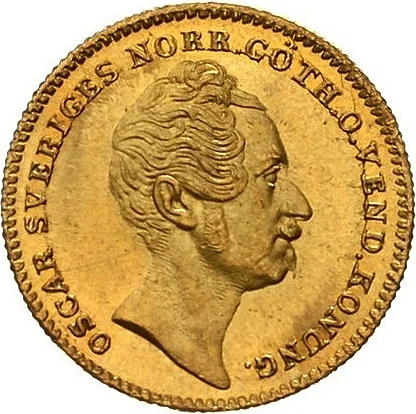
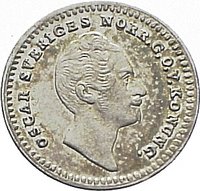
Obverse
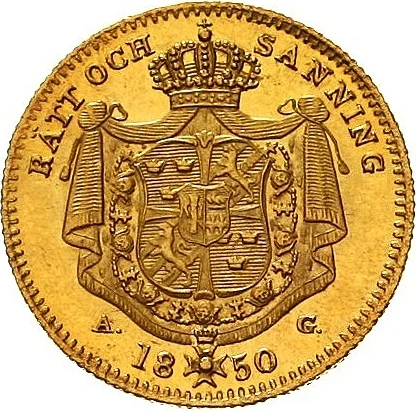
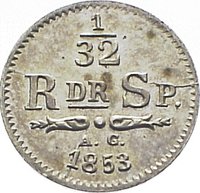
Reverse
Edge
Categories
| Symbols> Coat of Arms |
Mints
| Name | Mark |
|---|---|
| Kungliga Myntet | — |
| Stockholm | — |
Mintings
| Year | Mint Mark | Mintage | Quality | Collection |
|---|---|---|---|---|
| 1850 | — | 819 | ||
| 1852 | — | 386 | ||
| 1857 | — | 763 |
Historical background
In 1850, Sweden was in a state of monetary transition, caught between old and new systems. The official currency was the Riksdaler Riksmynt, a silver-based currency established in 1834 to bring order after a period of financial instability. However, the older Riksdaler Species, a higher-value silver coin, still circulated alongside it, creating a dual system with a fixed exchange rate (1 Riksdaler Species = 2⅔ Riksdaler Riksmynt). Furthermore, the Riksbank and numerous private banks issued paper banknotes, which were supposed to be fully convertible into silver upon demand, though public confidence in this convertibility varied.
This complex landscape was a legacy of Sweden's shift from a commodity-based to a fiduciary system. The early 19th century had seen significant inflation and banknote devaluation, leading to the 1834 reform which aimed to restore stability by pegging the new Riksdaler Riksmynt to silver. Despite this, the money supply was largely dictated by the issuing banks, and the economy remained vulnerable to liquidity crises and bouts of distrust in paper money, especially outside major cities where metal coin was often preferred for everyday transactions.
Economically, the mid-19th century was a period of industrial and agricultural modernization, which increased the demand for a flexible and trustworthy monetary medium. The 1850s would therefore see critical developments, culminating in the 1855-1856 monetary reform. This reform finally demonetized the old Riksdaler Species and introduced a new, decimalized standard: the Riksdaler Riksmynt was replaced by the Riksdaler (divided into 100 öre), simplifying the system and further consolidating a national currency in preparation for Sweden's rapid industrial expansion. Thus, 1850 represents a pivotal point just before Sweden solidified its modern monetary framework.
This complex landscape was a legacy of Sweden's shift from a commodity-based to a fiduciary system. The early 19th century had seen significant inflation and banknote devaluation, leading to the 1834 reform which aimed to restore stability by pegging the new Riksdaler Riksmynt to silver. Despite this, the money supply was largely dictated by the issuing banks, and the economy remained vulnerable to liquidity crises and bouts of distrust in paper money, especially outside major cities where metal coin was often preferred for everyday transactions.
Economically, the mid-19th century was a period of industrial and agricultural modernization, which increased the demand for a flexible and trustworthy monetary medium. The 1850s would therefore see critical developments, culminating in the 1855-1856 monetary reform. This reform finally demonetized the old Riksdaler Species and introduced a new, decimalized standard: the Riksdaler Riksmynt was replaced by the Riksdaler (divided into 100 öre), simplifying the system and further consolidating a national currency in preparation for Sweden's rapid industrial expansion. Thus, 1850 represents a pivotal point just before Sweden solidified its modern monetary framework.
✨ Legendary