

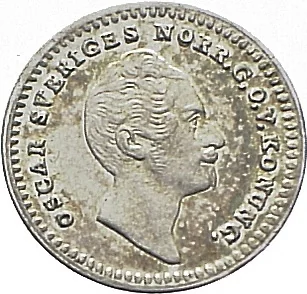
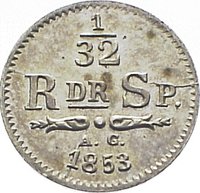
Obverse
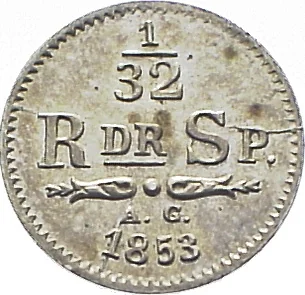
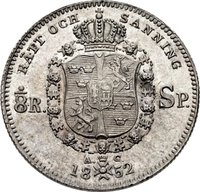
Reverse
Description:
Value and date separated by decorative bars and mintmark.
Inscription:
1
-
32
R DR SP.
A. G.
1852
-
32
R DR SP.
A. G.
1852
Script: Latin
Edge
Mintings
| Year | Mint Mark | Mintage | Quality | Collection |
|---|---|---|---|---|
| 1851 | AG | — | ||
| 1852 | AG | 480,000 | ||
| 1853 | AG | 744,800 |
Historical background
In 1851, Sweden was navigating a complex and transitional monetary landscape. The country operated on a dual currency system, with both the Riksdaler Riksmynt (the domestic currency) and the Riksdaler Specie (a silver-based currency used for international trade) circulating simultaneously. This system, formalized in 1834, established a fixed exchange rate where 1 Riksdaler Specie was equal to 4 Riksdaler Riksmynt. However, the domestic Riksmynt was a fiat currency, its value backed by government decree rather than a direct link to silver, which created inherent instability and public skepticism.
The period was marked by a persistent shortage of small, everyday coinage, causing significant inconvenience for the general populace and hampering minor commercial transactions. To address this, the state increasingly issued copper and silver tokens, but the fundamental structural issues remained. Furthermore, the Scandinavian Monetary Union, which would later create a unified currency system with Denmark and Norway, was still two decades away. Sweden's monetary policy was thus inwardly focused on managing this cumbersome dual system and its associated trust issues.
Economically, the mid-19th century was a time of industrialization and liberal reform in Sweden. The inadequate currency system was seen as an obstacle to modern commerce, investment, and economic growth. The debates of 1851 were therefore part of a longer prelude to major monetary reform. This pressure would eventually culminate in the 1873 adoption of the Krona (crown) and Sweden's entry into the Scandinavian Monetary Union, finally abandoning the old Riksdaler system for a modern, decimalized, and gold-backed currency.
The period was marked by a persistent shortage of small, everyday coinage, causing significant inconvenience for the general populace and hampering minor commercial transactions. To address this, the state increasingly issued copper and silver tokens, but the fundamental structural issues remained. Furthermore, the Scandinavian Monetary Union, which would later create a unified currency system with Denmark and Norway, was still two decades away. Sweden's monetary policy was thus inwardly focused on managing this cumbersome dual system and its associated trust issues.
Economically, the mid-19th century was a time of industrialization and liberal reform in Sweden. The inadequate currency system was seen as an obstacle to modern commerce, investment, and economic growth. The debates of 1851 were therefore part of a longer prelude to major monetary reform. This pressure would eventually culminate in the 1873 adoption of the Krona (crown) and Sweden's entry into the Scandinavian Monetary Union, finally abandoning the old Riksdaler system for a modern, decimalized, and gold-backed currency.
🌟 Limited