

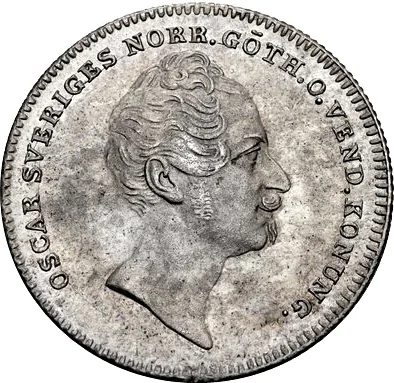
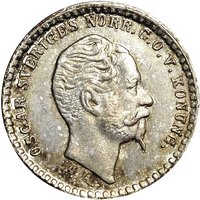
Obverse
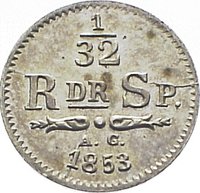
Reverse
Description:
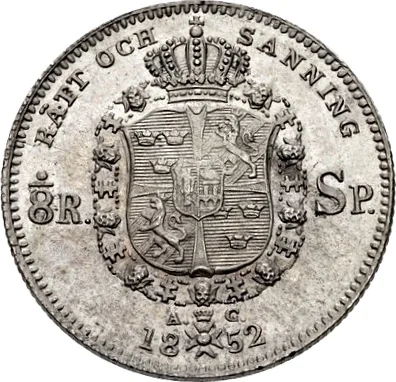
Sweden’s crowned Arms, encircled by the Seraphim Order’s Chain, divides the value. The King’s motto is above; the date and mintmark are below, separated by the Chain’s pendant.
Inscription:
RÄTT OCH SANNING
·/8 R. Sp.
A G
18 52
·/8 R. Sp.
A G
18 52
Translation:
Right and Truth
·/8 R. Sp.
A G
18 52
·/8 R. Sp.
A G
18 52
Script: Latin
Language: Swedish
Edge
Categories
| Symbols> Coat of Arms |
Mintings
| Year | Mint Mark | Mintage | Quality | Collection |
|---|---|---|---|---|
| 1852 | AG | 45,600 |
Historical background
In 1852, Sweden operated under a complex and restrictive monetary system, a legacy of the early 19th century. The nation was on a silver standard, with the riksdaler riksmynt as the primary unit. However, the currency in circulation was a confusing mix of old and new: alongside full-valued silver coins, there were heavily depreciated paper notes issued by the private Riksens Ständers Bank (predecessor to the Riksbank) and a vast array of low-quality copper mynt and tokens. This created a dual system where goods often had two prices—one in silver and a much higher one in paper—hampering trade and economic calculation.
The root of the problem lay in the excessive issuance of paper money to finance the Russian War of 1808-1809 and subsequent economic difficulties. These notes were not convertible to silver, leading to significant depreciation and a severe loss of public confidence. By the 1830s, the paper riksdaler had lost about two-thirds of its value against the silver riksdaler. While a stabilization law in 1834 formally pegged the paper currency to silver at a fixed, devalued rate, the system remained fragile and inefficient, with the public still wary of banknotes.
Therefore, the period around 1852 was one of transition and reform. The government and the bank were actively working to restore full convertibility and simplify the monetary chaos. This culminated in the major currency reform of 1855, which introduced a new decimal-based currency, the riksdaler riksmynt, and a new silver coin, the riksdaler specie, while finally making banknotes fully convertible. Thus, 1852 represents the final years of Sweden's cumbersome old monetary order, immediately preceding its modernization into a more stable and unified system.
The root of the problem lay in the excessive issuance of paper money to finance the Russian War of 1808-1809 and subsequent economic difficulties. These notes were not convertible to silver, leading to significant depreciation and a severe loss of public confidence. By the 1830s, the paper riksdaler had lost about two-thirds of its value against the silver riksdaler. While a stabilization law in 1834 formally pegged the paper currency to silver at a fixed, devalued rate, the system remained fragile and inefficient, with the public still wary of banknotes.
Therefore, the period around 1852 was one of transition and reform. The government and the bank were actively working to restore full convertibility and simplify the monetary chaos. This culminated in the major currency reform of 1855, which introduced a new decimal-based currency, the riksdaler riksmynt, and a new silver coin, the riksdaler specie, while finally making banknotes fully convertible. Thus, 1852 represents the final years of Sweden's cumbersome old monetary order, immediately preceding its modernization into a more stable and unified system.
✨ Legendary