

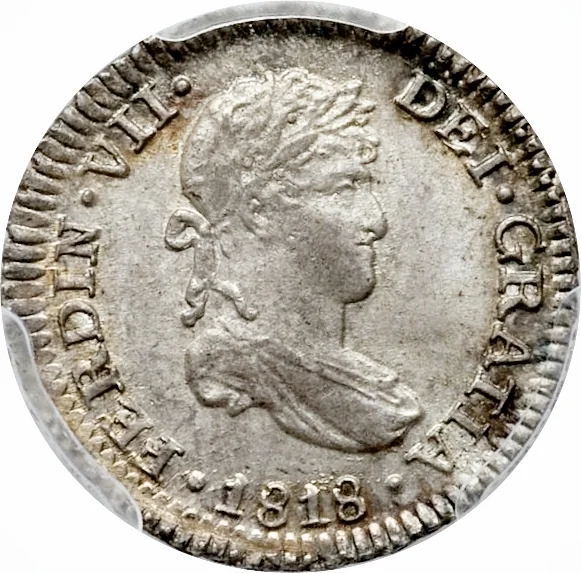

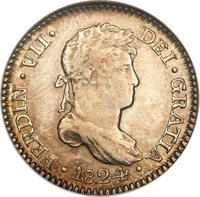
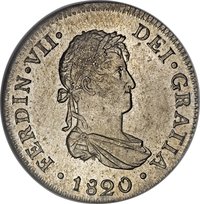
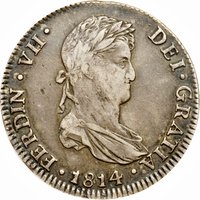
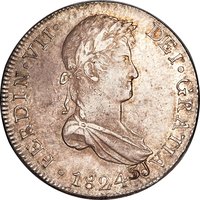
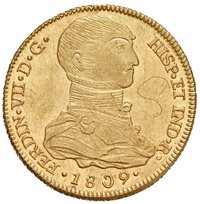
Obverse
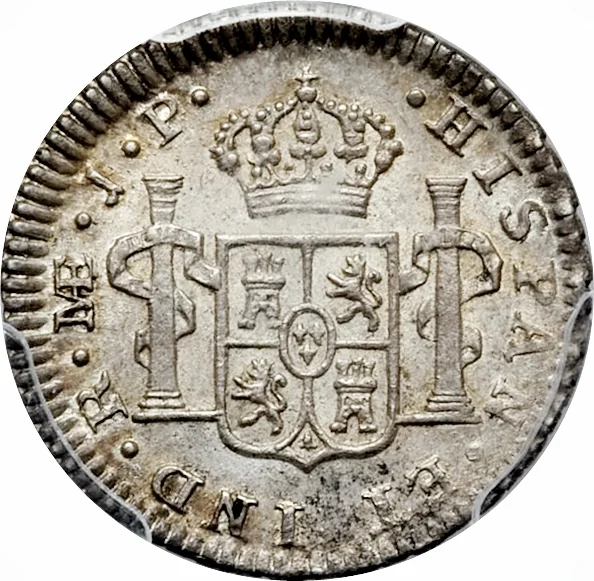
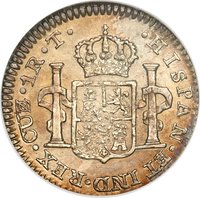
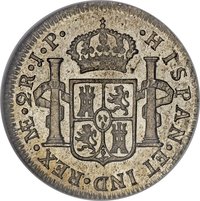
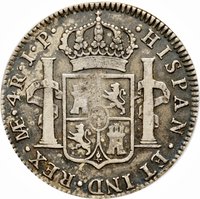
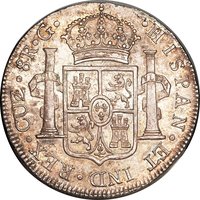
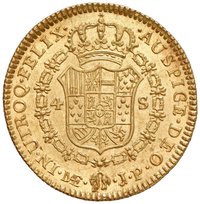
Reverse
Description:
Bourbon arms flanked by columns
Inscription:
· HISPAN · ET IND · R · LIMAE · J · P ·
Script: Latin
Edge
Mints
| Name | Mark |
|---|---|
| Lima | (LIMAE) |
Mintings
| Year | Mint Mark | Mintage | Quality | Collection |
|---|---|---|---|---|
| 1811 | LIMAE | — | BU | |
| 1812 | LIMAE | — | BU | |
| 1813 | LIMAE | — | BU | |
| 1814 | LIMAE | — | BU | |
| 1815 | LIMAE | — | BU | |
| 1816 | LIMAE | — | BU | |
| 1817 | LIMAE | — | BU | |
| 1818 | LIMAE | — | BU | |
| 1819 | LIMAE | — | BU | |
| 1820 | LIMAE | — | BU | |
| 1821 | LIMAE | — | BU |
Historical background
In 1811, the currency situation in the Viceroyalty of Peru was one of profound instability and scarcity, a direct consequence of its role as the financial and administrative heart of Spanish South America. The Royal Mint in Lima was the primary source of coinage for much of the continent, producing silver reales and gold escudos from the vast mineral wealth of the Andes. However, the outbreak of the Peninsular War in Spain (1808) and the burgeoning independence movements across the continent had severely disrupted economic and supply chains. While Peru itself remained a royalist stronghold, the wars in other regions choked the flow of silver from mines, increased military expenditures, and led to hoarding, creating a chronic shortage of circulating specie.
This scarcity was exacerbated by a chaotic mix of legitimate and illegitimate coins in circulation. Alongside official Peruvian-minted currency, there was a significant influx of lower-quality "macuquina" (clipped or irregular) coins from other Spanish American mints, as well as counterfeit coins. Furthermore, the financial strain of funding royalist armies led the colonial government to issue copper coinage (moneda de cobre) to facilitate small, everyday transactions. These coins, however, were deeply unpopular and often traded at a steep discount to their face value, eroding public trust in the monetary system and effectively creating a tiered and unreliable currency environment.
Ultimately, the monetary disarray of 1811 reflected the broader political unraveling of Spanish rule. The Viceroyalty's attempt to maintain financial order through emergency copper issues and by battling counterfeiting was a losing struggle against powerful centrifugal forces. The currency shortage stifled commerce, fueled inflation for goods, and sowed social discontent. This economic distress, set against the backdrop of revolutionary fervor sweeping the continent, weakened the colonial regime's authority, making Peru's currency crisis both a symptom and an accelerator of the coming struggle for independence.
This scarcity was exacerbated by a chaotic mix of legitimate and illegitimate coins in circulation. Alongside official Peruvian-minted currency, there was a significant influx of lower-quality "macuquina" (clipped or irregular) coins from other Spanish American mints, as well as counterfeit coins. Furthermore, the financial strain of funding royalist armies led the colonial government to issue copper coinage (moneda de cobre) to facilitate small, everyday transactions. These coins, however, were deeply unpopular and often traded at a steep discount to their face value, eroding public trust in the monetary system and effectively creating a tiered and unreliable currency environment.
Ultimately, the monetary disarray of 1811 reflected the broader political unraveling of Spanish rule. The Viceroyalty's attempt to maintain financial order through emergency copper issues and by battling counterfeiting was a losing struggle against powerful centrifugal forces. The currency shortage stifled commerce, fueled inflation for goods, and sowed social discontent. This economic distress, set against the backdrop of revolutionary fervor sweeping the continent, weakened the colonial regime's authority, making Peru's currency crisis both a symptom and an accelerator of the coming struggle for independence.
Series: 1811 Peru circulation coins
⭐ Rare