

5 Kroner – Denmark
Denmark
Context
Years: 1973–1988
Issuer: Denmark 
Ruler: Margrethe II
Currency:
(since 1873)
Total mintage: 45,564,000
Material
References
KM: #Click to copy to clipboard863
Numista: #1421
Value
Exchange value: 5 DKK = $0.79
Inflation-adjusted value: 38.82 DKK
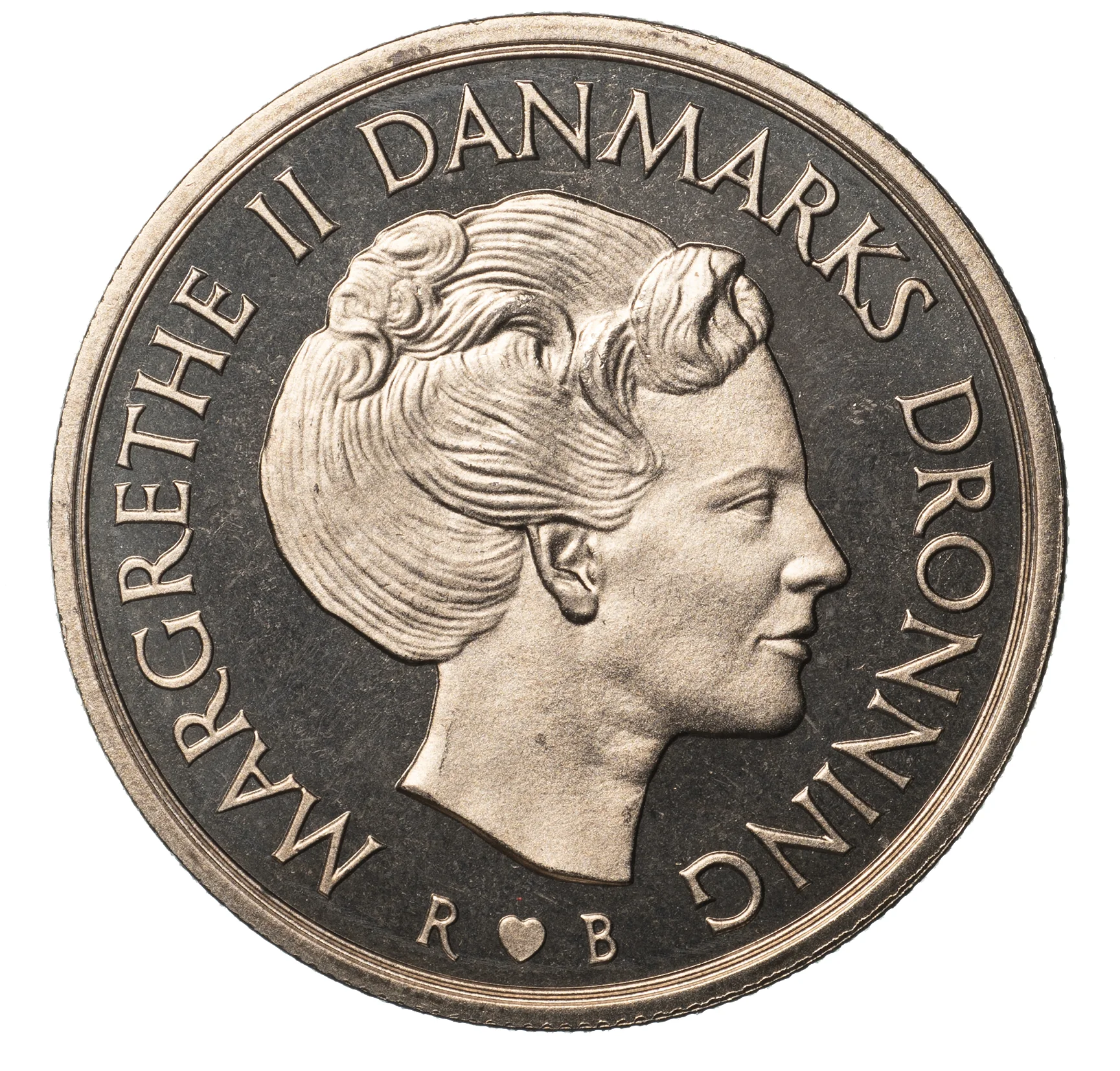
Obverse
Description:
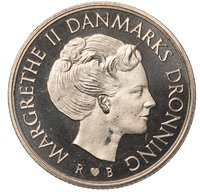
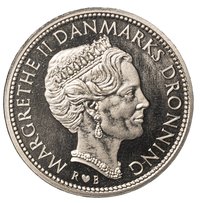
Queen Margrethe II of Denmark.
Inscription:
MARGRETHE II DANMARKS DRONNING
S ♥ B
S ♥ B
Translation:
Margrethe II, Denmark's Queen
S ♥ B
S ♥ B
Script: Latin
Language: Danish
Engraver: Frode Bahnsen
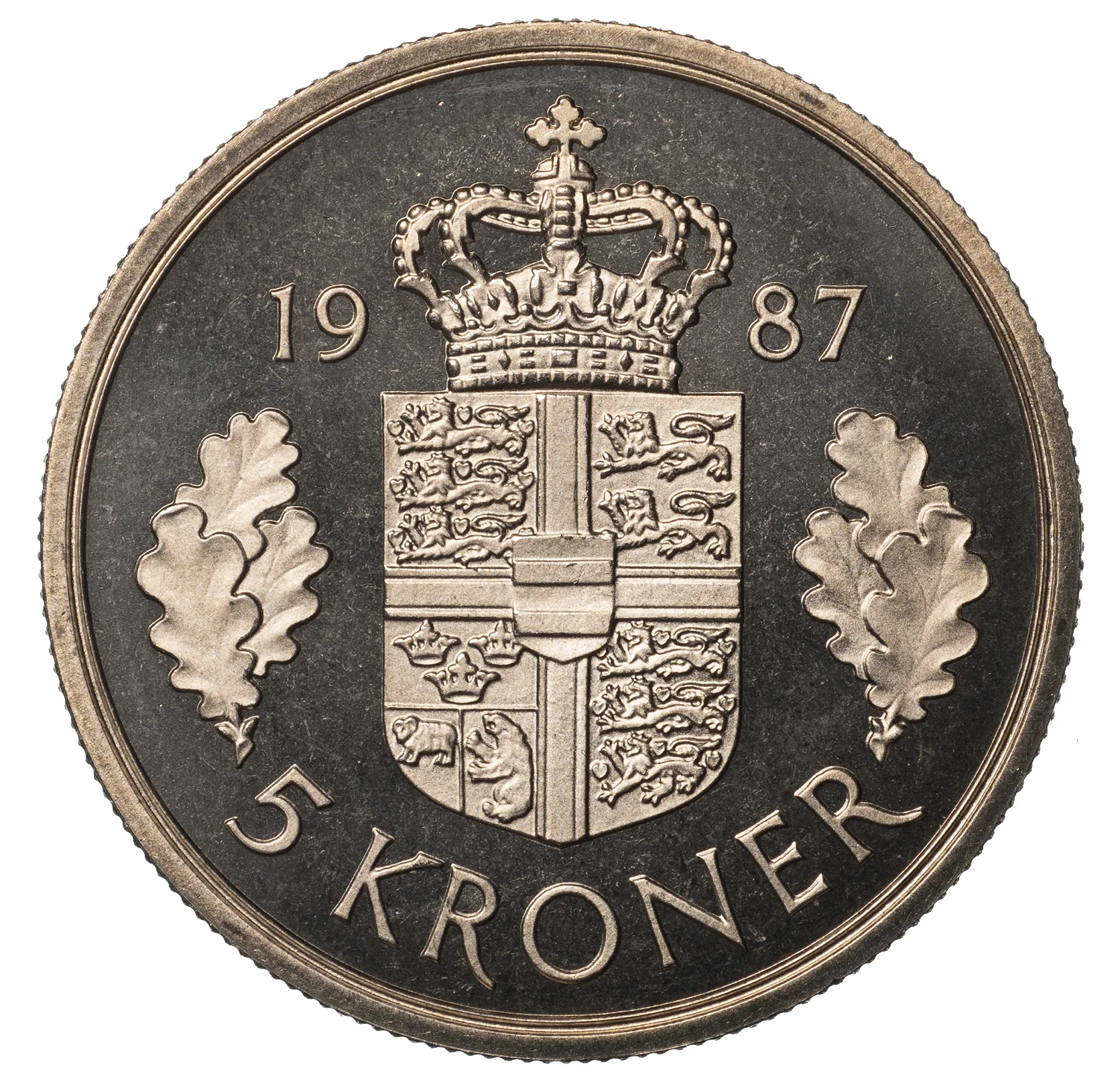
Reverse
Description:
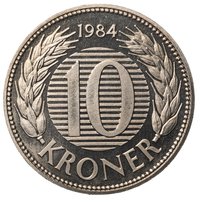
Royal Danish coat of arms flanked by oak leaves.
Inscription:
19 76
5 KRONER
5 KRONER
Script: Latin
Engraver: Frode Bahnsen
Edge
Reeded
Categories
| Symbols> Coat of Arms |
Mints
| Name | Mark |
|---|---|
| Royal Danish Mint | — |
Mintings
| Year | Mint Mark | Mintage | Quality | Collection |
|---|---|---|---|---|
| 1973 | S♥B | 3,774,000 | ||
| 1974 | S♥B | 5,239,000 | ||
| 1975 | S♥B | 5,810,000 | ||
| 1976 | S♥B | 7,651,000 | ||
| 1977 | S♥B | 6,885,000 | ||
| 1978 | S♥B | 2,984,000 | ||
| 1979 | B♥B | 2,861,000 | ||
| 1980 | B♥B | 3,622,000 | ||
| 1981 | B♥B | 1,057,000 | ||
| 1982 | R♥B | 1,002,000 | ||
| 1983 | R♥B | 1,044,000 | ||
| 1984 | R♥B | 713,000 | ||
| 1985 | R♥B | 621,000 | ||
| 1986 | R♥B | 1,042,000 | ||
| 1987 | R♥B | 611,000 | ||
| 1988 | R♥B | 648,000 |
Historical background
Denmark's currency situation in 1973 was fundamentally shaped by its entry into the European Economic Community (EEC) on January 1st of that year. This membership occurred against a backdrop of global monetary turmoil, as the Bretton Woods system of fixed exchange rates had collapsed just two years prior. In response, Denmark, like many European nations, sought stability through regional cooperation. It joined the nascent "European currency snake," a mechanism designed to limit fluctuations between participating European currencies by maintaining them within narrow bands against each other. This was a pivotal step, tying the Danish krone's fate more closely to its major trading partners, particularly West Germany.
However, maintaining this peg proved immediately challenging. The first oil crisis erupted in October 1973, causing severe economic shockwaves, including soaring inflation and widening trade deficits. These pressures strained the Danish krone within the snake's constraints. Consequently, Denmark was forced to abandon the arrangement in early 1974, just over a year after joining, opting instead to let the krone float temporarily. This exit highlighted the difficulty of reconciling domestic economic pressures with the demands of a multinational fixed exchange rate system during a period of profound global instability.
Thus, 1973 represents a transitional and somewhat contradictory year for Danish currency policy. It began with a formal commitment to European monetary integration through EEC accession and the currency snake, symbolizing a forward-looking, cooperative approach. Yet, it ended with the underlying weaknesses of the Danish economy exposed by external shocks, setting the stage for the krone's departure from the snake and a period of more independent, albeit turbulent, monetary management. This tension between the pursuit of stable external exchange rates and the needs of the domestic economy would define Danish currency policy for decades to come.
However, maintaining this peg proved immediately challenging. The first oil crisis erupted in October 1973, causing severe economic shockwaves, including soaring inflation and widening trade deficits. These pressures strained the Danish krone within the snake's constraints. Consequently, Denmark was forced to abandon the arrangement in early 1974, just over a year after joining, opting instead to let the krone float temporarily. This exit highlighted the difficulty of reconciling domestic economic pressures with the demands of a multinational fixed exchange rate system during a period of profound global instability.
Thus, 1973 represents a transitional and somewhat contradictory year for Danish currency policy. It began with a formal commitment to European monetary integration through EEC accession and the currency snake, symbolizing a forward-looking, cooperative approach. Yet, it ended with the underlying weaknesses of the Danish economy exposed by external shocks, setting the stage for the krone's departure from the snake and a period of more independent, albeit turbulent, monetary management. This tension between the pursuit of stable external exchange rates and the needs of the domestic economy would define Danish currency policy for decades to come.
Series: 1973 Denmark circulation coins
🌱 Very Common