

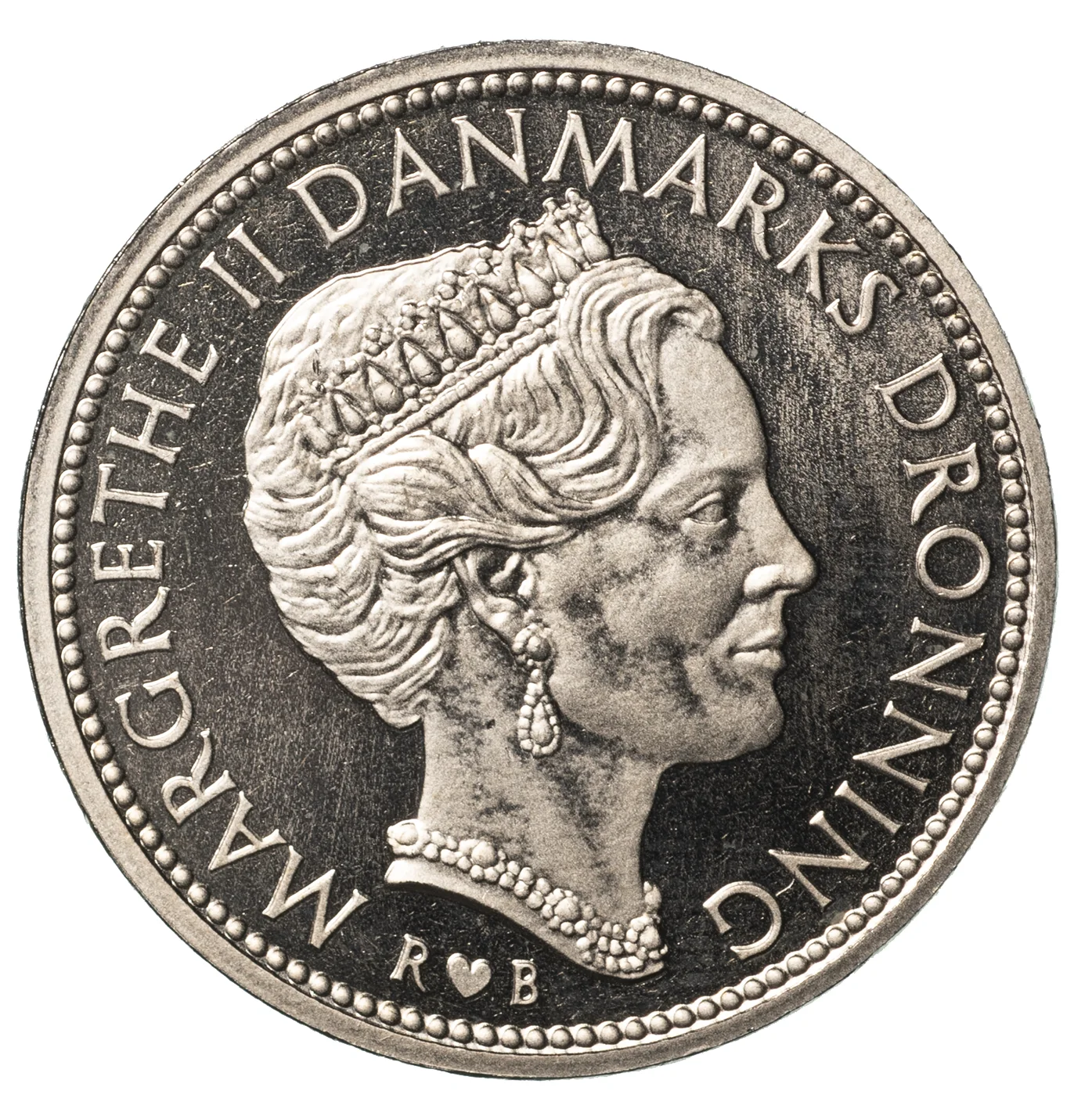
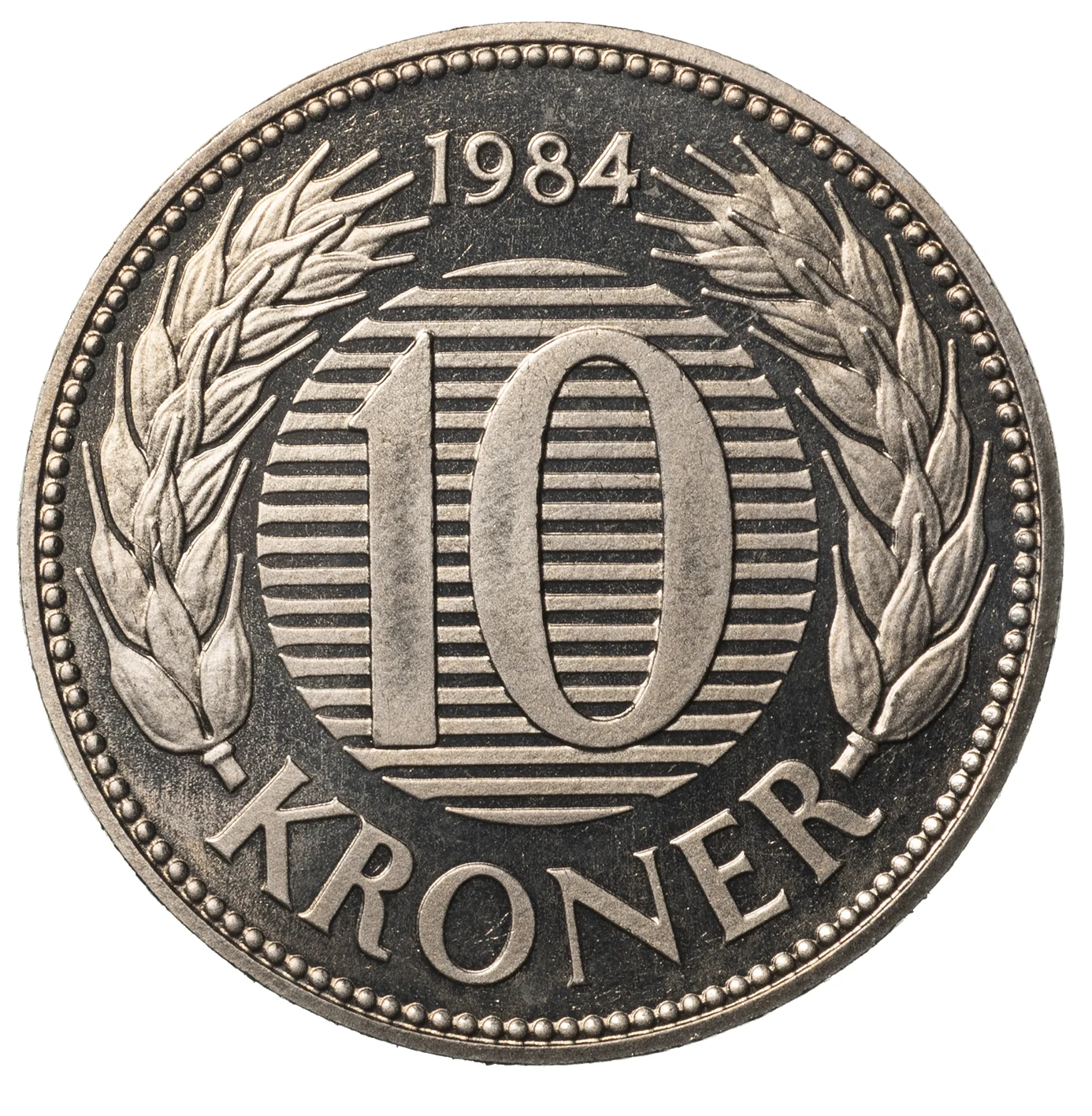
10 kroner – Denmark
Add to wishlist
Denmark
Context
Years: 1979–1988
Issuer: Denmark
Ruler: Margrethe II
Currency:
(since 1873)
Total mintage: 92,414,000
Material
References
KM: #
Numista: #2379
Value
Exchange value: 10 DKK
Inflation-adjusted value: 42.18 DKK
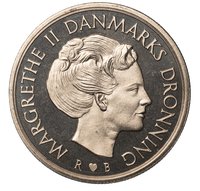
Obverse
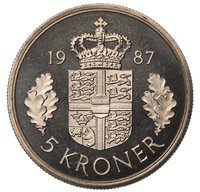
Reverse
Edge
Plain
Mints
| Name | Mark |
|---|---|
| Royal Danish Mint | — |
Mintings
| Year | Mint Mark | Mintage | Quality | Collection |
|---|---|---|---|---|
| 1979 | B♥B | 76,801,000 | ||
| 1981 | B♥B | 10,520,000 | ||
| 1982 | R♥B | 1,065,000 | ||
| 1983 | R♥B | 1,123,000 | ||
| 1984 | R♥B | 748,000 | ||
| 1985 | R♥B | 720,000 | ||
| 1987 | R♥B | 719,000 | ||
| 1988 | R♥B | 718,000 |
Historical background
In 1979, Denmark found itself at a pivotal monetary crossroads, deeply intertwined with the broader European project of economic integration. The nation was a member of the European Community's "snake in the tunnel" arrangement, a precursor to the European Monetary System (EMS), but had struggled with currency instability throughout the 1970s. High inflation, significant public debt, and frequent devaluations of the Danish krone had eroded its credibility, creating economic uncertainty and pressure from trading partners for greater stability.
The defining event of that year was Denmark's participation in the launch of the European Monetary System (EMS) on March 13, 1979. Denmark chose to join the system's core mechanism, the Exchange Rate Mechanism (ERM), which required member currencies to fluctuate within narrow bands against a new benchmark called the European Currency Unit (ECU). This commitment was a strategic political choice to anchor the krone to the strong German Deutsche Mark, aiming to import the Bundesbank's anti-inflation credibility and discipline domestic fiscal and wage policies.
However, Denmark's entry into the ERM was marked by immediate and telling strain. Within just seven months, in September 1979, the krone came under severe speculative pressure due to Denmark's persistent high inflation and large current account deficit. This forced a unilateral 5% devaluation of the krone within the system, a move that highlighted the tension between the fixed exchange rate commitment and domestic economic realities. Thus, 1979 set the stage for Denmark's subsequent decades within European exchange rate frameworks, characterized by a hard-won stability achieved through strict policy alignment, but punctuated by periods of intense market pressure testing the krone's peg.
The defining event of that year was Denmark's participation in the launch of the European Monetary System (EMS) on March 13, 1979. Denmark chose to join the system's core mechanism, the Exchange Rate Mechanism (ERM), which required member currencies to fluctuate within narrow bands against a new benchmark called the European Currency Unit (ECU). This commitment was a strategic political choice to anchor the krone to the strong German Deutsche Mark, aiming to import the Bundesbank's anti-inflation credibility and discipline domestic fiscal and wage policies.
However, Denmark's entry into the ERM was marked by immediate and telling strain. Within just seven months, in September 1979, the krone came under severe speculative pressure due to Denmark's persistent high inflation and large current account deficit. This forced a unilateral 5% devaluation of the krone within the system, a move that highlighted the tension between the fixed exchange rate commitment and domestic economic realities. Thus, 1979 set the stage for Denmark's subsequent decades within European exchange rate frameworks, characterized by a hard-won stability achieved through strict policy alignment, but punctuated by periods of intense market pressure testing the krone's peg.
🌱 Very Common