

1 cent – United States
Add to wishlist
United States
Context
Years: 1816–1835
Issuer: United States
Period:
(since 1776)
Currency:
(since 1785)
Total mintage: 39,921,412
Material
References
KM: #
Numista: #14203
Value
Exchange value: 0.01 USD = $0.01
Obverse
Description:
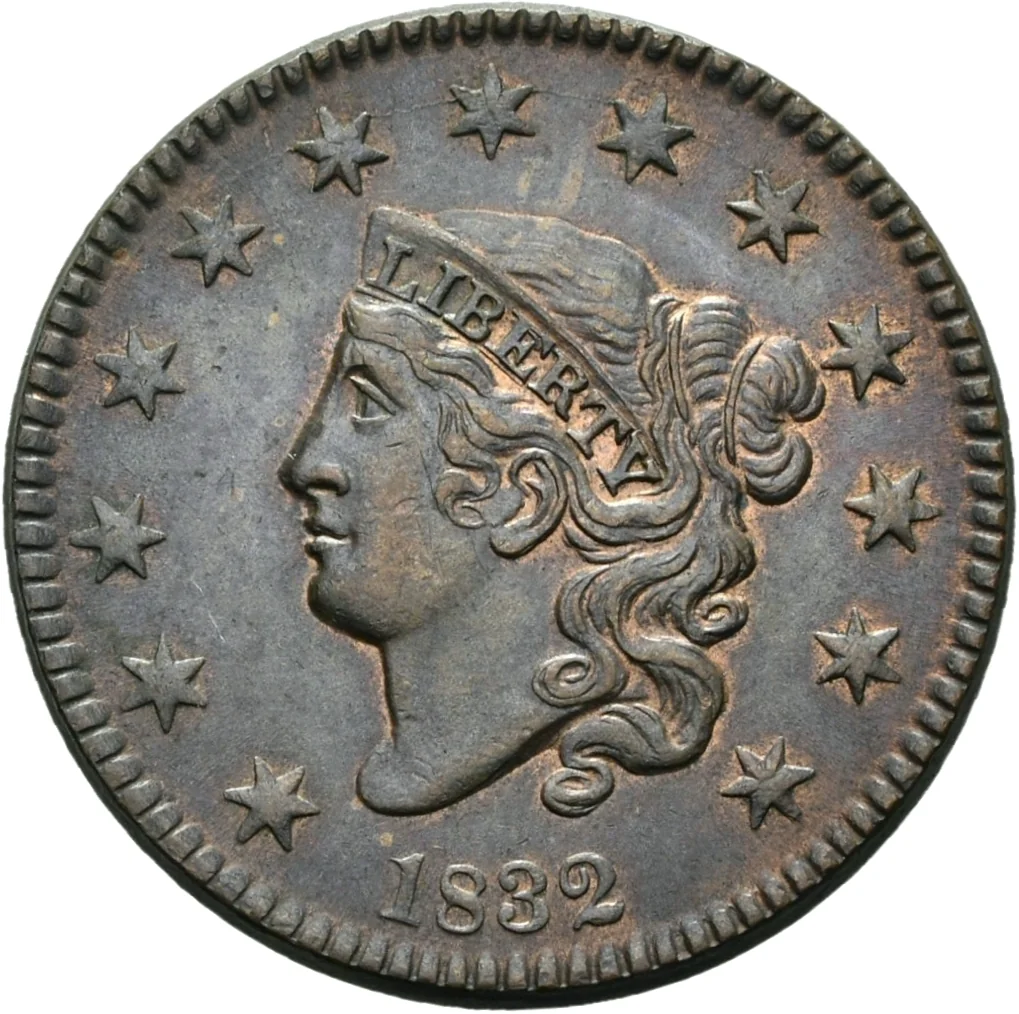
Bust left, 13 stars, date below.
Inscription:
LIBERTY
1820
1820
Script: Latin
Engravers: Robert Scot, John Reich
Reverse
Description:
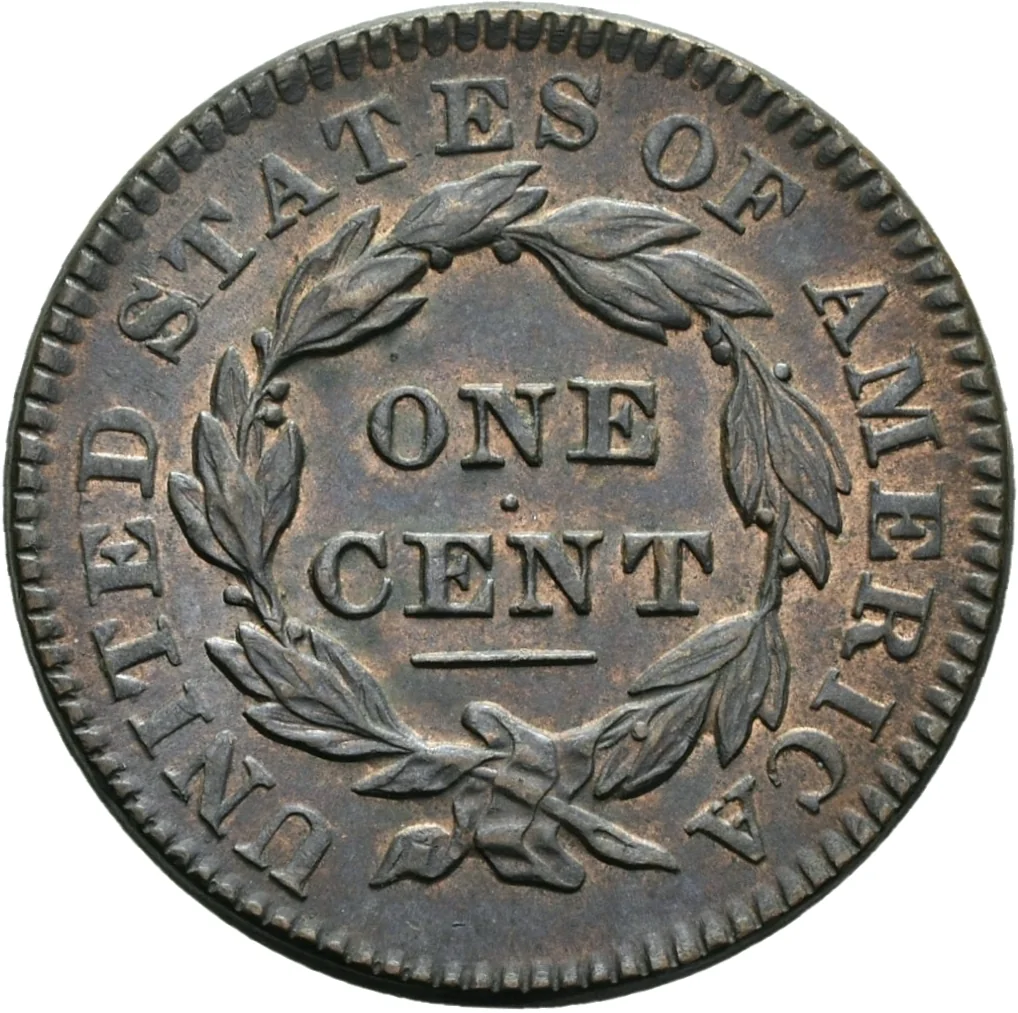
Denomination in wreath, country name around rim.
Inscription:
UNITED STATES OF AMERICA
ONE CENT
ONE CENT
Script: Latin
Engravers: Robert Scot, John Reich
Edge
Plain
Mints
| Name | Mark |
|---|---|
| United States Mint of Philadelphia | — |
Mintings
| Year | Mint Mark | Mintage | Quality | Collection |
|---|---|---|---|---|
| 1816 | — | 2,820,982 | ||
| 1817 | — | 3,948,400 | ||
| 1818 | — | 3,167,000 | ||
| 1819 | — | 2,671,000 | ||
| 1820 | — | 4,407,550 | ||
| 1821 | — | 389,000 | ||
| 1822 | — | 2,072,339 | ||
| 1823 | — | — | ||
| 1824 | — | 1,262,000 | ||
| 1825 | — | 1,461,100 | ||
| 1826 | — | 1,517,425 | ||
| 1827 | — | 2,357,732 | ||
| 1828 | — | 2,260,624 | ||
| 1829 | — | 1,414,500 | ||
| 1830 | — | 1,711,500 | ||
| 1831 | — | 3,359,260 | ||
| 1832 | — | 2,362,000 | ||
| 1833 | — | 2,739,000 | ||
| 1834 | — | — | ||
| 1835 | — | — |
Historical background
In the aftermath of the War of 1812, the United States faced severe monetary chaos in 1816. The conflict had exposed the profound weaknesses of the nation's financial system, which relied heavily on a patchwork of state-chartered banks. These banks had suspended specie payments (redeeming their notes for gold or silver) during the war, leading to a flood of depreciated and unreliable paper currency. With hundreds of different banknotes in circulation, many of questionable value, interstate trade was hampered, and public confidence in the banking system was shattered. This unstable environment created an urgent need for a uniform national currency and a centralized authority to restore order.
The federal government's primary response was the creation of the Second Bank of the United States, chartered in April 1816. Modeled after Alexander Hamilton's first Bank, its key roles were to serve as the federal government's fiscal agent, hold its deposits, and ensure a sound national currency. Crucially, it was tasked with compelling state banks to resume specie payments by refusing to accept their notes unless they were redeemable in gold or silver. This was intended to curb inflationary practices and discipline the sprawling state banking system, thereby stabilizing the value of money across the states.
However, the situation in 1816 was one of transition and immediate crisis, not yet stability. The Second Bank was newly established and would not open for business until 1817. Furthermore, its early management was poor, and it initially contributed to, rather than curtailed, speculative lending. Thus, while 1816 marks the pivotal legislative attempt to solve the currency crisis through federal power, the actual restoration of a uniform, specie-backed currency remained a work in progress, with the real test of the Bank's effectiveness lying in the years immediately following its launch.
The federal government's primary response was the creation of the Second Bank of the United States, chartered in April 1816. Modeled after Alexander Hamilton's first Bank, its key roles were to serve as the federal government's fiscal agent, hold its deposits, and ensure a sound national currency. Crucially, it was tasked with compelling state banks to resume specie payments by refusing to accept their notes unless they were redeemable in gold or silver. This was intended to curb inflationary practices and discipline the sprawling state banking system, thereby stabilizing the value of money across the states.
However, the situation in 1816 was one of transition and immediate crisis, not yet stability. The Second Bank was newly established and would not open for business until 1817. Furthermore, its early management was poor, and it initially contributed to, rather than curtailed, speculative lending. Thus, while 1816 marks the pivotal legislative attempt to solve the currency crisis through federal power, the actual restoration of a uniform, specie-backed currency remained a work in progress, with the real test of the Bank's effectiveness lying in the years immediately following its launch.
🌱 Very Common