

2½ dollars – United States
Add to wishlist
United States
Context
Years: 1821–1827
Issuer: United States
Period:
(since 1776)
Currency:
(since 1785)
Total mintage: 17,049
Material
References
KM: #
Numista: #30779
Value
Exchange value: 2.50 USD = $2.50
Bullion value: $613.81
Obverse
Description:
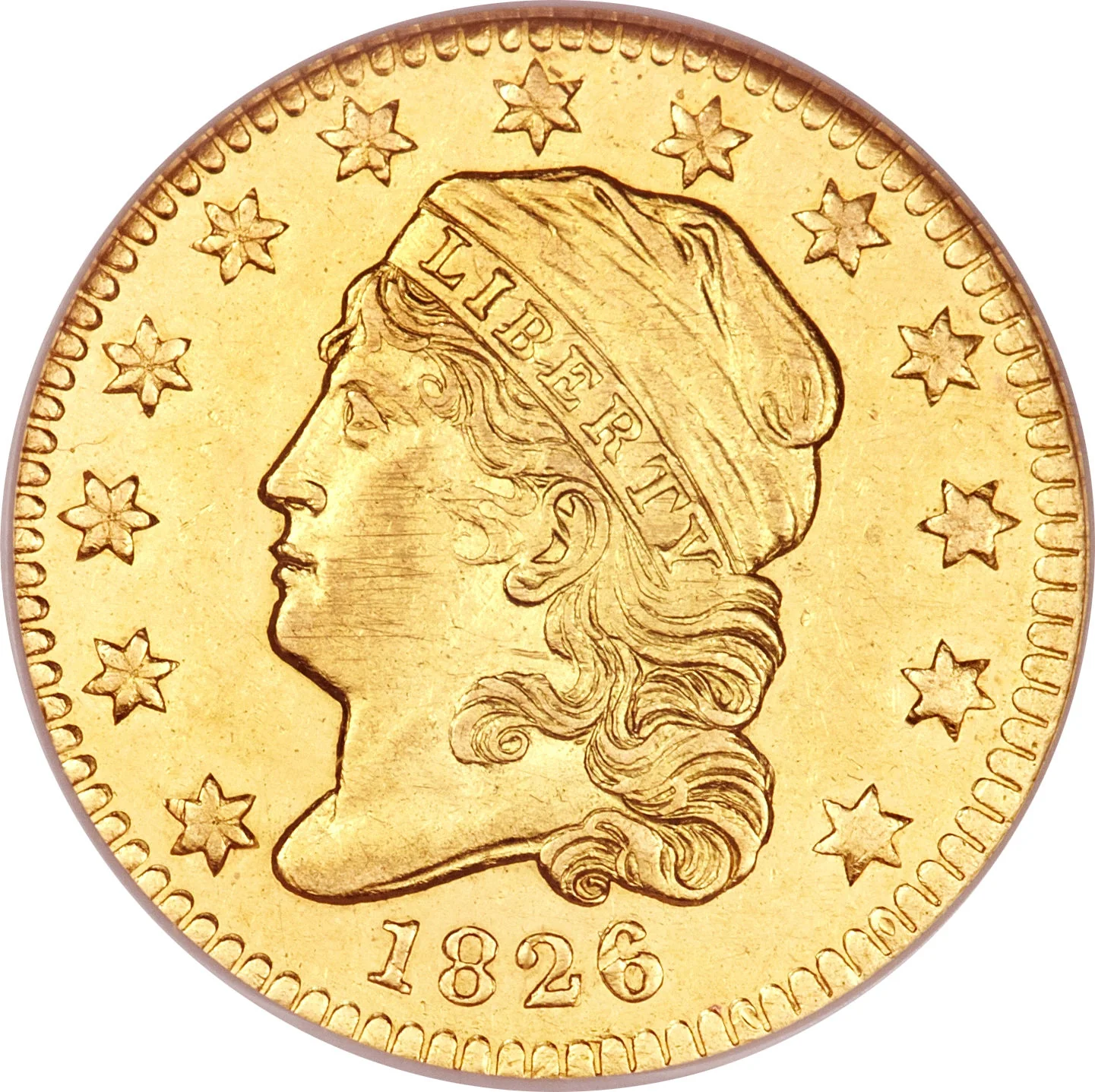
Bust left in cap, surrounded by 13 stars.
Inscription:
LIBERTY
1826
1826
Script: Latin
Engraver: John Reich
Reverse
Description:
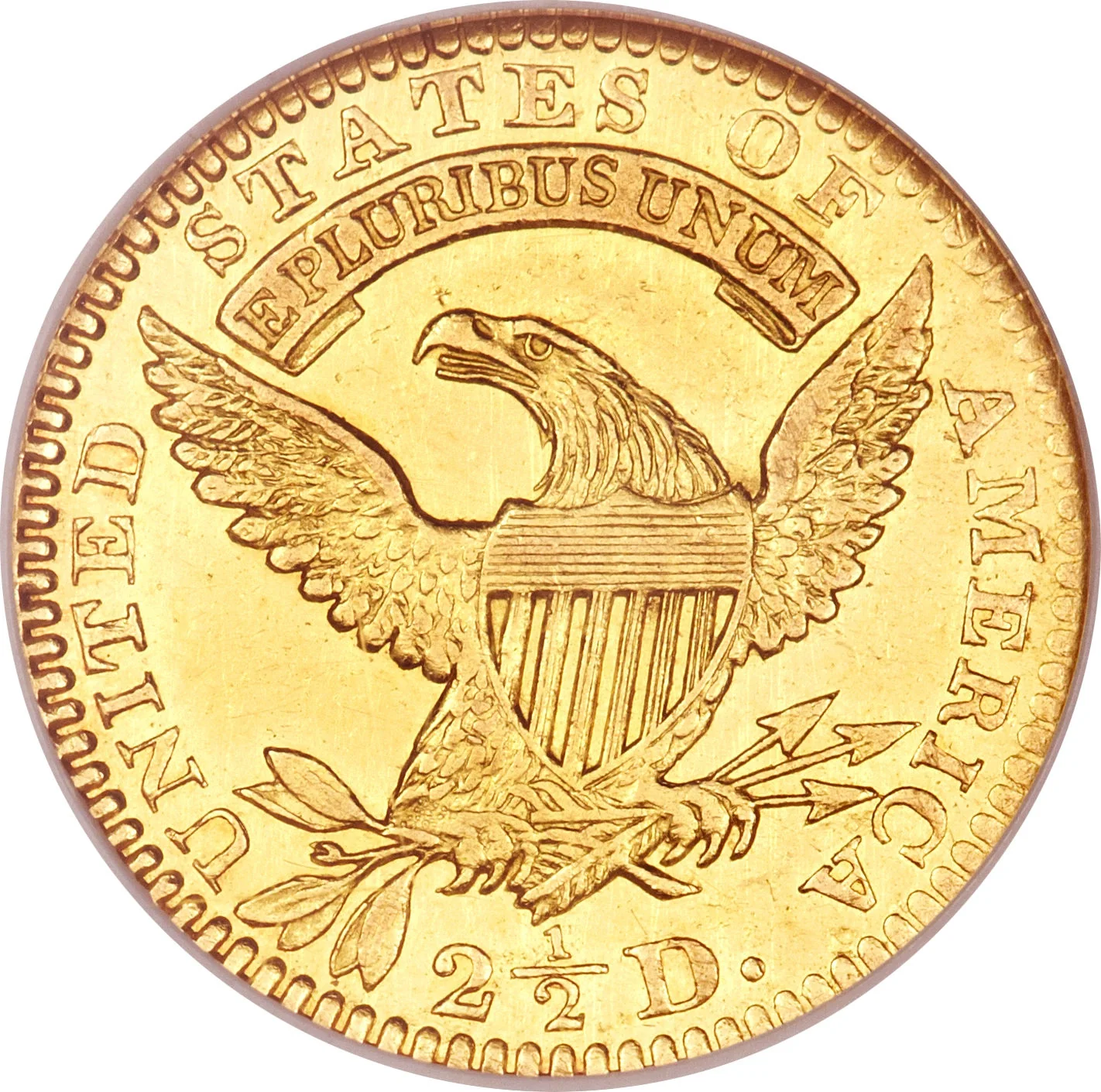
Eagle clutching arrows and olive branch, motto above.
Inscription:
UNITED STATES OF AMERICA
E PLURIBUS UNUM
2 ½ D.
E PLURIBUS UNUM
2 ½ D.
Script: Latin
Engraver: John Reich
Edge
Reeded
Categories
| Animal> Bird> Eagle |
| Symbol> Allegory |
| Object> Cold weapons |
| Symbol> Phrygian cap |
Mints
| Name | Mark |
|---|---|
| United States Mint of Philadelphia | — |
Mintings
| Year | Mint Mark | Mintage | Quality | Collection |
|---|---|---|---|---|
| 1821 | — | 6,448 | ||
| 1821 | — | 7 | Proof | |
| 1824 | — | 2,600 | ||
| 1825 | — | 4,434 | ||
| 1826 | — | 760 | ||
| 1827 | — | 2,800 |
Historical background
The United States in 1821 stood at the conclusion of a tumultuous period of monetary instability known as the "Era of Good Feelings," which was anything but good for the nation's currency. The country operated on a bimetallic standard, but the War of 1812 had forced the suspension of specie payments (redemption of paper money for gold or silver) by state-chartered banks. This led to a proliferation of unsound banknotes and severe inflation. The subsequent Panic of 1819 caused widespread bank failures, crushing debt, and a painful economic contraction, starkly revealing the vulnerabilities of a decentralized and poorly regulated banking system.
In response to these crises, a major shift occurred with the 1821 resumption of specie payments by the Second Bank of the United States (B.U.S.). Chartered in 1816 to restore order, the B.U.S. had initially contributed to the panic through its own mismanagement. Under new leadership, it now aggressively demanded that state banks redeem their notes in gold or silver, forcing a dramatic contraction of the paper money supply. This successfully curtailed inflation and stabilized the currency on a specie basis, but it also prolonged the economic hardship in many regions by making credit scarce.
Thus, the currency situation in 1821 was one of painful transition toward hard-money stability. The federal government, having eliminated its own debt from the War of 1812, was also moving toward a purely specie-based system for its transactions. While the actions of the B.U.S. established a firmer national currency anchored in precious metals, they also ignited significant political resentment. This resentment was directed against the bank's powerful role and the deflationary pressure it exerted, sowing the seeds for the "Bank War" that would define the presidency of Andrew Jackson a decade later.
In response to these crises, a major shift occurred with the 1821 resumption of specie payments by the Second Bank of the United States (B.U.S.). Chartered in 1816 to restore order, the B.U.S. had initially contributed to the panic through its own mismanagement. Under new leadership, it now aggressively demanded that state banks redeem their notes in gold or silver, forcing a dramatic contraction of the paper money supply. This successfully curtailed inflation and stabilized the currency on a specie basis, but it also prolonged the economic hardship in many regions by making credit scarce.
Thus, the currency situation in 1821 was one of painful transition toward hard-money stability. The federal government, having eliminated its own debt from the War of 1812, was also moving toward a purely specie-based system for its transactions. While the actions of the B.U.S. established a firmer national currency anchored in precious metals, they also ignited significant political resentment. This resentment was directed against the bank's powerful role and the deflationary pressure it exerted, sowing the seeds for the "Bank War" that would define the presidency of Andrew Jackson a decade later.
💎 Extremely Rare