

¼ Dollar – United States
United States
Context
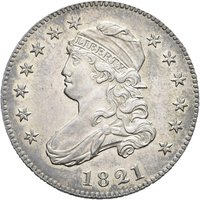
Years: 1815–1828
Issuer: United States 
Period:
(since 1776)
Currency:
(since 1785)
Subdivision: ¼ Dollar = 25 Cents
Total mintage: 639,886
Material
References
KM: #Click to copy to clipboard44
Numista: #30778
Value
Exchange value: ¼ USD = $0.25
Bullion value: $17.21
Obverse
Description:
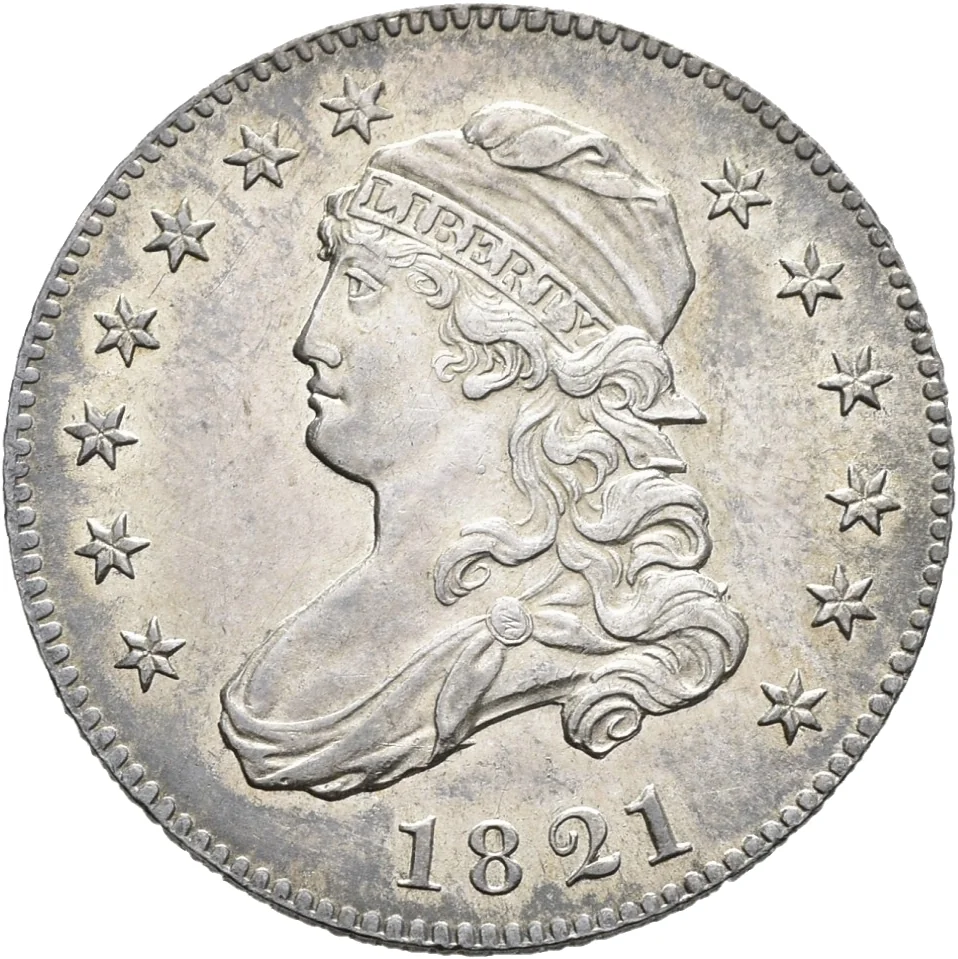
Liberty cap, left. Thirteen stars.
Inscription:
1825
Translation:
ONE RUBLE. PURE SILVER 4 ZOLOTNIKS AND 21 PARTS.
Script: Latin
Language: Russian
Designer: John Reich
Reverse
Description:
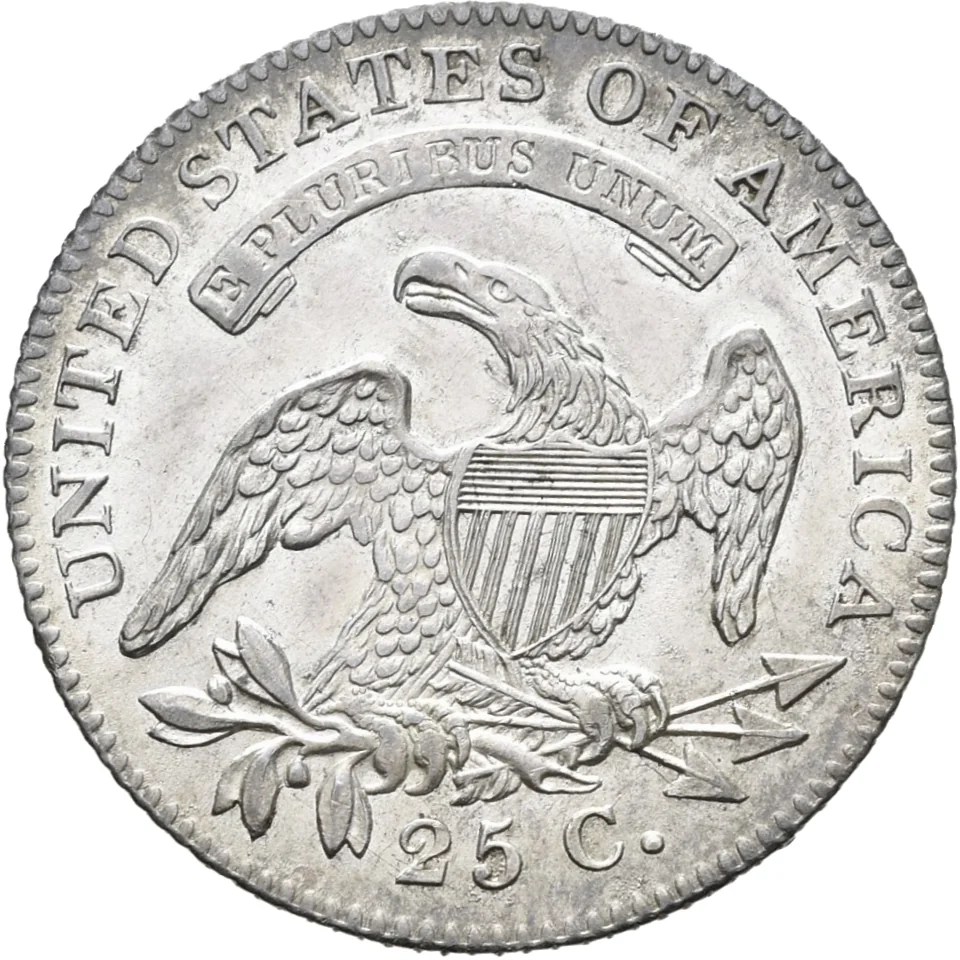
Eagle clutching arrows and an olive branch, with a banner above.
Inscription:
UNITED STATES OF AMERICA
E PLURIBUS UNUM
25 C.
E PLURIBUS UNUM
25 C.
Script: Latin
Designer: John Reich
Edge
Reeded
Categories
| Animal> Bird> Eagle |
| Symbol> Allegory |
| Symbol> Phrygian cap |
| Object> Cold weapons |
Mints
| Name | Mark |
|---|---|
| United States Mint of Philadelphia | — |
Mintings
| Year | Mint Mark | Mintage | Quality | Collection |
|---|---|---|---|---|
| 1815 | — | 89,235 | ||
| 1818 | — | — | ||
| 1819 | — | 144,000 | ||
| 1820 | — | — | ||
| 1821 | — | 216,851 | ||
| 1822 | — | — | ||
| 1823 | — | 17,800 | ||
| 1824 | — | 168,000 | ||
| 1825 | — | — | ||
| 1827 | — | 4,000 | ||
| 1828 | — | — |
Historical background
In 1815, the United States emerged from the War of 1812 with its currency system in a state of profound disarray. The conflict had severed the nation from the gold and silver reserves of British banks, while government borrowing and the issuance of Treasury notes to fund the war flooded the economy with paper money. Most critically, the charter for the First Bank of the United States—the nation’s central bank and a key regulator of state-chartered banks—had expired in 1811. Without its restraining influence, the number of state banks exploded, each issuing its own notes with little oversight, leading to widespread inflation and a collapse in the value of paper currency, particularly outside the bank's local area.
The result was a chaotic and fragmented monetary landscape. Hundreds of different state bank notes circulated at wildly varying discounts to their face value, making everyday commerce difficult and risky. Specie (gold and silver coin) was hoarded and virtually absent from circulation, as its real value far exceeded that of the depreciated paper. This period exemplified the problems of a purely decentralized system: counterfeiting was rampant, and the public’s trust in paper money was severely damaged. The federal government itself struggled to manage its finances, as it received depreciated bank notes for taxes and land sales, complicating the effort to pay off substantial war debts.
This monetary crisis set the stage for a major political and economic debate that would define the next decade. A growing consensus among commercial interests and many in Congress held that the solution was a return to a centralized banking authority to restore order and credibility. This momentum led directly to the chartering of the Second Bank of the United States in 1816, tasked with stabilizing the currency by demanding that state banks redeem their notes in specie, thereby curtailing excessive paper issues. Thus, the currency situation of 1815 was not an endpoint, but a pivotal moment of breakdown that forced a decisive turn toward renewed federal oversight of the nation's money.
The result was a chaotic and fragmented monetary landscape. Hundreds of different state bank notes circulated at wildly varying discounts to their face value, making everyday commerce difficult and risky. Specie (gold and silver coin) was hoarded and virtually absent from circulation, as its real value far exceeded that of the depreciated paper. This period exemplified the problems of a purely decentralized system: counterfeiting was rampant, and the public’s trust in paper money was severely damaged. The federal government itself struggled to manage its finances, as it received depreciated bank notes for taxes and land sales, complicating the effort to pay off substantial war debts.
This monetary crisis set the stage for a major political and economic debate that would define the next decade. A growing consensus among commercial interests and many in Congress held that the solution was a return to a centralized banking authority to restore order and credibility. This momentum led directly to the chartering of the Second Bank of the United States in 1816, tasked with stabilizing the currency by demanding that state banks redeem their notes in specie, thereby curtailing excessive paper issues. Thus, the currency situation of 1815 was not an endpoint, but a pivotal moment of breakdown that forced a decisive turn toward renewed federal oversight of the nation's money.
⭐ Somewhat Rare