


10 rubles – Russian Federation
Add to wishlist
Russia
Context
Year: 2023
Country: Russia
Issuer: Russian Federation
Period:
(since 1991)
Currency:
(since 1998)
Total mintage: 1,000,000
Material

References
Value
Exchange value: 10 RUB
Inflation-adjusted value: 14.70 RUB
Obverse
Description:
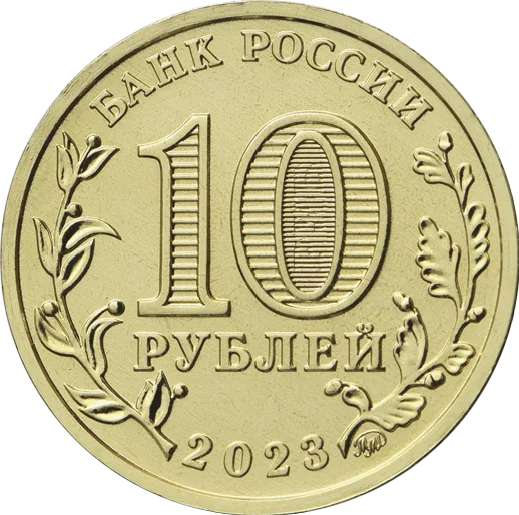
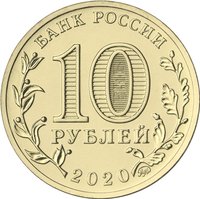
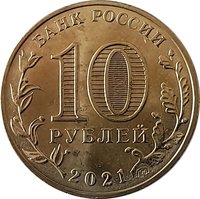
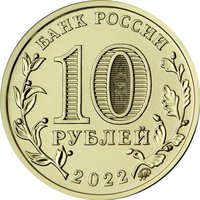
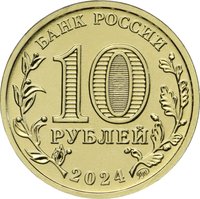
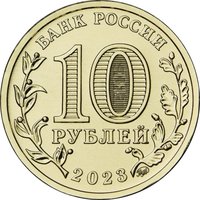
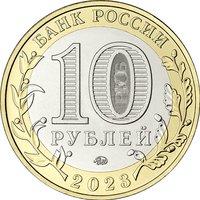
Central: '10 РУБЛЕЙ' (10 ROUBLES). Inside the '0', hidden images of '10' and 'РУБ' (RUB) appear alternately when tilted. Flanked by stylized laurel (left) and oak (right) branches. Along the rim: 'БАНК РОССИИ' (BANK OF RUSSIA) above, and the year '2023' with mint mark below.
Inscription:
БАНК РОССИИ
10
РУБЛЕЙ
2023 ММД
10
РУБЛЕЙ
2023 ММД
Translation:
BANK OF RUSSIA
10
RUBLES
2023 MMD
10
RUBLES
2023 MMD
Script: Cyrillic
Language: Russian
Designer and engraver: Alexander Vasilyevich Baklanov
Reverse
Description:
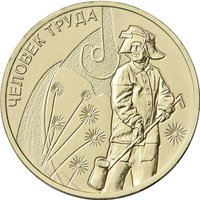
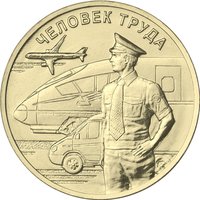
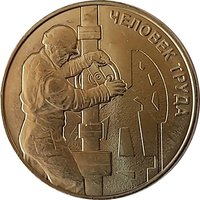
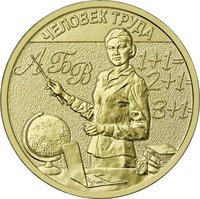
The reverse depicts a bricklayer against stylized buildings, with the circumferential inscription "ЧЕЛОВЕК ТРУДА" (MAN OF LABOUR).
Inscription:
ЧЕЛОВЕК ТРУДА
Translation:
THE WORKING MAN
Script: Cyrillic
Language: Russian
Engraver: Elizaveta Davydova
Designer: Andrey Anatolyevich Brynza
Edge
Categories
| Industry |
Mints
| Name | Mark |
|---|---|
| Moscow Mint | (ММД) |
Mintings
| Year | Mint Mark | Mintage | Quality | Collection |
|---|---|---|---|---|
| 2023 | ММД | 1,000,000 |
Historical background
In 2023, the Russian currency, the ruble, experienced significant volatility and a pronounced depreciation against major world currencies, marking one of its weakest periods in over a year. After initial resilience in 2022 due to capital controls and high energy revenues, the ruble's value deteriorated sharply from around 70 to the US dollar in January to briefly exceeding 100 in August. This decline was primarily driven by a substantial reduction in Russia's current account surplus, as sanctions redirected oil exports and lowered prices, while imports recovered, increasing demand for foreign currency. Domestic factors, including increased government defense spending, a tight labor market fueling inflation, and a rise in capital outflows, further pressured the currency.
The Russian government and Central Bank responded with a series of aggressive policy measures to stabilize the situation. In July, the Bank of Russia raised its key interest rate by 100 basis points, and by August's emergency 350-basis-point hike to 12%, it signaled a strong shift towards prioritizing currency and price stability. Authorities also reintroduced some informal capital controls, pressuring major exporters to sell foreign exchange earnings, and discussed reinstating mandatory sales of hard currency revenue. These actions, combined with higher global oil prices in the latter part of the year, helped the ruble recover to the 90-95 range against the dollar by December, though it remained markedly weaker than at the start of the year.
The currency turmoil of 2023 underscored the profound and ongoing structural challenges to Russia's financial stability imposed by the war in Ukraine and international sanctions. The episode highlighted the economy's continued dependence on hydrocarbon revenues and its vulnerability to shifts in trade patterns, as well as the inflationary pressures of military-focused fiscal policy. While the immediate crisis was contained, the ruble's trajectory reflected a managed but persistent devaluation within a shrinking and increasingly isolated economic framework, setting a precedent of higher interest rates and controlled capital flows as the new normal for Russia's financial system.
The Russian government and Central Bank responded with a series of aggressive policy measures to stabilize the situation. In July, the Bank of Russia raised its key interest rate by 100 basis points, and by August's emergency 350-basis-point hike to 12%, it signaled a strong shift towards prioritizing currency and price stability. Authorities also reintroduced some informal capital controls, pressuring major exporters to sell foreign exchange earnings, and discussed reinstating mandatory sales of hard currency revenue. These actions, combined with higher global oil prices in the latter part of the year, helped the ruble recover to the 90-95 range against the dollar by December, though it remained markedly weaker than at the start of the year.
The currency turmoil of 2023 underscored the profound and ongoing structural challenges to Russia's financial stability imposed by the war in Ukraine and international sanctions. The episode highlighted the economy's continued dependence on hydrocarbon revenues and its vulnerability to shifts in trade patterns, as well as the inflationary pressures of military-focused fiscal policy. While the immediate crisis was contained, the ruble's trajectory reflected a managed but persistent devaluation within a shrinking and increasingly isolated economic framework, setting a precedent of higher interest rates and controlled capital flows as the new normal for Russia's financial system.
Series: Man of Labour


🌱 Fairly Common