

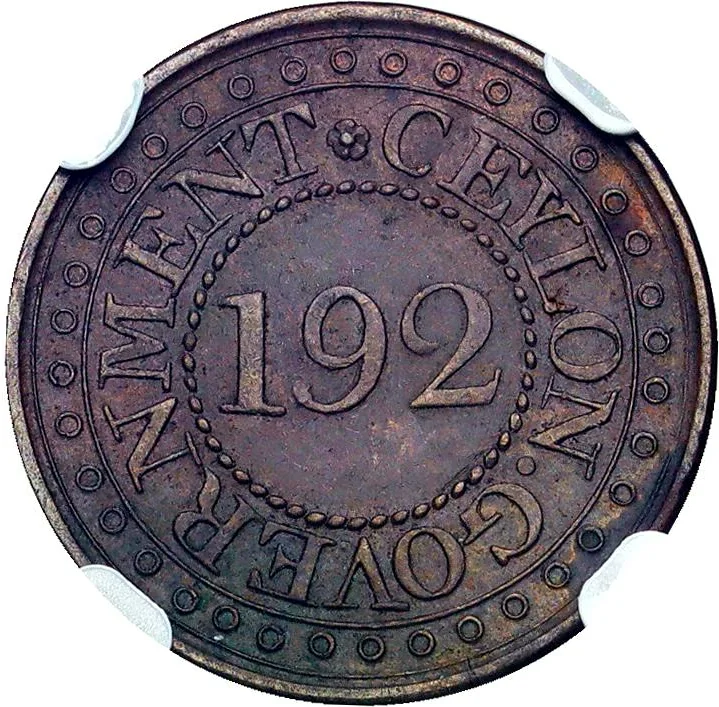
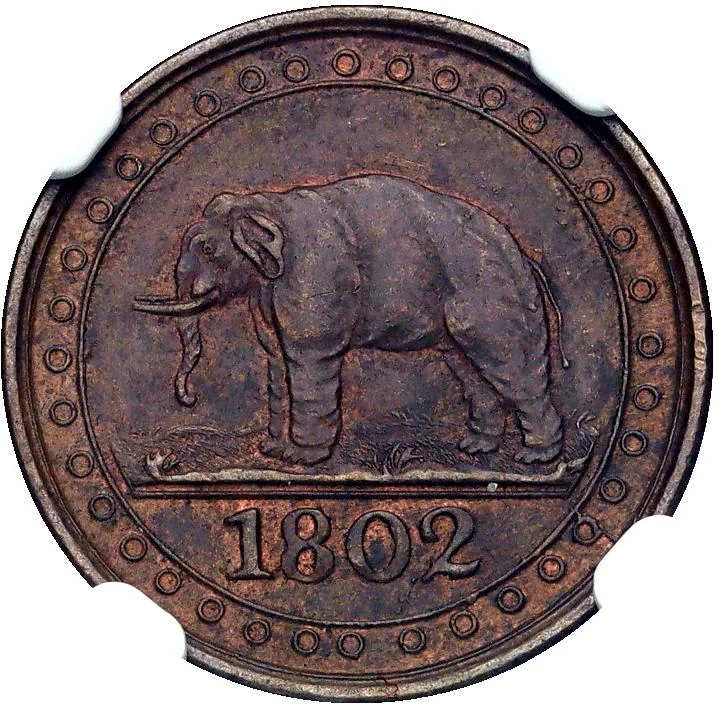
1⁄192 Rixdollar – Ceylon
Sri Lanka
Context
Years: 1802–1804
Country: Sri Lanka 
Issuer: Ceylon
Ruler: George III
Currency:
(1796—1828)
Demonetized: Yes
Total mintage: 3,600,000
Material
References
KM: #Click to copy to clipboard73
Numista: #37156
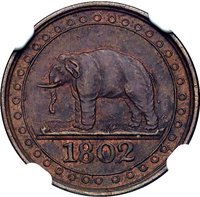
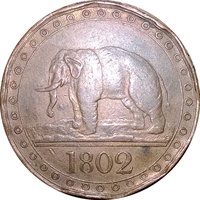
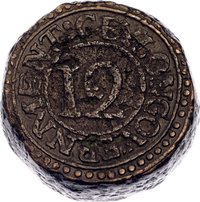
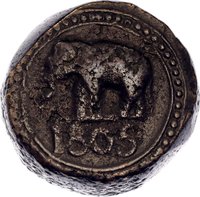
Obverse
Reverse
Edge
Plain
Mints
| Name | Mark |
|---|---|
| Soho Mint | — |
Mintings
| Year | Mint Mark | Mintage | Quality | Collection |
|---|---|---|---|---|
| 1802 | — | — | Proof | |
| 1802 | — | 3,600,000 | ||
| 1804 | — | — | Proof |
Historical background
In 1802, Ceylon (modern Sri Lanka) was a British Crown Colony, having been formally ceded by the Dutch under the Treaty of Amiens. This followed a period of initial British invasion and military administration beginning in 1796. The currency situation was chaotic and transitional, characterised by the circulation of multiple, often depreciated, foreign coins. The most common units were the Dutch rijksdaalder and stuiver, but Portuguese, Spanish, Indian (Fanams), and even old local coins remained in use, creating a complex and inefficient system for trade and administration.
The British authorities faced immediate economic challenges. The value of these coins was not fixed against British sterling, and their fluctuating worth, combined with widespread forgery and clipping, hampered commerce and revenue collection. To address this, Governor Frederick North issued a proclamation in 1801 (effective into 1802) that attempted to standardise the system. It fixed the exchange rates for the various foreign coins in terms of British currency, establishing the rix-dollar as the principal accounting unit, valued at 1 shilling 6 pence sterling.
Despite this regulation, the situation remained unstable. The fixed rates often failed to reflect the actual market value or intrinsic silver content of the old coins, leading to discontent and economic distortion. Furthermore, there was a critical shortage of small change for everyday transactions, which stifled local trade. Consequently, 1802 represents a pivotal year of early British attempts to impose monetary order on the colony, laying the groundwork for the eventual introduction of a dedicated Ceylon currency system later in the decade, though its immediate success was limited by the entrenched legacy of its diverse colonial past.
The British authorities faced immediate economic challenges. The value of these coins was not fixed against British sterling, and their fluctuating worth, combined with widespread forgery and clipping, hampered commerce and revenue collection. To address this, Governor Frederick North issued a proclamation in 1801 (effective into 1802) that attempted to standardise the system. It fixed the exchange rates for the various foreign coins in terms of British currency, establishing the rix-dollar as the principal accounting unit, valued at 1 shilling 6 pence sterling.
Despite this regulation, the situation remained unstable. The fixed rates often failed to reflect the actual market value or intrinsic silver content of the old coins, leading to discontent and economic distortion. Furthermore, there was a critical shortage of small change for everyday transactions, which stifled local trade. Consequently, 1802 represents a pivotal year of early British attempts to impose monetary order on the colony, laying the groundwork for the eventual introduction of a dedicated Ceylon currency system later in the decade, though its immediate success was limited by the entrenched legacy of its diverse colonial past.
Series: 1802 Ceylon circulation coins
🌟 Limited