

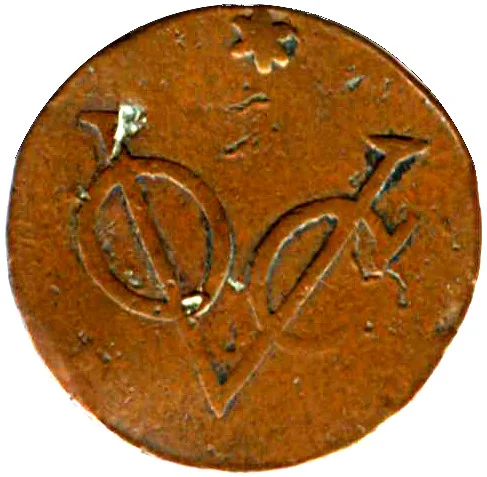
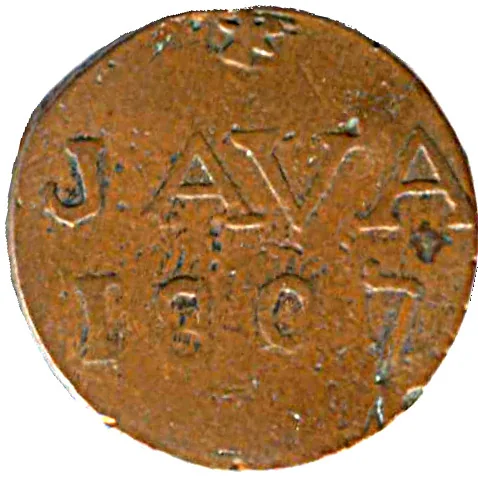
1 duit – Java
Add to wishlist
Indonesia
Context
Years: 1806–1810
Country: Indonesia
Issuer: Java
Period:
(1806—1811)
Ruler: Louis Napoléon
Currency:
(1744—1818)
Demonetized: Yes
Material
References
KM: #
Numista: #37112
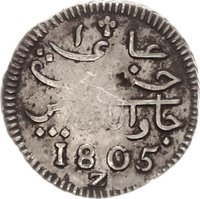
Obverse
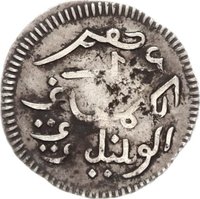
Reverse
Edge
Plain
Mintings
| Year | Mint Mark | Mintage | Quality | Collection |
|---|---|---|---|---|
| 1806 | — | — | ||
| 1807 | — | — | ||
| 1808 | — | — | ||
| 1809 | — | — | ||
| 1810 | — | — |
Historical background
In 1806, the currency situation in Java was a complex and unstable system, reflecting the island's turbulent political transition. The island was under the administration of the Dutch East India Company (VOC) until its bankruptcy in 1799, after which it came under direct but weakened Dutch state control. However, the Napoleonic Wars in Europe had severed direct links between the Netherlands and its colony, leading to a power vacuum. During this period, multiple currencies circulated simultaneously: Spanish silver dollars (reales), Dutch guilders, and a vast array of locally minted copper duit coins. The value of these coins was not fixed, fluctuating wildly based on metal content, availability, and the authority of the issuer, creating a chaotic and unreliable monetary environment.
This confusion was exacerbated by the arrival of the British, who invaded Java in 1806 as part of their campaign against French and Dutch interests. The British interim administration, under the leadership of Sir Stamford Raffles (who would become Lieutenant-Governor in 1811), encountered a monetary system on the brink of collapse. They found a severe shortage of sound coinage, widespread counterfeiting of the ubiquitous duit, and a public deeply distrustful of the paper money issued by the previous Dutch regime. The economy was effectively hampered by this lack of a uniform and trusted medium of exchange, which stifled trade and complicated taxation.
Therefore, the year 1806 represents a critical juncture—the final year of faltering Dutch control before the British interregnum. The currency situation was not merely an economic issue but a symptom of collapsed colonial authority. The chaotic multi-currency system, with its unreliable copper coins and discredited paper, set the stage for the monetary reforms that the British administration would soon attempt to implement in an effort to stabilize the economy and consolidate their own political control over the island.
This confusion was exacerbated by the arrival of the British, who invaded Java in 1806 as part of their campaign against French and Dutch interests. The British interim administration, under the leadership of Sir Stamford Raffles (who would become Lieutenant-Governor in 1811), encountered a monetary system on the brink of collapse. They found a severe shortage of sound coinage, widespread counterfeiting of the ubiquitous duit, and a public deeply distrustful of the paper money issued by the previous Dutch regime. The economy was effectively hampered by this lack of a uniform and trusted medium of exchange, which stifled trade and complicated taxation.
Therefore, the year 1806 represents a critical juncture—the final year of faltering Dutch control before the British interregnum. The currency situation was not merely an economic issue but a symptom of collapsed colonial authority. The chaotic multi-currency system, with its unreliable copper coins and discredited paper, set the stage for the monetary reforms that the British administration would soon attempt to implement in an effort to stabilize the economy and consolidate their own political control over the island.
⭐ Somewhat Rare