

½ Mohar – Nepal
Nepal
Context
Year: 1938
Vikram Samvat Year: 1995
Issuer: Nepal 
Ruler: Tribhuvan Bir Bikram Shah
Currency:
(since 1932)
Demonetized: Yes
Material
References
KM: #Click to copy to clipboard717
Numista: #37035
Value
Exchange value: ¼ NPR
Bullion value: $466.14
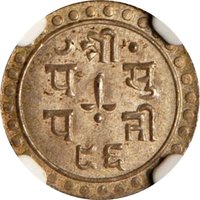
Obverse
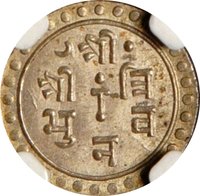
Reverse
Edge
Mintings
| Year | Mint Mark | Mintage | Quality | Collection |
|---|---|---|---|---|
| 1938 | — | — |
Historical background
In 1938, Nepal's currency system was characterized by a complex duality, operating under the Nepal Mint and the silver mohar standard, while being fundamentally anchored to the British Indian rupee. The primary circulating coin was the silver mohar, but the economy was heavily dependent on trade with British India, making the Indian rupee the de facto benchmark for value and a common medium of exchange, especially for larger transactions and foreign trade. This created a system where two currency standards coexisted, with fixed but sometimes cumbersome exchange rates between the mohar and the rupee.
The period was one of relative monetary stability under the autocratic Rana regime, but it was also a time of isolation and economic stagnation. The government strictly controlled the minting of coins, which were produced from silver obtained through trade surplus with Tibet and India. However, the system was archaic; banknotes did not yet exist, and the money supply was limited by the availability of precious metals. The economy remained largely agrarian and feudal, with a limited need for a sophisticated financial system beyond basic coinage for tax collection and local commerce.
Looking forward, the situation in 1938 was on the cusp of change. The stability was fragile, reliant on the fixed exchange with India and the Rana regime's control. Within a few years, the pressures of World War II would disrupt trade flows and silver supplies, exposing the system's vulnerabilities. This would eventually lead to significant reforms in the 1940s and 1950s, including the establishment of a central bank and the introduction of a decimalized rupee, finally moving Nepal away from the mohar and creating a more modern, unified currency system.
The period was one of relative monetary stability under the autocratic Rana regime, but it was also a time of isolation and economic stagnation. The government strictly controlled the minting of coins, which were produced from silver obtained through trade surplus with Tibet and India. However, the system was archaic; banknotes did not yet exist, and the money supply was limited by the availability of precious metals. The economy remained largely agrarian and feudal, with a limited need for a sophisticated financial system beyond basic coinage for tax collection and local commerce.
Looking forward, the situation in 1938 was on the cusp of change. The stability was fragile, reliant on the fixed exchange with India and the Rana regime's control. Within a few years, the pressures of World War II would disrupt trade flows and silver supplies, exposing the system's vulnerabilities. This would eventually lead to significant reforms in the 1940s and 1950s, including the establishment of a central bank and the introduction of a decimalized rupee, finally moving Nepal away from the mohar and creating a more modern, unified currency system.

✨ Legendary