

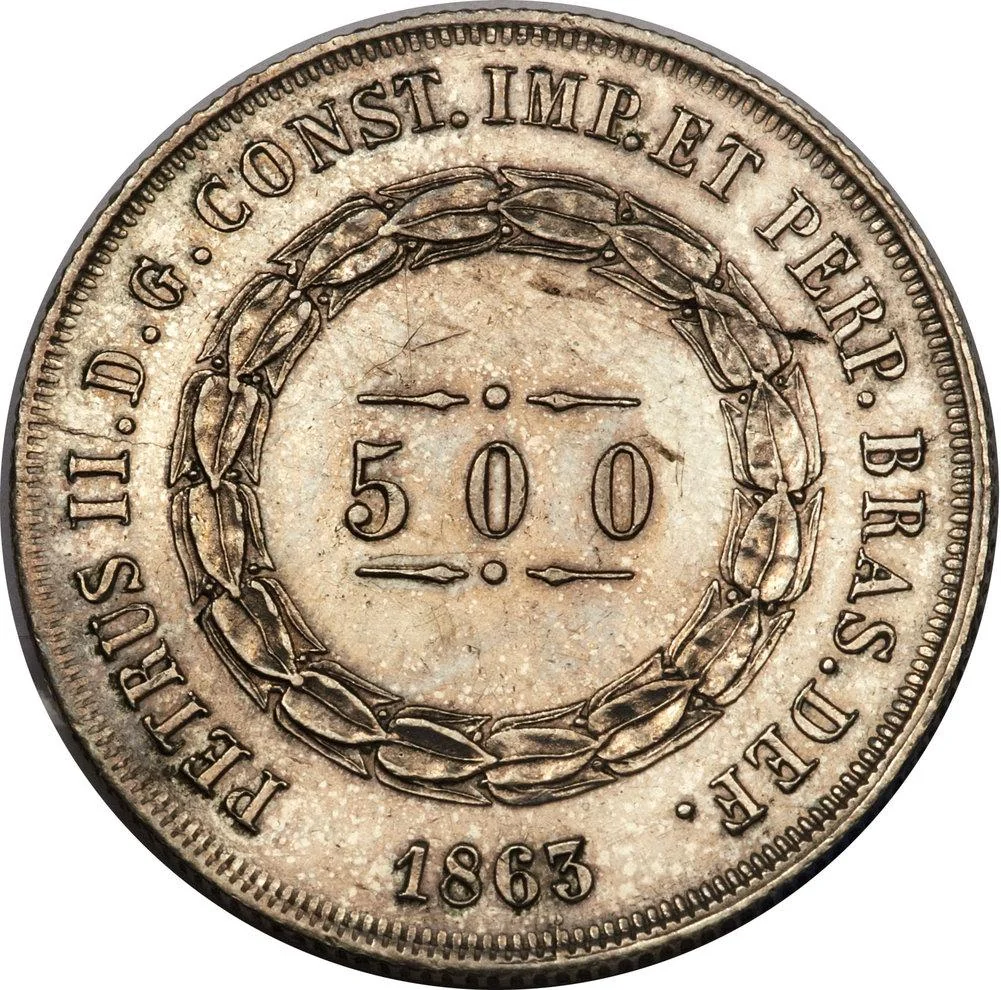
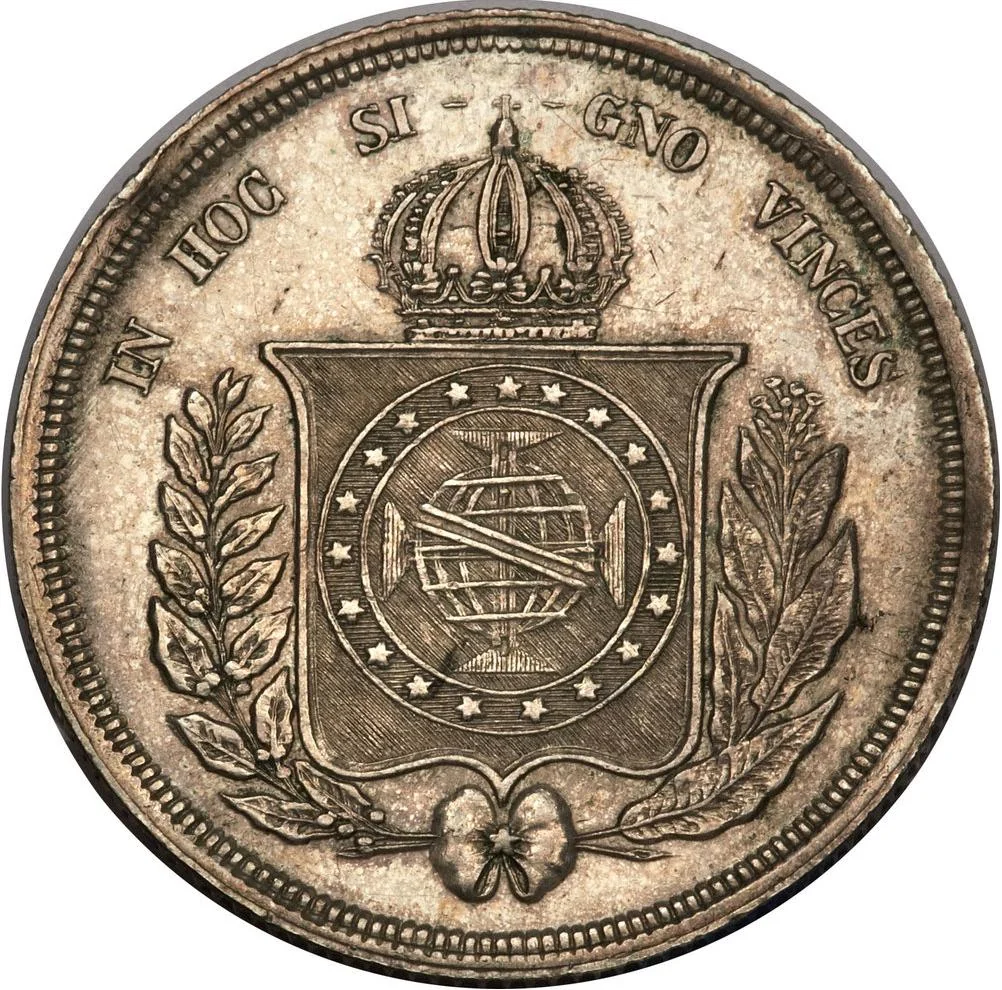
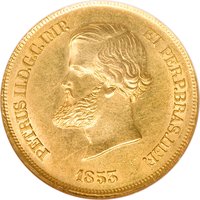
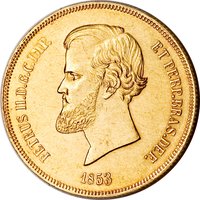
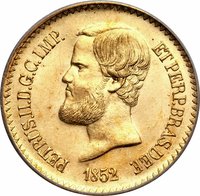
Obverse
Description:
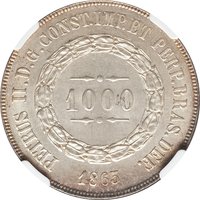
Leafy circle denomination.
Inscription:
PETRUS II.D.G.CONST.IMP.ET PERP. BRAS.DEF.
500
1863
500
1863
Script: Latin
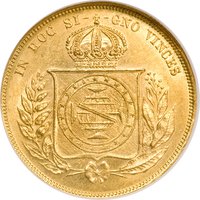
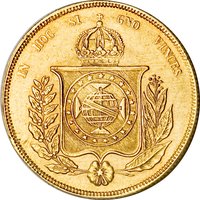
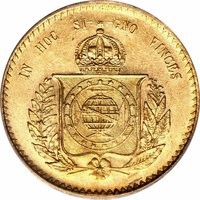
Reverse
Edge
Reeded
Mintings
| Year | Mint Mark | Mintage | Quality | Collection |
|---|---|---|---|---|
| 1853 | — | 241,487 | ||
| 1854 | — | 316,573 | ||
| 1855 | — | 211,769 | ||
| 1856 | — | 223,132 | ||
| 1857 | — | 264,775 | ||
| 1858 | — | 791,333 | ||
| 1859 | — | 492,099 | ||
| 1860 | — | 108,380 | ||
| 1861 | — | — | ||
| 1862 | — | — | ||
| 1863 | — | — | ||
| 1864 | — | — | ||
| 1865 | — | — | ||
| 1866 | — | — | ||
| 1867 | — | — |
Historical background
In 1853, Brazil's currency situation was characterized by profound instability and fragmentation, a legacy of the colonial era and early independence. The monetary system was a chaotic mix of copper, silver, and gold coins, alongside a vast array of paper money issued recklessly by provincial and even private banks. Most critically, the value of paper currency had plummeted, trading at a steep discount to its face value in precious metal (metalismo). This severe depreciation fueled rampant inflation, crippled long-term commerce, and created a climate of financial uncertainty that hindered both domestic and foreign investment.
The central catalyst for change in this period was the decisive action of the Minister of Finance, Joaquim José Rodrigues Torres, the Viscount of Itaboraí. Appointed in 1853 with a mandate for reform, he implemented a sweeping consolidation of the banking sector. His most significant act was the forced merger of the Banco do Brasil with the Banco Comercial do Rio de Janeiro, creating a new, stronger Banco do Brasil with a monopoly on note-issue in the capital. This move drastically reduced the number of entities printing money and began the process of retiring the discredited old paper notes from circulation.
Therefore, 1853 stands as a pivotal turning point, marking the end of Brazil's era of unregulated banknote emission and the beginning of a more centralized and stable monetary authority. While the task of fully restoring parity between paper and metal and unifying the national currency would take decades more—culminating in the Padrão Ouro (Gold Standard) reforms of the 1860s—the reforms of Itaboraí laid the essential institutional foundation. The year set Brazil on a path toward financial credibility, which was crucial for supporting the coffee export boom and the infrastructure projects, particularly railways, that would define the latter half of the Empire.
The central catalyst for change in this period was the decisive action of the Minister of Finance, Joaquim José Rodrigues Torres, the Viscount of Itaboraí. Appointed in 1853 with a mandate for reform, he implemented a sweeping consolidation of the banking sector. His most significant act was the forced merger of the Banco do Brasil with the Banco Comercial do Rio de Janeiro, creating a new, stronger Banco do Brasil with a monopoly on note-issue in the capital. This move drastically reduced the number of entities printing money and began the process of retiring the discredited old paper notes from circulation.
Therefore, 1853 stands as a pivotal turning point, marking the end of Brazil's era of unregulated banknote emission and the beginning of a more centralized and stable monetary authority. While the task of fully restoring parity between paper and metal and unifying the national currency would take decades more—culminating in the Padrão Ouro (Gold Standard) reforms of the 1860s—the reforms of Itaboraí laid the essential institutional foundation. The year set Brazil on a path toward financial credibility, which was crucial for supporting the coffee export boom and the infrastructure projects, particularly railways, that would define the latter half of the Empire.
Series: 1853 Brazil circulation coins
🌱 Common