

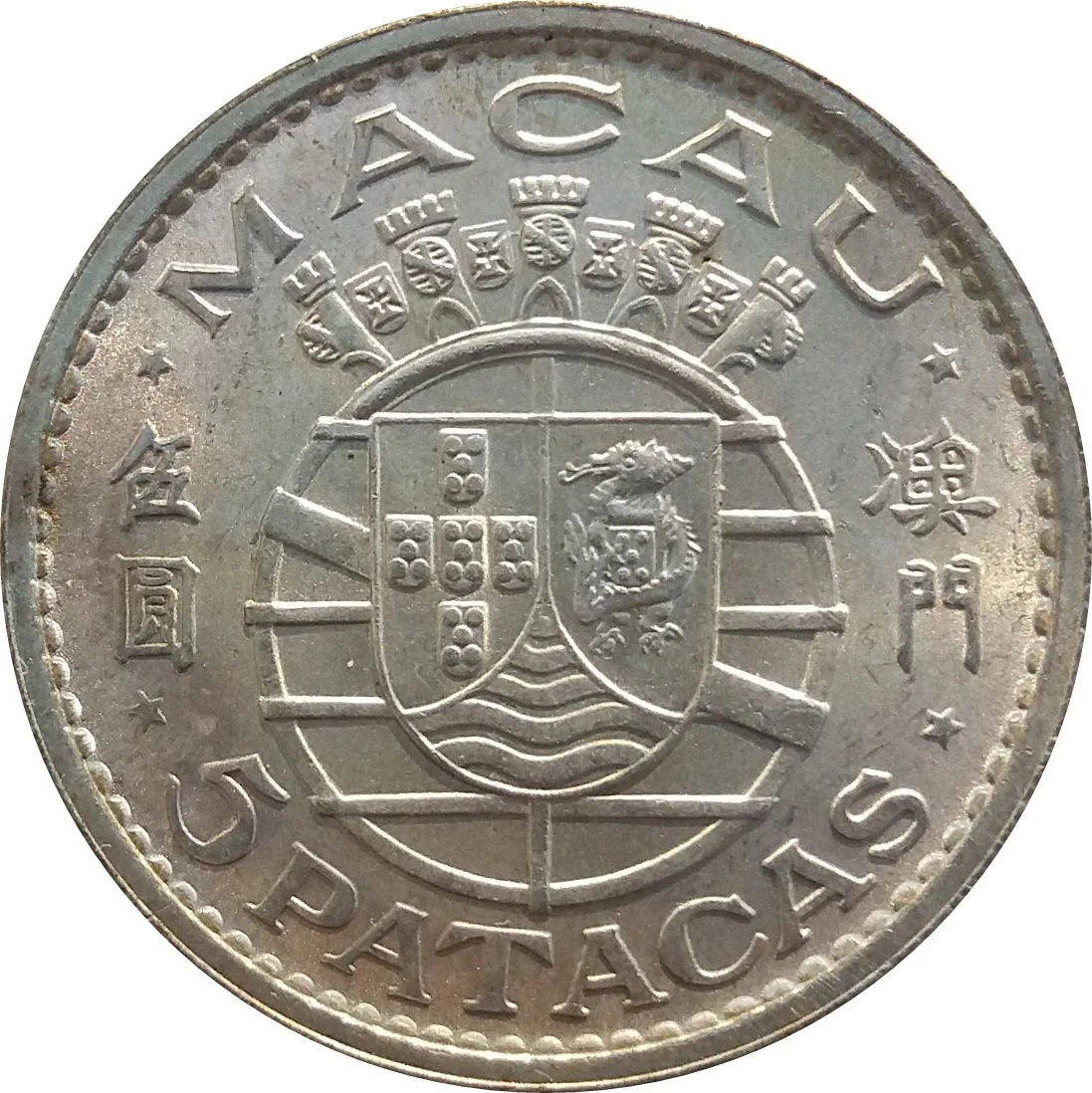
Obverse
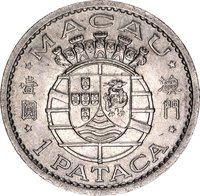
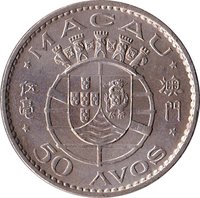
Description:
Portuguese shield on globe with cross.
Inscription:
MACAU
5 PATACAS
5 PATACAS
Translation:
MACAU
5 PATACAS
5 PATACAS
Languages: Portuguese, Chinese
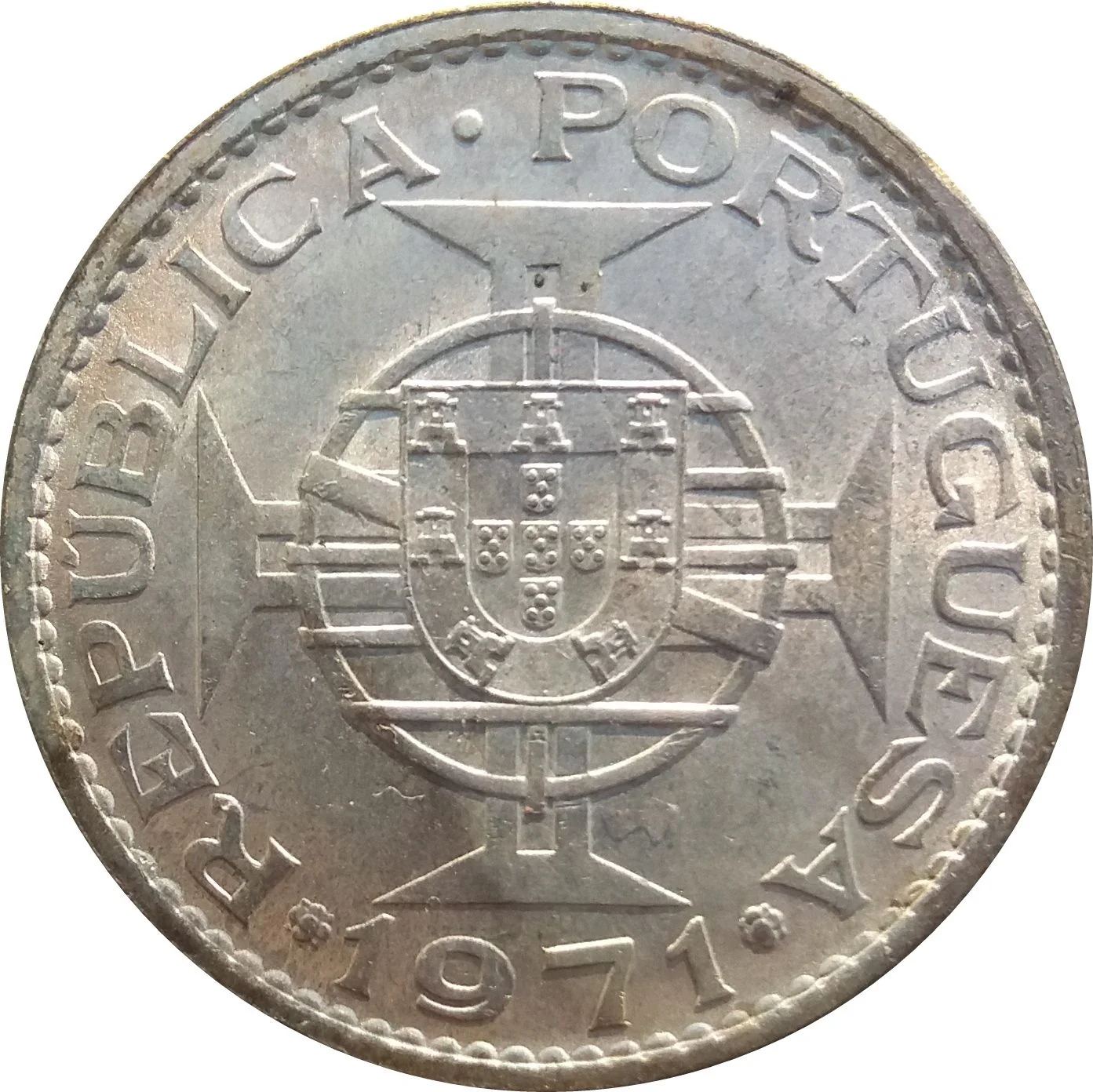
Reverse
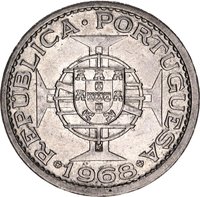
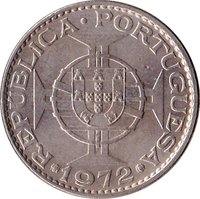
Description:
Crowned globe with arms of Portuguese Macau between stars, value below.
Inscription:
REPUBLICA PORTUGUESA
1971
1971
Translation:
Portuguese Republic
1971
1971
Language: Portuguese
Edge
Reeded
Mintings
| Year | Mint Mark | Mintage | Quality | Collection |
|---|---|---|---|---|
| 1971 | — | 500,000 |
Historical background
In 1971, Macau's currency situation was defined by its status as a Portuguese-administered territory adjacent to the Portuguese escudo zone but deeply integrated into the regional economy of Southeast China and Hong Kong. The official currency was the Macau pataca (MOP), which was issued by two privately-owned, Portuguese-chartered banks: the Banco Nacional Ultramarino (BNU) and, from 1971 onward, the Banco da China (Bank of China). This dual-issuance system, unique for the time, reflected Macau's complex political and economic positioning—formally under Portuguese administration but with growing economic ties and deference to China, especially following the 1966-67 riots that solidified Beijing's influence.
The pataca itself was not a strong, independent currency but was pegged to the Portuguese escudo at a fixed rate of 1 pataca to 5 escudos. However, this official peg was largely symbolic for international trade and did not reflect the reality of daily commerce. In practice, the Hong Kong dollar (HKD) was the dominant medium for business, tourism, and high-value transactions, circulating widely and often preferred due to Hong Kong's role as a major financial hub. The pataca's stability and acceptance were therefore indirectly underpinned by its unofficial, market-driven link to the Hong Kong dollar, with a fairly stable exchange rate of approximately 1.075 patacas to 1 Hong Kong dollar.
The global monetary upheaval of 1971, particularly the collapse of the Bretton Woods system and the US dollar's devaluation, indirectly affected Macau. While the pataca's formal peg to the escudo remained, the escudo itself was destabilized, further eroding confidence in the official arrangement. This reinforced the market's reliance on the Hong Kong dollar, which itself was pegged to the US dollar after 1972. Consequently, Macau's monetary system in 1971 was in a state of functional duality: a colonial-era official structure of declining relevance, and a de facto dollarized economy increasingly oriented toward its British neighbor and, through it, the global market.
The pataca itself was not a strong, independent currency but was pegged to the Portuguese escudo at a fixed rate of 1 pataca to 5 escudos. However, this official peg was largely symbolic for international trade and did not reflect the reality of daily commerce. In practice, the Hong Kong dollar (HKD) was the dominant medium for business, tourism, and high-value transactions, circulating widely and often preferred due to Hong Kong's role as a major financial hub. The pataca's stability and acceptance were therefore indirectly underpinned by its unofficial, market-driven link to the Hong Kong dollar, with a fairly stable exchange rate of approximately 1.075 patacas to 1 Hong Kong dollar.
The global monetary upheaval of 1971, particularly the collapse of the Bretton Woods system and the US dollar's devaluation, indirectly affected Macau. While the pataca's formal peg to the escudo remained, the escudo itself was destabilized, further eroding confidence in the official arrangement. This reinforced the market's reliance on the Hong Kong dollar, which itself was pegged to the US dollar after 1972. Consequently, Macau's monetary system in 1971 was in a state of functional duality: a colonial-era official structure of declining relevance, and a de facto dollarized economy increasingly oriented toward its British neighbor and, through it, the global market.
🌱 Fairly Common