

50 Avos – Macau
China
Context
Material
References
KM: #Click to copy to clipboard7
Numista: #2943
Value
Exchange value: 0.50 MOP
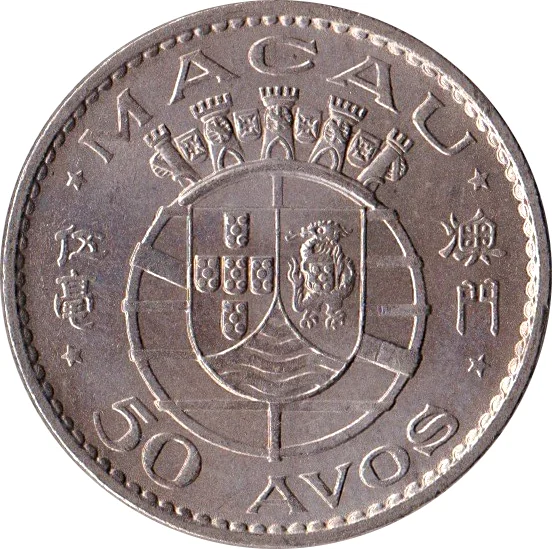
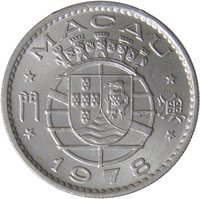
Obverse
Description:
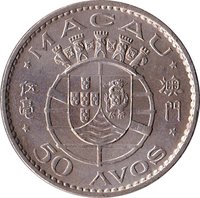
Macau's coat of arms legend in Portuguese and Cantonese.
Inscription:
* MACAU *
伍 澳
毫 門
* 50 AVOS *
伍 澳
毫 門
* 50 AVOS *
Translation:
* MACAU *
Fifty Avos Macao
* 50 AVOS *
Fifty Avos Macao
* 50 AVOS *
Languages: Portuguese, Chinese
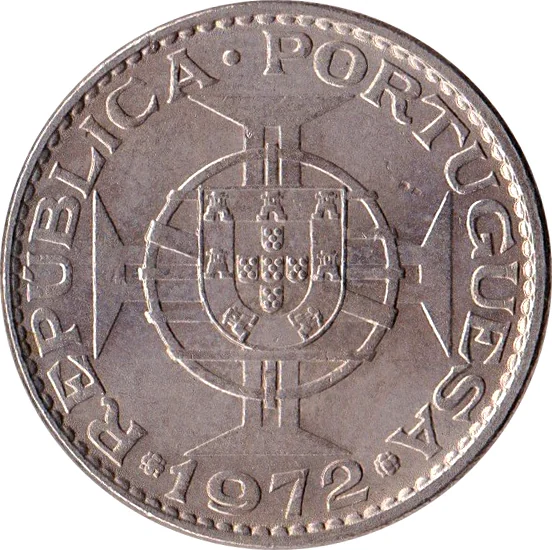
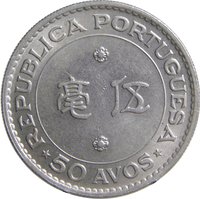
Reverse
Inscription:
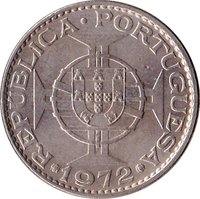
REPUBLICA · PORTUGUESA
*1972*
*1972*
Translation:
PORTUGUESE REPUBLIC
*1972*
*1972*
Language: Portuguese
Edge
Reeded
Mints
| Name | Mark |
|---|---|
| Imprensa Nacional - Casa da Moeda | — |
Mintings
| Year | Mint Mark | Mintage | Quality | Collection |
|---|---|---|---|---|
| 1972 | — | 1,600,000 | ||
| 1973 | — | 4,840,000 |
Historical background
In 1972, Macau's currency situation was defined by its unique colonial status and economic ties. As a Portuguese-administered territory, the official currency was the Macau pataca (MOP), which had been issued by two designated commercial banks—Banco Nacional Ultramarino and, later, the Banco da China—since the 1950s. However, the pataca's circulation and stability were not autonomous; it was pegged to the Portuguese escudo at a fixed rate. This link reflected Macau's political subordination to Lisbon but was increasingly misaligned with its economic reality, as trade and financial interactions with neighbouring Hong Kong and Mainland China far outweighed those with Portugal.
Economically, the pataca coexisted with and was often overshadowed by the Hong Kong dollar (HKD). Due to the sheer volume of cross-border trade, tourism, and investment, the Hong Kong dollar was widely accepted and even preferred for many transactions, especially in larger businesses and the nascent casino industry. This created a de facto dual-currency system where the Hong Kong dollar served as a parallel and more trusted medium of exchange and store of value, undermining the pataca's dominance in its own market.
The year 1972, however, marked a pivotal shift. Following the collapse of the Bretton Woods system and the float of major currencies, Portugal re-pegged the escudo to the US dollar. Consequently, on December 27, 1972, Macau officially severed the pataca's link to the escudo and re-pegged it directly to the Hong Kong dollar at a rate of 1.075 patacas to 1 Hong Kong dollar. This decisive move acknowledged Macau's true economic sphere of influence, aligning its monetary policy with Hong Kong's robust and stable currency, and laid the foundation for the modern pataca's stability, which continues to be backed by Hong Kong dollar reserves.
Economically, the pataca coexisted with and was often overshadowed by the Hong Kong dollar (HKD). Due to the sheer volume of cross-border trade, tourism, and investment, the Hong Kong dollar was widely accepted and even preferred for many transactions, especially in larger businesses and the nascent casino industry. This created a de facto dual-currency system where the Hong Kong dollar served as a parallel and more trusted medium of exchange and store of value, undermining the pataca's dominance in its own market.
The year 1972, however, marked a pivotal shift. Following the collapse of the Bretton Woods system and the float of major currencies, Portugal re-pegged the escudo to the US dollar. Consequently, on December 27, 1972, Macau officially severed the pataca's link to the escudo and re-pegged it directly to the Hong Kong dollar at a rate of 1.075 patacas to 1 Hong Kong dollar. This decisive move acknowledged Macau's true economic sphere of influence, aligning its monetary policy with Hong Kong's robust and stable currency, and laid the foundation for the modern pataca's stability, which continues to be backed by Hong Kong dollar reserves.
🌱 Common