

Obverse
Description:
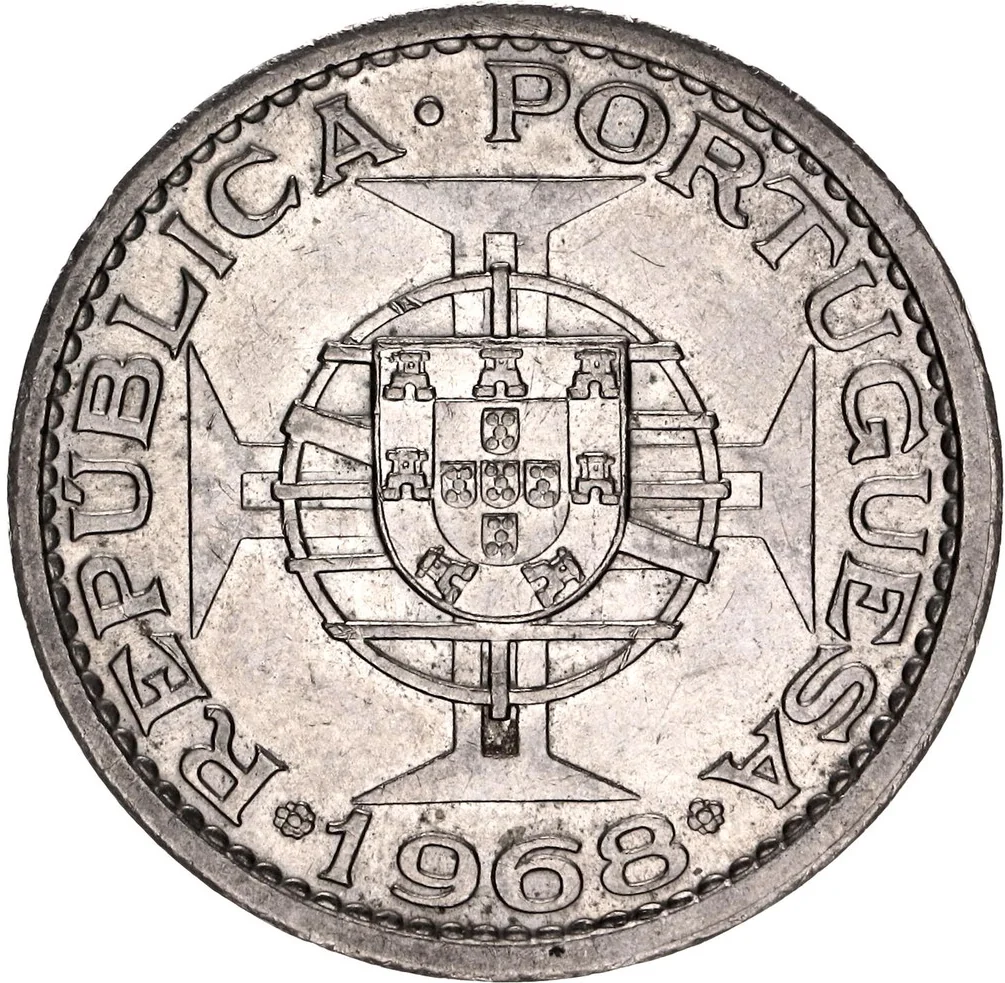
Portuguese shield on globe with cross.
Inscription:
REPUBLICA · PORTUGUESA
*1968*
*1968*
Translation:
PORTUGUESE REPUBLIC
*1968*
*1968*
Script: Latin
Languages: Latin, Portuguese
Reverse
Description:
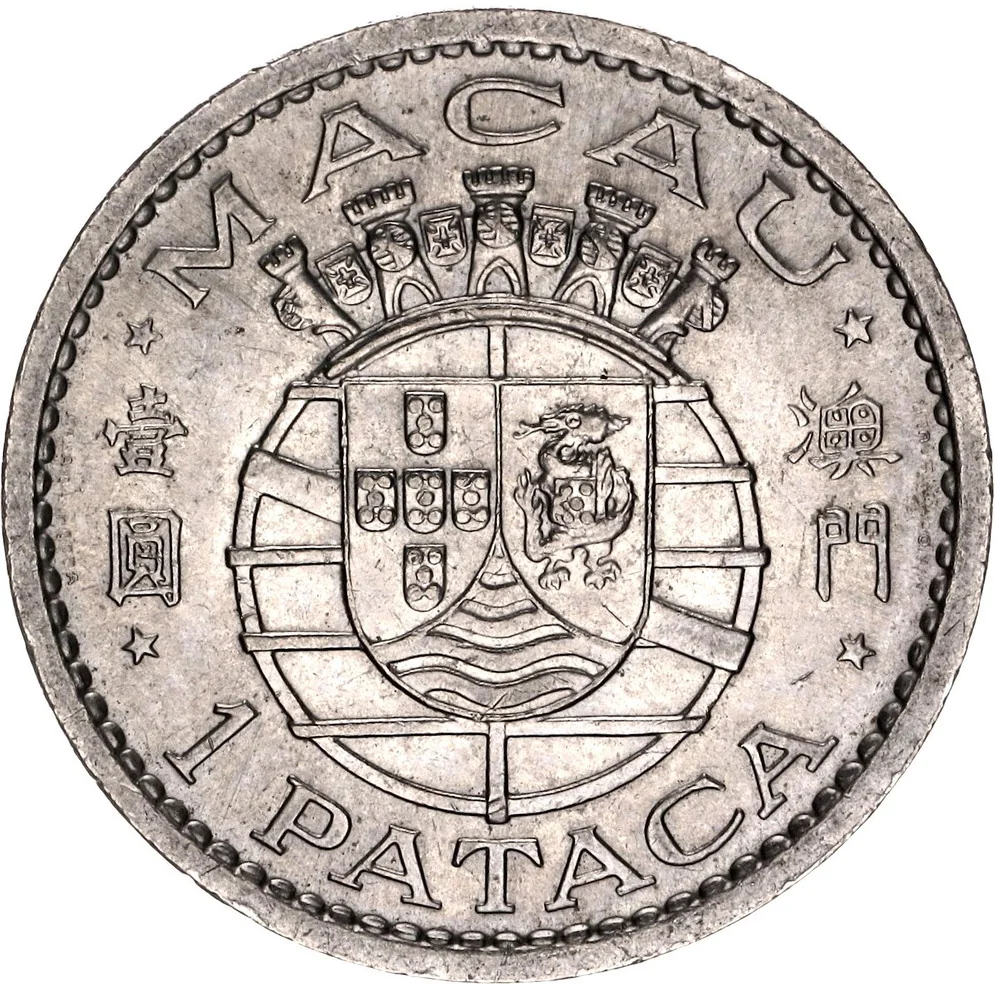
Crowned globe with arms of Portuguese Macau between stars, value below.
Inscription:
* MACAU *
壹圓
澳門
* 1 PATACA *
壹圓
澳門
* 1 PATACA *
Translation:
One Dollar
Macau
* 1 Pataca *
Macau
* 1 Pataca *
Languages: Portuguese, Chinese
Edge
Plain
Mintings
| Year | Mint Mark | Mintage | Quality | Collection |
|---|---|---|---|---|
| 1968 | — | 5,000,000 | ||
| 1975 | — | 6,000,000 |
Historical background
In 1968, Macau's currency situation was defined by its unique colonial status and regional economic ties. As a Portuguese-administered territory, the official currency was the Macanese pataca (MOP), which had been pegged to the Portuguese escudo since 1906. However, the escudo's own instability and Portugal's economic struggles diminished its role as a reliable anchor. In practice, the pataca's daily value and utility were sustained not by Lisbon, but by a fixed, unofficial peg to the Hong Kong dollar, facilitated by the Banco Nacional Ultramarino, Macau's note-issuing bank.
The Hong Kong dollar's dominance was the true cornerstone of Macau's monetary stability. Given Macau's small, open economy and deep commercial and social links with Hong Kong, the Hong Kong dollar circulated widely and was often preferred for larger transactions and savings. This unofficial dual-currency system provided a crucial buffer, insulating Macau's economy from the volatility of the Portuguese escudo and linking it to the more robust and internationally connected British sterling area, to which the Hong Kong dollar was itself pegged.
Economically, 1968 fell within a period of transition for Macau, as its traditional gambling and tourism industries began a slow modernization. The currency stability provided by the Hong Kong dollar link was essential for this development, fostering commercial confidence. Consequently, while the pataca remained the legal tender, the monetary reality was one of dependency on Hong Kong, a arrangement that foreshadowed the formal re-peg of the pataca to the Hong Kong dollar in 1977.
The Hong Kong dollar's dominance was the true cornerstone of Macau's monetary stability. Given Macau's small, open economy and deep commercial and social links with Hong Kong, the Hong Kong dollar circulated widely and was often preferred for larger transactions and savings. This unofficial dual-currency system provided a crucial buffer, insulating Macau's economy from the volatility of the Portuguese escudo and linking it to the more robust and internationally connected British sterling area, to which the Hong Kong dollar was itself pegged.
Economically, 1968 fell within a period of transition for Macau, as its traditional gambling and tourism industries began a slow modernization. The currency stability provided by the Hong Kong dollar link was essential for this development, fostering commercial confidence. Consequently, while the pataca remained the legal tender, the monetary reality was one of dependency on Hong Kong, a arrangement that foreshadowed the formal re-peg of the pataca to the Hong Kong dollar in 1977.
🌱 Very Common