

25 øre – Denmark
Add to wishlist
Denmark
Context
Years: 1948–1960
Issuer: Denmark
Ruler: Frederick IX
Currency:
(since 1873)
Demonetization: 30 September 2008
Total mintage: 91,874,850
Material
References
KM: #
Numista: #1412
Value
Exchange value: 0.25 DKK
Obverse
Description:
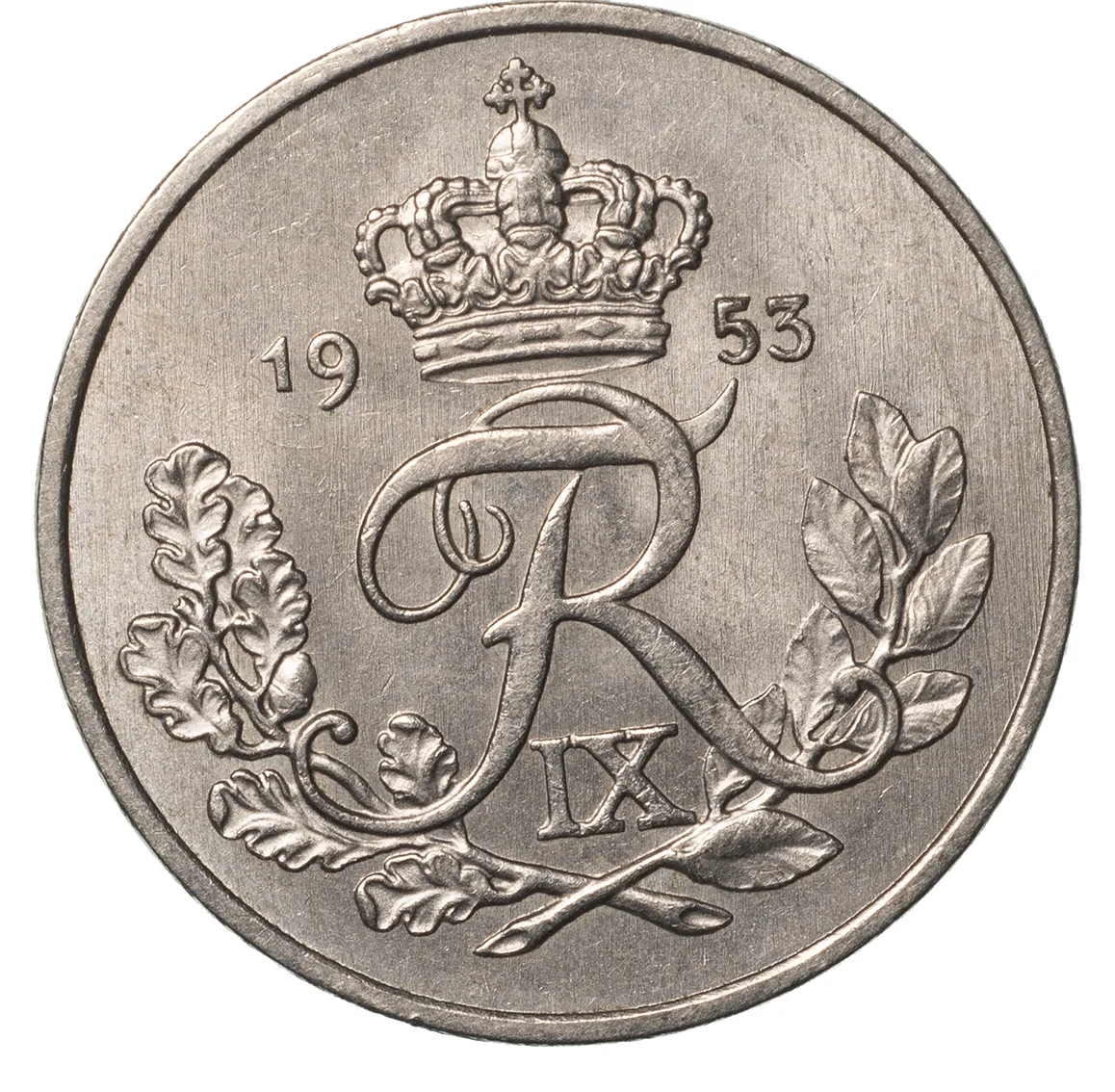
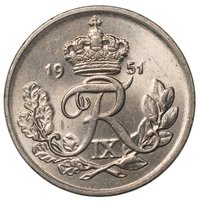
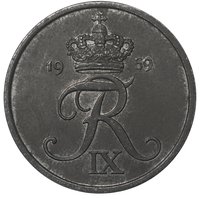
Crowned monogram of Frederik IX framed by oak and beech twigs.
Inscription:
FR IX 1951
Script: Latin
Reverse
Description:
Valuable
Inscription:
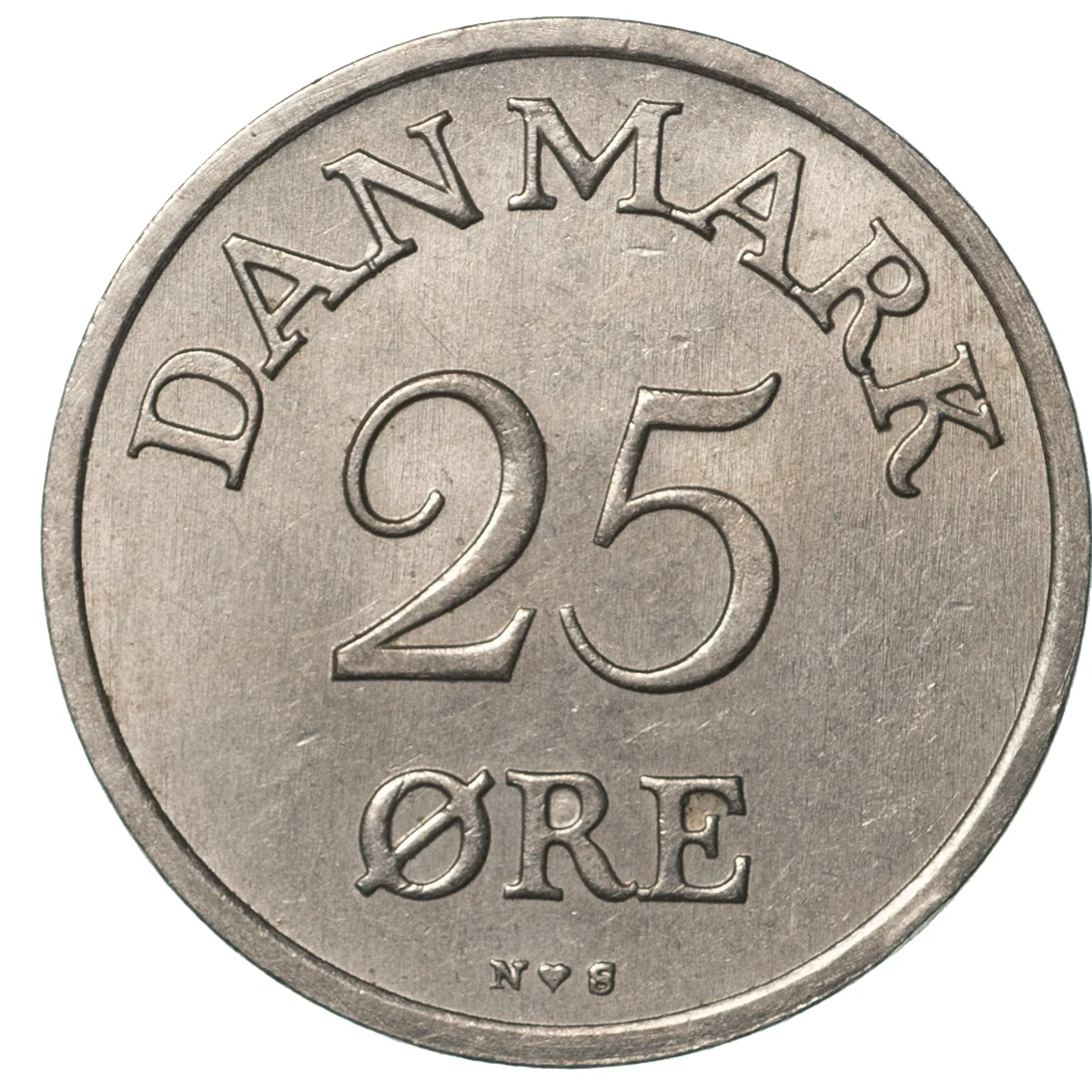
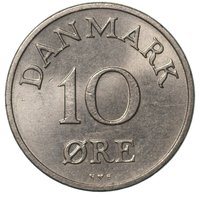
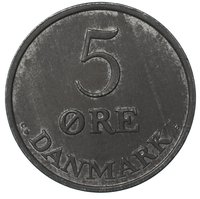
DANMARK 25 ØRE
N ♥ S
N ♥ S
Translation:
DENMARK 25 ØRE
N ♥ S
N ♥ S
Script: Latin
Engraver: H. Salomon
Edge
Plain
Mints
| Name | Mark |
|---|---|
| Royal Danish Mint | — |
Mintings
| Year | Mint Mark | Mintage | Quality | Collection |
|---|---|---|---|---|
| 1948 | N♥S | 1,852,926 | ||
| 1949 | N♥S | 15,000,165 | ||
| 1950 | N♥S | 13,771,162 | ||
| 1951 | N♥S | 5,045,336 | ||
| 1952 | N♥S | 2,017,759 | ||
| 1953 | N♥S | 9,553,390 | ||
| 1954 | N♥S | 11,337,408 | ||
| 1955 | N♥S | 6,384,790 | ||
| 1956 | C♥S | 10,228,227 | ||
| 1957 | C♥S | 7,420,607 | ||
| 1958 | C♥S | 3,599,643 | ||
| 1959 | C♥S | 2,210,877 | ||
| 1960 | C♥S | 3,452,560 |
Historical background
In the aftermath of World War II, Denmark, like much of Europe, faced severe economic strain and a critical shortage of foreign currency, particularly US dollars. The country's reserves were depleted, and its economy was burdened by a large trade deficit and a substantial national debt. This situation was exacerbated by the requirements of postwar reconstruction and the pressing need to import essential goods like fuel, raw materials, and machinery, which were primarily purchased with hard currency. Denmark was thus operating within a complex web of bilateral trade agreements and strict exchange controls to conserve its limited reserves.
The currency situation came to a head in 1948 with the implementation of the "Trekantsaftalen" (The Triangular Agreement), a pivotal arrangement negotiated with the United States and the United Kingdom. The core of the deal was a $130 million loan from the US, which was not granted as direct cash but as "conditional aid." These funds were specifically earmarked to finance Danish imports of essential American goods, thereby stimulating industrial recovery without draining Denmark's own dollar holdings. In return, Denmark committed to using its sterling earnings from exports to Britain to help finance the British zone of occupation in Germany.
This agreement provided immediate relief and was a crucial step in stabilizing Denmark's external accounts. It effectively integrated Denmark into the emerging Western European economic structure under the US-led Marshall Plan (ERP), which began disbursing funds that same year. The 1948 measures did not instantly resolve all monetary issues, but they provided the breathing room and hard currency inflow necessary for gradual recovery, setting the stage for the eventual liberalization of trade and the establishment of the modern Danish welfare state economy in the 1950s.
The currency situation came to a head in 1948 with the implementation of the "Trekantsaftalen" (The Triangular Agreement), a pivotal arrangement negotiated with the United States and the United Kingdom. The core of the deal was a $130 million loan from the US, which was not granted as direct cash but as "conditional aid." These funds were specifically earmarked to finance Danish imports of essential American goods, thereby stimulating industrial recovery without draining Denmark's own dollar holdings. In return, Denmark committed to using its sterling earnings from exports to Britain to help finance the British zone of occupation in Germany.
This agreement provided immediate relief and was a crucial step in stabilizing Denmark's external accounts. It effectively integrated Denmark into the emerging Western European economic structure under the US-led Marshall Plan (ERP), which began disbursing funds that same year. The 1948 measures did not instantly resolve all monetary issues, but they provided the breathing room and hard currency inflow necessary for gradual recovery, setting the stage for the eventual liberalization of trade and the establishment of the modern Danish welfare state economy in the 1950s.
Series: 1948 Denmark circulation coins
🌱 Very Common