

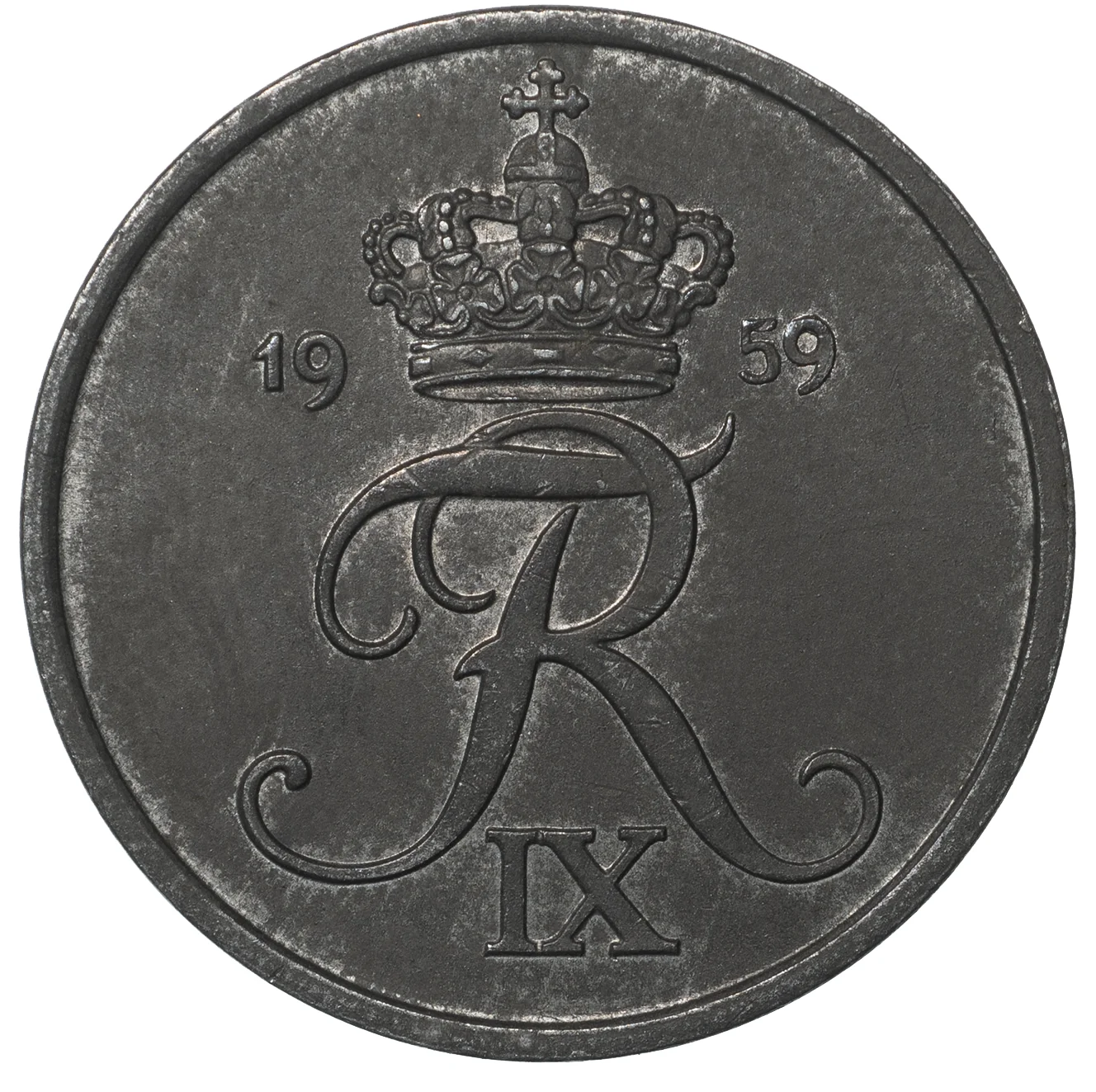
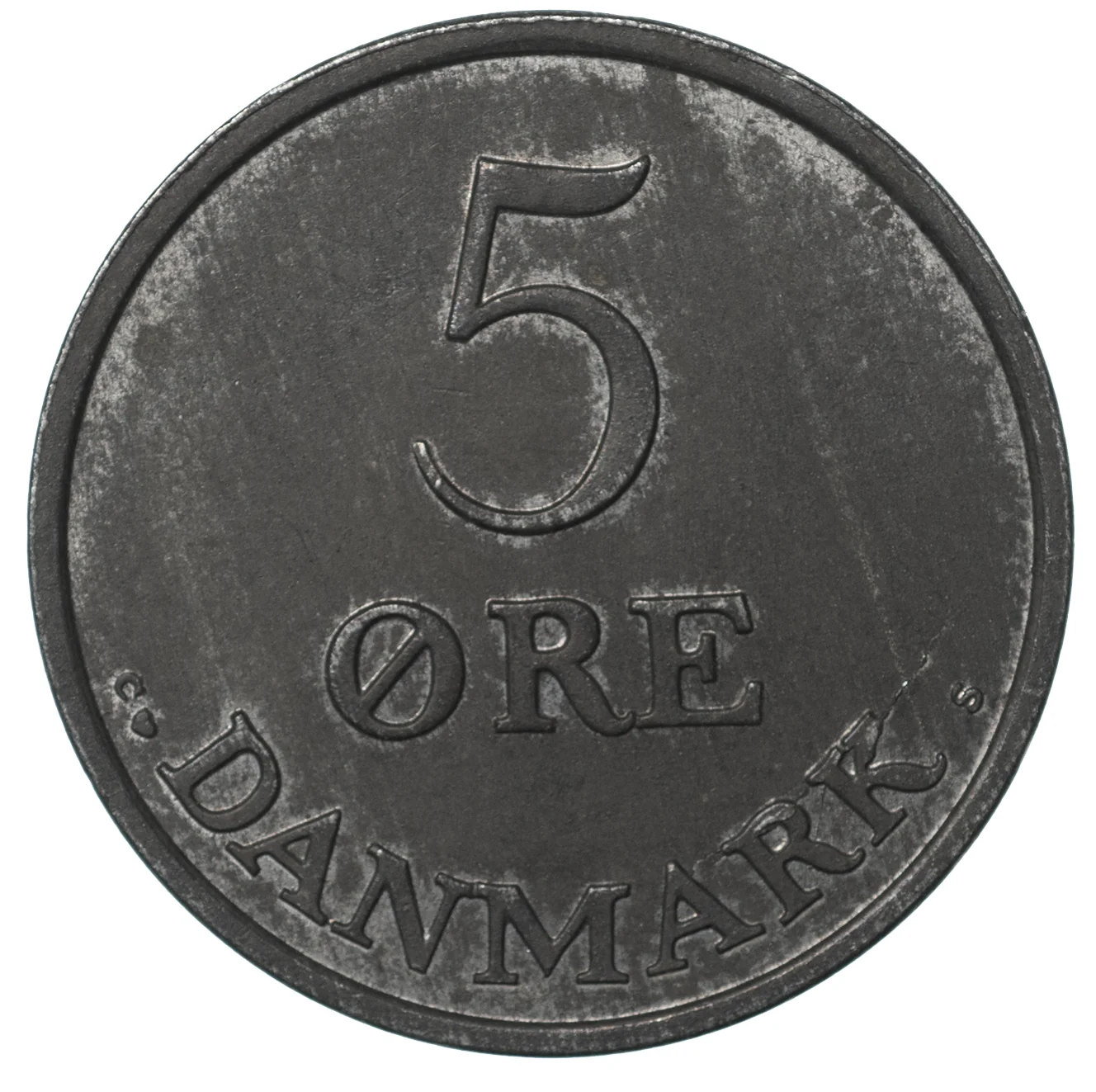
5 øre – Denmark
Add to wishlist
Denmark
Context
Years: 1950–1964
Issuer: Denmark
Ruler: Frederick IX
Currency:
(since 1873)
Demonetization: 30 June 1989
Total mintage: 93,840,307
Material
References
KM: #
Numista: #1409
Value
Exchange value: 0.05 DKK
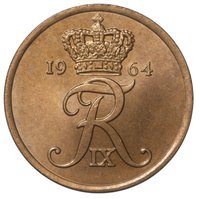
Obverse
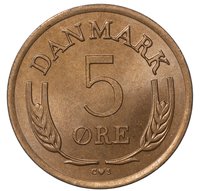
Reverse
Edge
Plain
Mints
| Name | Mark |
|---|---|
| Royal Danish Mint | (♥) |
Mintings
| Year | Mint Mark | Mintage | Quality | Collection |
|---|---|---|---|---|
| 1950 | N♥;S | 656,989 | ||
| 1951 | N♥;S | 1,858,091 | ||
| 1952 | N♥;S | 3,562,286 | ||
| 1953 | N♥;S | 5,944,297 | ||
| 1954 | N♥;S | 3,060,203 | ||
| 1955 | N♥;S | 2,313,991 | ||
| 1956 | C♥;S | 5,887,938 | ||
| 1957 | C♥;S | 8,606,231 | ||
| 1958 | C♥;S | 9,598,158 | ||
| 1959 | C♥;S | 6,110,278 | ||
| 1960 | C♥;S | 11,799,585 | ||
| 1961 | C♥;S | 8,995,127 | ||
| 1962 | C♥;S | 9,729,220 | ||
| 1963 | C♥;S | 8,980,040 | ||
| 1964 | C♥;S | 6,737,873 |
Historical background
In 1950, Denmark's currency situation was defined by its participation in the Bretton Woods system, which pegged the Danish krone (DKK) to the US dollar at a fixed rate of 4.79 kroner per dollar. This arrangement, established in the late 1940s, provided much-needed monetary stability after the turbulence of the interwar period and World War II. However, this stability came with constraints; Denmark had to maintain sufficient dollar reserves and adjust its domestic monetary policy to defend the peg, limiting its ability to use independent currency devaluation as a tool for economic adjustment.
The post-war Danish economy was characterized by reconstruction, a persistent trade deficit, and strict capital controls. The krone was not freely convertible, meaning its exchange for foreign currencies was heavily regulated by the central bank to prevent capital flight and conserve scarce foreign reserves, primarily dollars. These controls were essential for managing the balance of payments, as Denmark relied heavily on imports of raw materials and capital goods for its industrial and agricultural modernization, while its export sector, though strong in agriculture, was still recovering.
Overall, the 1950 krone was a managed currency in a tightly controlled financial environment. The fixed peg to the dollar under Bretton Woods provided a credible anchor for trade and investment, but it also meant Denmark's economic policy was significantly oriented towards maintaining external balance. This framework would shape Denmark's monetary landscape for the next two decades, until the pressures of the 1960s eventually led to a devaluation of the krone in 1967 and the system's collapse in the early 1970s.
The post-war Danish economy was characterized by reconstruction, a persistent trade deficit, and strict capital controls. The krone was not freely convertible, meaning its exchange for foreign currencies was heavily regulated by the central bank to prevent capital flight and conserve scarce foreign reserves, primarily dollars. These controls were essential for managing the balance of payments, as Denmark relied heavily on imports of raw materials and capital goods for its industrial and agricultural modernization, while its export sector, though strong in agriculture, was still recovering.
Overall, the 1950 krone was a managed currency in a tightly controlled financial environment. The fixed peg to the dollar under Bretton Woods provided a credible anchor for trade and investment, but it also meant Denmark's economic policy was significantly oriented towards maintaining external balance. This framework would shape Denmark's monetary landscape for the next two decades, until the pressures of the 1960s eventually led to a devaluation of the krone in 1967 and the system's collapse in the early 1970s.
🌱 Very Common