

2 euro (Sovereignty) – Monaco
Add to wishlist
Circulating commemorative coins
Commemoration: 500th Anniversary of Sovereignity
Monaco
Obverse
Description:
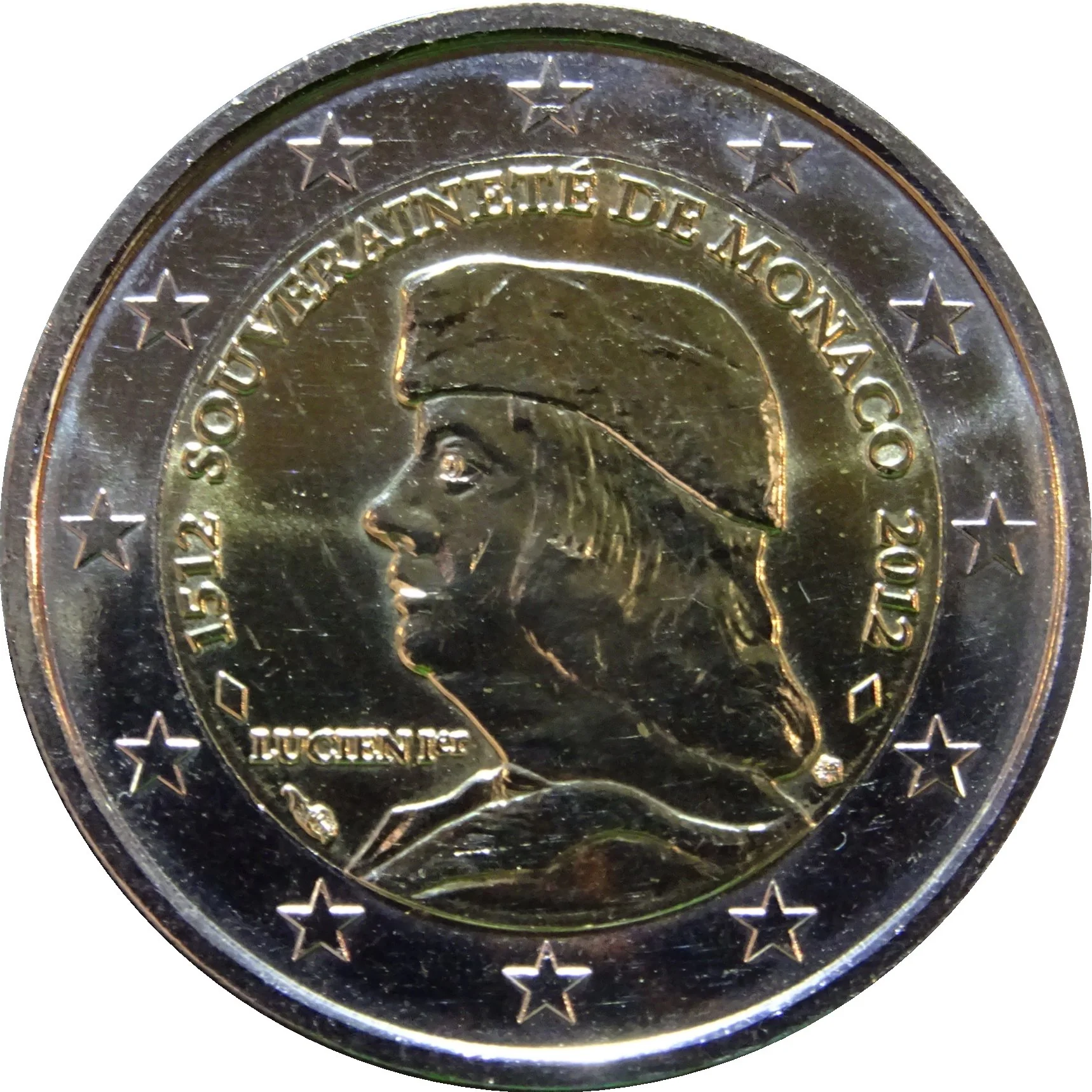
The inner coin features a left-profile portrait of Lucien I Grimaldi, encircled by the arched inscription “1512 SOUVERAINETE DE MONACO 2012” and flanked by two diamonds. Below the portrait are the horn of plenty mintmark and the “fleurette” hallmark, with “Lucien Ier” above the mintmark. The outer ring displays the 12 stars of the European Union.
Inscription:
1512 SOUVERAINETÉ DE MONACO 2012
LUCIEN 1er
LUCIEN 1er
Translation:
1512 SOVEREIGNTY OF MONACO 2012
LUCIEN THE 1ST
LUCIEN THE 1ST
Script: Latin
Language: French
Engraver: Robert Prat
Reverse
Edge
Reeded with inscription
Legend:
2 ** 2 ** 2 ** 2 ** 2 ** 2 **
Mints
| Name | Mark |
|---|---|
| Monnaie de Paris | — |
Mintings
| Year | Mint Mark | Mintage | Quality | Collection |
|---|---|---|---|---|
| 2012 | — | 100,000 | ||
| 2012 | — | 10,000 | Proof |
Historical background
In 2012, Monaco's currency situation was fundamentally defined by its use of the euro as its sole legal tender, a status formalized through a monetary agreement with the European Union. This agreement, initially signed in 2001 and reaffirmed in 2011, granted Monaco the unique right to issue its own euro coins (with Monegasque national designs on the reverse) while ceding authority over monetary policy to the European Central Bank. Consequently, the principality was fully integrated into the Eurozone's monetary system, benefiting from currency stability and seamless financial transactions with its largest neighbors, France and Italy, which were crucial for its tourism and banking sectors.
The year 2012, however, unfolded against the tense backdrop of the Eurozone debt crisis, which posed an indirect but significant contextual challenge. While Monaco's sovereign finances were robust, the crisis threatened the broader economic stability of the region upon which the principality's economy depended. Concerns over the potential fragmentation of the Eurozone, though remote, highlighted Monaco's vulnerability to external monetary shocks despite its fiscal autonomy. Domestically, there were no currency shortages or exchange issues; the primary focus for financial authorities was ensuring continued compliance with the EU agreement and monitoring the external economic environment.
Furthermore, 2012 saw Monaco continuing to navigate the balance between its monetary integration and its status as a sovereign state. The use of the euro provided immense practical advantages, but it also meant that Monegasque monetary sovereignty was voluntarily limited. The principality's financial stability during this period was underpinned by its strong fiscal reserves and its niche, high-value economy, which insulated it from the worst of the regional downturn. Thus, the currency situation was one of embedded stability within the Eurozone framework, albeit with a watchful eye on the systemic risks unfolding elsewhere in Europe.
The year 2012, however, unfolded against the tense backdrop of the Eurozone debt crisis, which posed an indirect but significant contextual challenge. While Monaco's sovereign finances were robust, the crisis threatened the broader economic stability of the region upon which the principality's economy depended. Concerns over the potential fragmentation of the Eurozone, though remote, highlighted Monaco's vulnerability to external monetary shocks despite its fiscal autonomy. Domestically, there were no currency shortages or exchange issues; the primary focus for financial authorities was ensuring continued compliance with the EU agreement and monitoring the external economic environment.
Furthermore, 2012 saw Monaco continuing to navigate the balance between its monetary integration and its status as a sovereign state. The use of the euro provided immense practical advantages, but it also meant that Monegasque monetary sovereignty was voluntarily limited. The principality's financial stability during this period was underpinned by its strong fiscal reserves and its niche, high-value economy, which insulated it from the worst of the regional downturn. Thus, the currency situation was one of embedded stability within the Eurozone framework, albeit with a watchful eye on the systemic risks unfolding elsewhere in Europe.
🌱 Common