

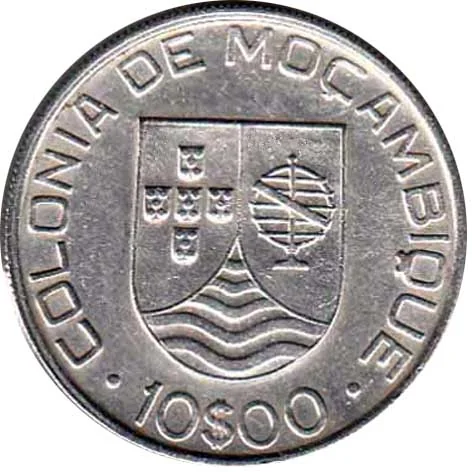
10 escudos – Mozambique
Add to wishlist
Mozambique
Context
Year: 1936
Issuer: Mozambique
Period:
(1910—1951)
Currency:
(1911—1974)
Demonetized: Yes
Total mintage: 497,000
Material
References
KM: #
Numista: #14046
Value
Bullion value: $26.20
Obverse
Description:
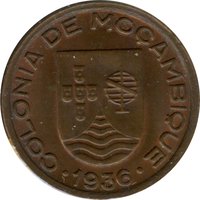
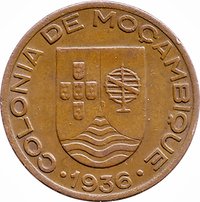
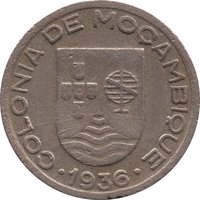
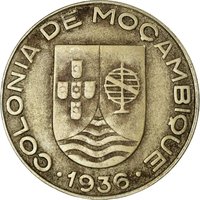
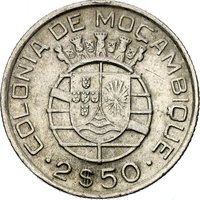
Portuguese Mozambique coat of arms, value below.
Inscription:
COLONIA DE MOÇAMBIQUE
10$00
10$00
Translation:
Colony of Mozambique
10$00
10$00
Script: Latin
Language: Portuguese
Reverse
Description:
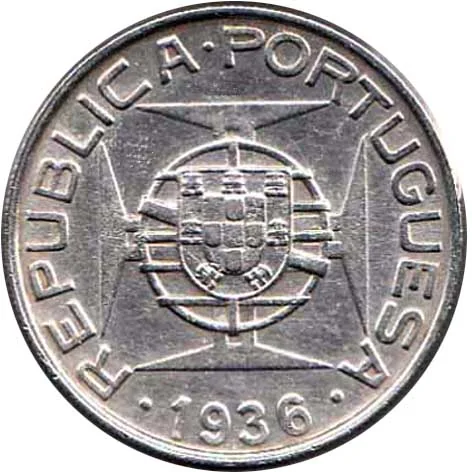
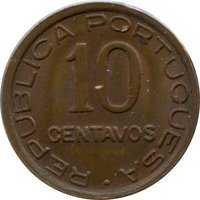
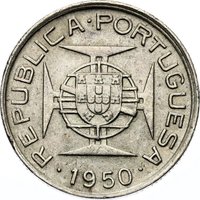
Globe with shield and Maltese cross.
Inscription:
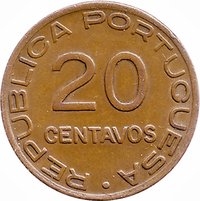
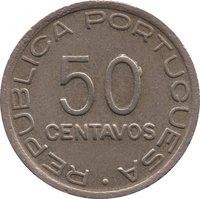
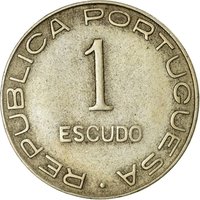
REPUBLICA · PORTUGUESA
1938
1938
Translation:
Portuguese Republic
1938
1938
Script: Latin
Language: Portuguese
Edge
Mints
| Name | Mark |
|---|---|
| Imprensa Nacional - Casa da Moeda | — |
Mintings
| Year | Mint Mark | Mintage | Quality | Collection |
|---|---|---|---|---|
| 1936 | — | 497,000 |
Historical background
In 1936, Mozambique's currency situation was fundamentally defined by its status as a Portuguese colony, integrated into the wider monetary system of the Portuguese Empire. The official currency was the Portuguese escudo, which had replaced the real in 1914. Mozambique did not issue its own distinct banknotes or coins; instead, it used the same metropolitan currency, though supplemented by notes from the Banco Nacional Ultramarino (BNU), which acted as the central bank for Portugal's overseas territories. These BNU notes, while legally equivalent to those circulating in Lisbon, were physically distinct and marked for use in Mozambique, ensuring colonial financial control remained firmly in Lisbon's hands.
The economy was heavily oriented towards supporting Portugal's interests, with currency policy designed to facilitate the extraction of agricultural and mineral resources. The escudo was pegged to the gold standard, but its value and stability were intrinsically linked to the often-fragile Portuguese economy. Internally, the monetary economy was largely confined to the coastal cities, plantations (prazo systems), and areas around major infrastructure projects, while much of the rural population continued to engage in subsistence farming and local barter, remaining on the periphery of the formal colonial cash economy.
This period also saw the increasing influence of neighbouring British economic interests, particularly from Southern Rhodesia and South Africa, in the colony's mining and railway sectors. While the Portuguese escudo was legally dominant, sterling and South African pounds held considerable practical importance in cross-border trade and within certain commercial enclaves. This created a de facto, though unofficial, multi-currency environment in key business sectors, highlighting the tension between Lisbon's strict monetary sovereignty and the gravitational pull of the stronger British-backed economies in the region.
The economy was heavily oriented towards supporting Portugal's interests, with currency policy designed to facilitate the extraction of agricultural and mineral resources. The escudo was pegged to the gold standard, but its value and stability were intrinsically linked to the often-fragile Portuguese economy. Internally, the monetary economy was largely confined to the coastal cities, plantations (prazo systems), and areas around major infrastructure projects, while much of the rural population continued to engage in subsistence farming and local barter, remaining on the periphery of the formal colonial cash economy.
This period also saw the increasing influence of neighbouring British economic interests, particularly from Southern Rhodesia and South Africa, in the colony's mining and railway sectors. While the Portuguese escudo was legally dominant, sterling and South African pounds held considerable practical importance in cross-border trade and within certain commercial enclaves. This created a de facto, though unofficial, multi-currency environment in key business sectors, highlighting the tension between Lisbon's strict monetary sovereignty and the gravitational pull of the stronger British-backed economies in the region.
🌟 Uncommon