

5 Pence – Ireland
Ireland
Context
Years: 1992–2000
Issuer: Ireland 
Period:
(since 1937)
Currency:
(1971—2001)
Demonetization: 9 February 2002
Total mintage: 489,153,000
Material
Diameter: 18.5 mm
Weight: 3.25 g
Thickness: 1.67 mm
Shape: Round
Composition: Copper-nickel
Technique: Milled
Alignment: Medal alignment
flip
References
KM: #Click to copy to clipboard28
Numista: #1404
Value
Exchange value: 0.05 IEP
Inflation-adjusted value: 0.10 IEP
Obverse
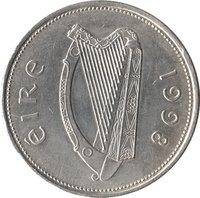
Description:
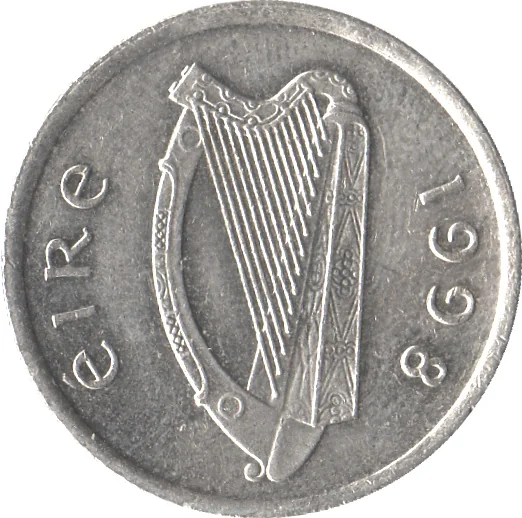
Irish harp, country name left, date right.
Inscription:
éIRe 1998
Translation:
Ireland 1998
Script: Latin (Gaelic)
Reverse
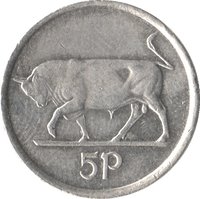
Description:
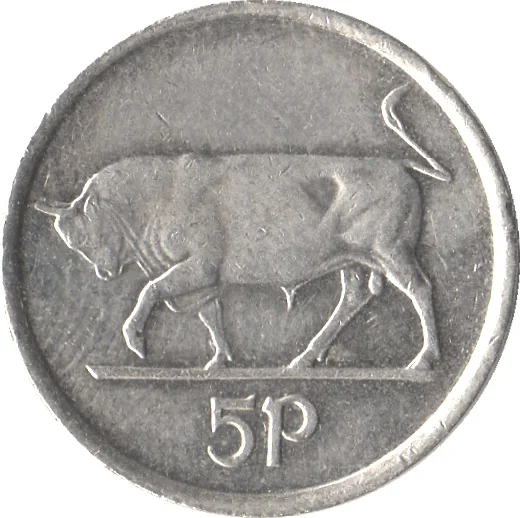
Left-facing bull's value.
Inscription:
5P
Script: Latin (Gaelic)
Engraver: Percy Metcalfe
Edge
Reeded
Mints
| Name | Mark |
|---|---|
| Irish Mint | — |
Mintings
| Year | Mint Mark | Mintage | Quality | Collection |
|---|---|---|---|---|
| 1992 | — | 74,526,000 | ||
| 1993 | — | 89,109,000 | ||
| 1994 | — | 31,058,000 | ||
| 1995 | — | 14,667,000 | ||
| 1996 | — | 158,546,000 | ||
| 1998 | — | 63,247,000 | ||
| 2000 | — | 58,000,000 |
Historical background
In 1992, the currency situation in Ireland was defined by its pivotal role within the European Exchange Rate Mechanism (ERM), a system designed to reduce exchange rate variability and achieve monetary stability in preparation for Economic and Monetary Union (EMU). Ireland had joined the ERM in 1979, pegging the Irish pound (punt) not to sterling, as had been historically the case, but to the Deutsche Mark within the ERM's narrow fluctuation band of ±2.25%. This deliberate shift aligned Ireland's monetary policy more closely with the core of the European Community, particularly Germany, and was a strategic move to break from the inflationary influence of British economic policy.
However, this period was one of severe strain. The system came under immense pressure in 1992 due to divergent economic policies across Europe; notably, Germany's high interest rates, aimed at controlling post-reunification inflation, were unsuitable for other ERM members like the UK and Italy, which were in recession. Intense speculative attacks targeted currencies perceived as weak. While the UK and Italy were forced to withdraw their currencies from the ERM in September 1992 (on "Black Wednesday"), Ireland made a determined and costly defence of the punt's parity. The Central Bank of Ireland was compelled to impose emergency interest rate hikes, with the short-term rate briefly reaching an extraordinary 100% at one point, to deter speculators and maintain the ERM peg.
The defence succeeded in keeping the Irish pound within the ERM, but at a significant economic cost, exacerbating the domestic recession and unemployment. In a crucial adjustment in early 1993, the ERM bands were widened to ±15%, effectively devaluing the punt by 10% against the Deutsche Mark. This devaluation provided a vital boost to Irish export competitiveness, particularly with its largest trading partner, the UK, whose currency had depreciated sharply. The crisis of 1992-93 ultimately reinforced Ireland's commitment to the European monetary project, setting the stage for its eventual adoption of the euro in 1999, having proven its willingness to endure short-term pain for long-term integration.
However, this period was one of severe strain. The system came under immense pressure in 1992 due to divergent economic policies across Europe; notably, Germany's high interest rates, aimed at controlling post-reunification inflation, were unsuitable for other ERM members like the UK and Italy, which were in recession. Intense speculative attacks targeted currencies perceived as weak. While the UK and Italy were forced to withdraw their currencies from the ERM in September 1992 (on "Black Wednesday"), Ireland made a determined and costly defence of the punt's parity. The Central Bank of Ireland was compelled to impose emergency interest rate hikes, with the short-term rate briefly reaching an extraordinary 100% at one point, to deter speculators and maintain the ERM peg.
The defence succeeded in keeping the Irish pound within the ERM, but at a significant economic cost, exacerbating the domestic recession and unemployment. In a crucial adjustment in early 1993, the ERM bands were widened to ±15%, effectively devaluing the punt by 10% against the Deutsche Mark. This devaluation provided a vital boost to Irish export competitiveness, particularly with its largest trading partner, the UK, whose currency had depreciated sharply. The crisis of 1992-93 ultimately reinforced Ireland's commitment to the European monetary project, setting the stage for its eventual adoption of the euro in 1999, having proven its willingness to endure short-term pain for long-term integration.
🌱 Very Common