

10 Pence – Ireland
Ireland
Context
Years: 1993–2000
Issuer: Ireland 
Period:
(since 1937)
Currency:
(1971—2001)
Demonetization: 9 February 2002
Total mintage: 262,966,000
Material
Diameter: 22 mm
Weight: 5.45 g
Thickness: 1.9 mm
Shape: Round
Composition: Copper-nickel
Technique: Milled
Alignment: Medal alignment
flip
References
KM: #Click to copy to clipboard29
Numista: #1457
Value
Exchange value: 0.10 IEP
Inflation-adjusted value: 0.20 IEP
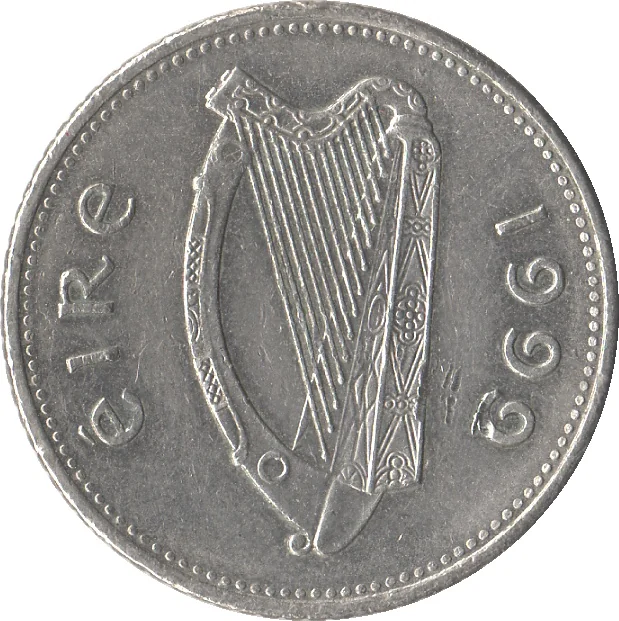
Obverse
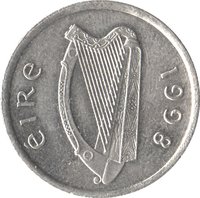
Description:
Celtic string instrument
Inscription:
éIRe 1999
Translation:
Ireland 1999
Script: Latin (Gaelic)
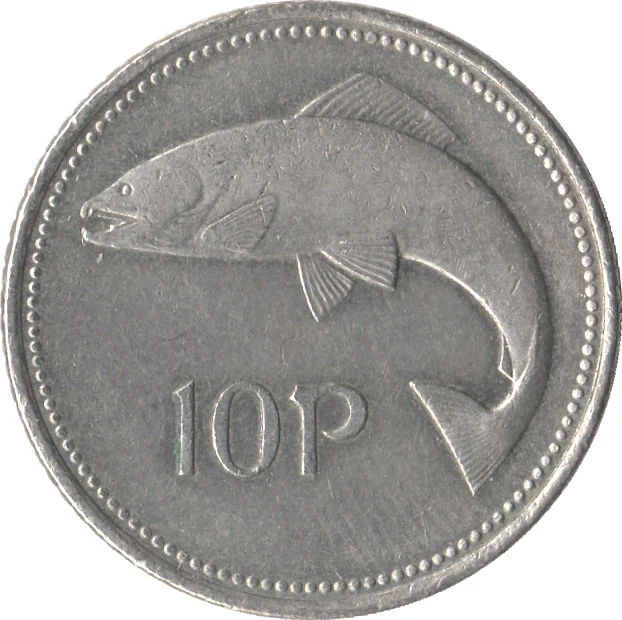
Reverse
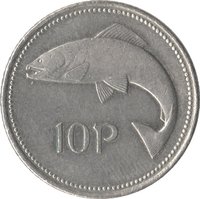
Description:
Salmon value (left)
Inscription:
10P
Translation:
Ten Pence
Script: Latin (Gaelic)
Language: Latin
Engraver: Percy Metcalfe
Edge
Reeded
Mints
| Name | Mark |
|---|---|
| Irish Mint | — |
Mintings
| Year | Mint Mark | Mintage | Quality | Collection |
|---|---|---|---|---|
| 1993 | — | 80,061,000 | ||
| 1994 | — | 58,510,000 | ||
| 1995 | — | 15,781,000 | ||
| 1996 | — | 18,402,000 | ||
| 1997 | — | 10,033,000 | ||
| 1998 | — | 10,000,000 | ||
| 1999 | — | 24,500,000 | ||
| 2000 | — | 45,679,000 |
Historical background
In 1993, the Irish currency situation was defined by Ireland's membership of the European Exchange Rate Mechanism (ERM). The Irish pound, or punt, was pegged within a narrow band against a basket of European currencies, with a central focus on maintaining a stable exchange rate with the Deutsche Mark. This system aimed to reduce exchange rate volatility and foster economic convergence in preparation for European Monetary Union. However, this stability came at a cost, as Irish monetary policy was largely dictated by the needs of the German economy, particularly high interest rates set by the Bundesbank to control post-reunification inflation.
The year was one of fragile recovery following the severe ERM crisis of 1992. During that crisis, speculative attacks had forced the devaluation of the pound by 10% in January 1993, a move deemed necessary to restore competitiveness. While Britain and Italy had exited the ERM altogether, Ireland had chosen to remain within the system but with a more sustainable parity. By 1993, this devaluation was beginning to yield positive effects for Irish exports, but the economy remained vulnerable. The narrow bands of the ERM were still under pressure, culminating in a wider European crisis in August 1993 when fluctuation bands were dramatically widened to ±15%, effectively ending the era of rigid parity.
Thus, by the close of 1993, the Irish currency was in a transitional phase. The immediate turbulence had subsided, and the widened ERM bands provided much-needed breathing room for domestic economic policy. The focus was shifting from short-term currency defence to the longer-term project of qualifying for a single European currency. The Maastricht Treaty criteria for Economic and Monetary Union (EMU), signed in 1992, now set the definitive roadmap, making 1993 a pivotal year where Ireland moved from the instability of the old fixed-rate system toward the deliberate convergence required for the future euro.
The year was one of fragile recovery following the severe ERM crisis of 1992. During that crisis, speculative attacks had forced the devaluation of the pound by 10% in January 1993, a move deemed necessary to restore competitiveness. While Britain and Italy had exited the ERM altogether, Ireland had chosen to remain within the system but with a more sustainable parity. By 1993, this devaluation was beginning to yield positive effects for Irish exports, but the economy remained vulnerable. The narrow bands of the ERM were still under pressure, culminating in a wider European crisis in August 1993 when fluctuation bands were dramatically widened to ±15%, effectively ending the era of rigid parity.
Thus, by the close of 1993, the Irish currency was in a transitional phase. The immediate turbulence had subsided, and the widened ERM bands provided much-needed breathing room for domestic economic policy. The focus was shifting from short-term currency defence to the longer-term project of qualifying for a single European currency. The Maastricht Treaty criteria for Economic and Monetary Union (EMU), signed in 1992, now set the definitive roadmap, making 1993 a pivotal year where Ireland moved from the instability of the old fixed-rate system toward the deliberate convergence required for the future euro.
🌱 Very Common