

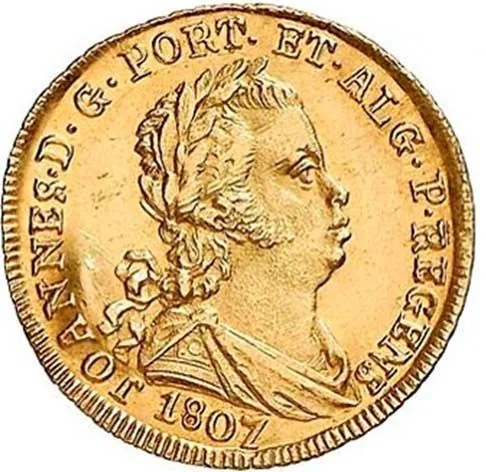
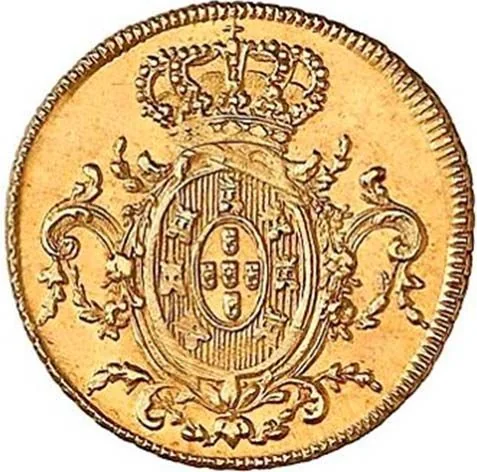
Escudo – Portugal
Standard circulation coins
Series: Bust
Portugal
Context

Material
References
KM: #Click to copy to clipboard338
Numista: #35584
Value
Bullion value: $546.86
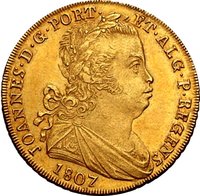
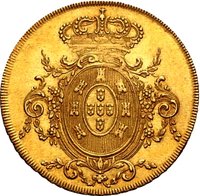
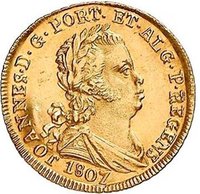
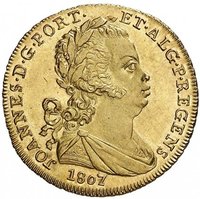
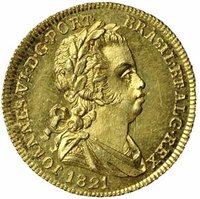
Obverse
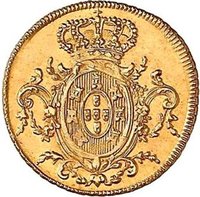
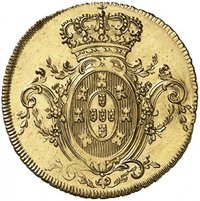
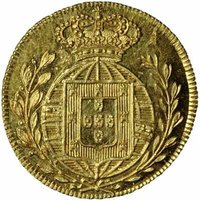
Reverse
Edge
Rope shaped
Mints
| Name | Mark |
|---|---|
| Imprensa Nacional - Casa da Moeda | — |
Mintings
| Year | Mint Mark | Mintage | Quality | Collection |
|---|---|---|---|---|
| 1805 | — | 143 | ||
| 1807 | — | 800 |
Historical background
In 1805, Portugal's currency situation was a complex and precarious reflection of its geopolitical position. The nation was officially on the gold standard, with the Portuguese Real (plural: réis) as its unit of account, but its monetary system was under severe strain. Decades of gold and diamond discoveries in Brazil had initially fueled the economy, but by the turn of the 19th century, this wealth was in decline. More critically, Portugal was caught in the vise of the Napoleonic Wars, forced to pay large tributes to France under the Treaty of Badajoz (1801) while remaining a traditional ally and major trading partner of Britain. This contradictory position drained the treasury of specie (gold and silver coin), leading to chronic shortages of hard currency in circulation.
The domestic economy suffered from a proliferation of low-quality copper coinage and a reliance on paper money, which often traded at a discount. The Royal Treasury, facing fiscal deficits, had increasingly resorted to issuing vales reais (royal bonds), which began to function as a form of inconvertible paper currency. While these helped facilitate large transactions, public confidence in them wavered, and their value fluctuated. Furthermore, the extensive use of foreign coins, particularly Spanish silver pesos and British gold sovereigns, was commonplace in major ports like Lisbon, highlighting the weakness of the domestic coinage and the kingdom's integration into, and dependence upon, Atlantic trade networks.
Ultimately, the monetary instability of 1805 was a symptom of Portugal's deeper political crisis. The pressures would soon prove unsustainable; within two years, in 1807, Napoleon's forces would invade, forcing the Portuguese Royal Family and treasury to flee to Brazil. This dramatic event would trigger a profound monetary transformation, including the opening of the Bank of Brazil and a shift in the empire's financial center across the Atlantic. Thus, the currency situation in 1805 represents the fragile final chapter of the old colonial monetary order before the cataclysm of the Peninsular War.
The domestic economy suffered from a proliferation of low-quality copper coinage and a reliance on paper money, which often traded at a discount. The Royal Treasury, facing fiscal deficits, had increasingly resorted to issuing vales reais (royal bonds), which began to function as a form of inconvertible paper currency. While these helped facilitate large transactions, public confidence in them wavered, and their value fluctuated. Furthermore, the extensive use of foreign coins, particularly Spanish silver pesos and British gold sovereigns, was commonplace in major ports like Lisbon, highlighting the weakness of the domestic coinage and the kingdom's integration into, and dependence upon, Atlantic trade networks.
Ultimately, the monetary instability of 1805 was a symptom of Portugal's deeper political crisis. The pressures would soon prove unsustainable; within two years, in 1807, Napoleon's forces would invade, forcing the Portuguese Royal Family and treasury to flee to Brazil. This dramatic event would trigger a profound monetary transformation, including the opening of the Bank of Brazil and a shift in the empire's financial center across the Atlantic. Thus, the currency situation in 1805 represents the fragile final chapter of the old colonial monetary order before the cataclysm of the Peninsular War.
Series: Bust

✨ Legendary