

Obverse
Description:
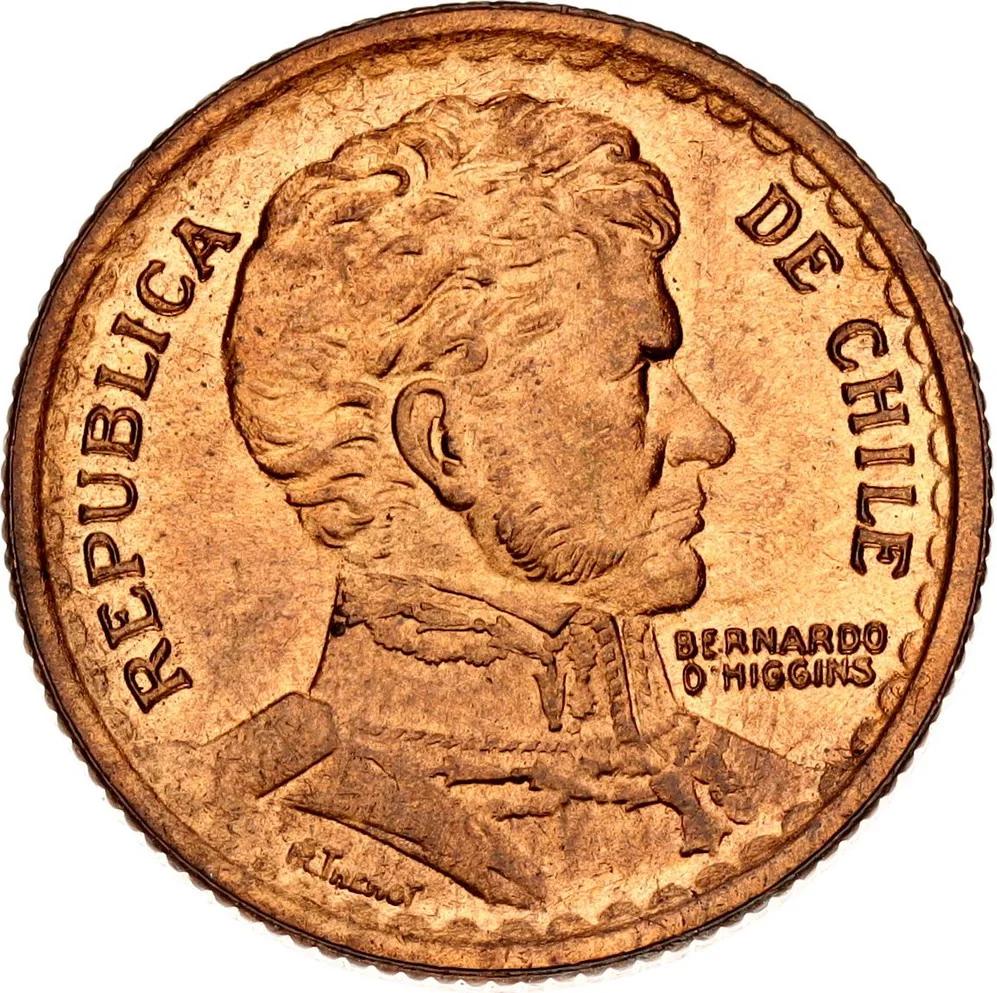
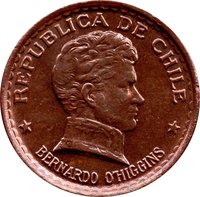
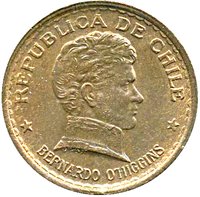
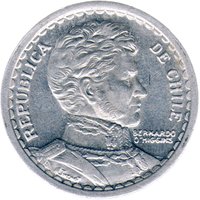
Portrait of Chilean independence leader Bernardo O'Higgins (1778-1842), facing left.
Inscription:
REPUBLICA DE CHILE
BERNARDO
O'HIGGINS
R.THENOT
BERNARDO
O'HIGGINS
R.THENOT
Translation:
REPUBLIC OF CHILE
BERNARDO
O'HIGGINS
R. THENOT
BERNARDO
O'HIGGINS
R. THENOT
Script: Latin
Engraver: René Thénot
Reverse
Edge
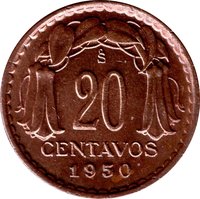
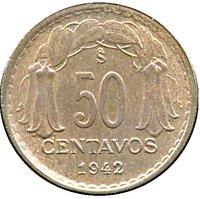
Reeded
Categories
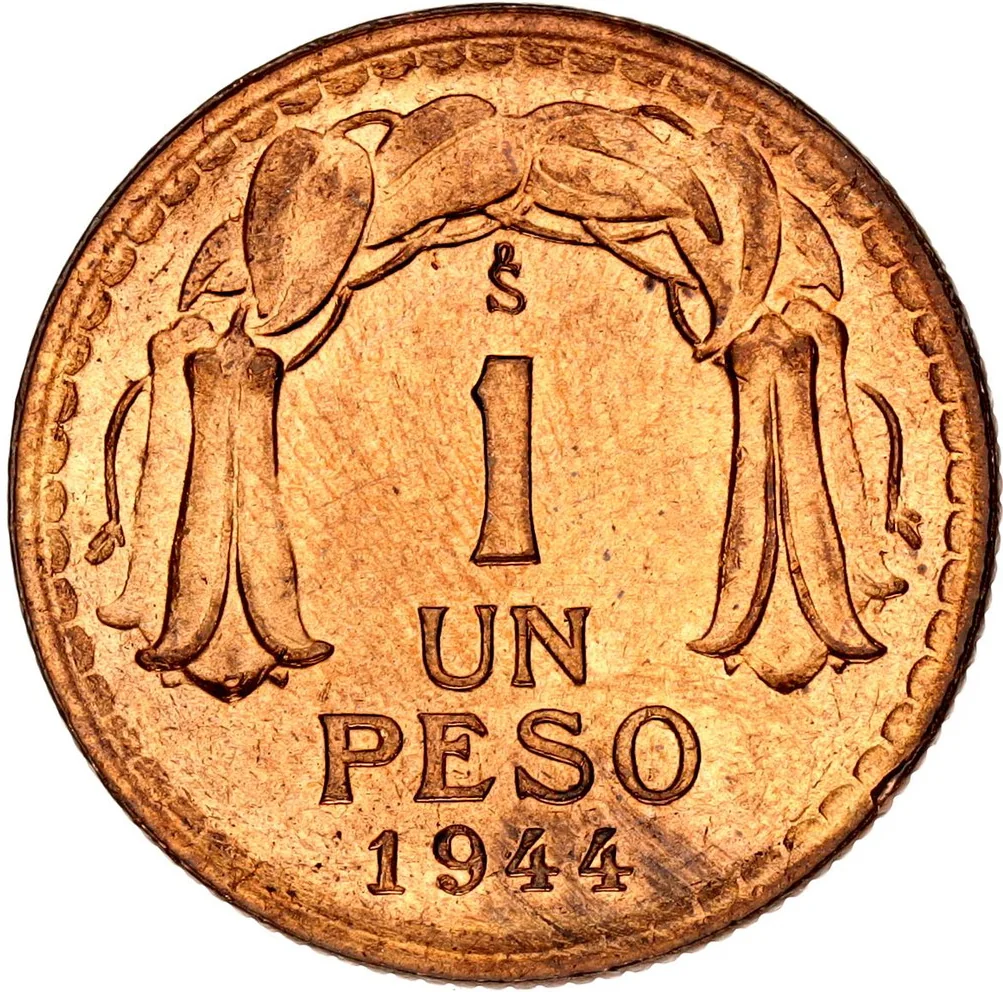
| Plants> Flower |
| Person> Politician |
Mints
| Name | Mark |
|---|---|
| Casa de Moneda de Chile | (So) |
Mintings
| Year | Mint Mark | Mintage | Quality | Collection |
|---|---|---|---|---|
| 1942 | So | 15,150,000 | ||
| 1943 | So | 16,900,000 | ||
| 1944 | So | 12,050,000 | ||
| 1945 | So | 7,600,000 | ||
| 1946 | So | 2,050,000 | ||
| 1947 | So | 2,200,000 | ||
| 1948 | So | 5,900,000 | ||
| 1949 | So | 7,100,000 | ||
| 1950 | So | 7,250,000 | ||
| 1951 | So | 8,150,000 | ||
| 1952 | So | 10,400,000 | ||
| 1953 | So | — | ||
| 1954 | So | 7,566,000 |
Historical background
In 1942, Chile's currency situation was defined by its integration into the global economic structures of World War II and the enduring legacy of the Great Depression. The country operated under a strict system of exchange controls and multiple exchange rates, managed by the Central Bank of Chile (founded in 1925). These controls, initially established in the early 1930s to combat capital flight and stabilize the peso, had become a permanent tool for directing the economy. The official exchange rate was fixed, but different rates were applied to various types of transactions—such as exports, essential imports, and financial flows—to prioritize strategic goods, conserve scarce foreign reserves (primarily US dollars and pounds sterling), and shield the domestic economy from external shocks.
Chile's economic and currency policy was heavily influenced by its status as a key Allied supplier of critical raw materials, most notably copper and nitrates. Wartime agreements, particularly with the United States, guaranteed purchases of these commodities at set prices, providing Chile with a vital inflow of foreign exchange. This income was meticulously managed through the control system to ensure the importation of essential manufactured goods, machinery, and fuel that the nation could not produce itself. Inflation, however, was a persistent underlying pressure, fueled by domestic fiscal deficits, global supply shortages, and the expansion of the money supply to finance industrial development under the state-led import substitution industrialization (ISI) model.
Overall, the 1942 currency regime was characterized by stability through strict administration rather than market forces. It successfully navigated the immediate challenges of the war economy, ensuring access to essential imports and supporting nascent industries. However, this system of financial repression and complex controls also entrenched distortions, sheltered inefficiencies, and laid the groundwork for the profound inflationary problems and exchange rate crises that would challenge Chile in the post-war decades as it struggled to reintegrate into a liberalizing global economy.
Chile's economic and currency policy was heavily influenced by its status as a key Allied supplier of critical raw materials, most notably copper and nitrates. Wartime agreements, particularly with the United States, guaranteed purchases of these commodities at set prices, providing Chile with a vital inflow of foreign exchange. This income was meticulously managed through the control system to ensure the importation of essential manufactured goods, machinery, and fuel that the nation could not produce itself. Inflation, however, was a persistent underlying pressure, fueled by domestic fiscal deficits, global supply shortages, and the expansion of the money supply to finance industrial development under the state-led import substitution industrialization (ISI) model.
Overall, the 1942 currency regime was characterized by stability through strict administration rather than market forces. It successfully navigated the immediate challenges of the war economy, ensuring access to essential imports and supporting nascent industries. However, this system of financial repression and complex controls also entrenched distortions, sheltered inefficiencies, and laid the groundwork for the profound inflationary problems and exchange rate crises that would challenge Chile in the post-war decades as it struggled to reintegrate into a liberalizing global economy.
🌱 Very Common