

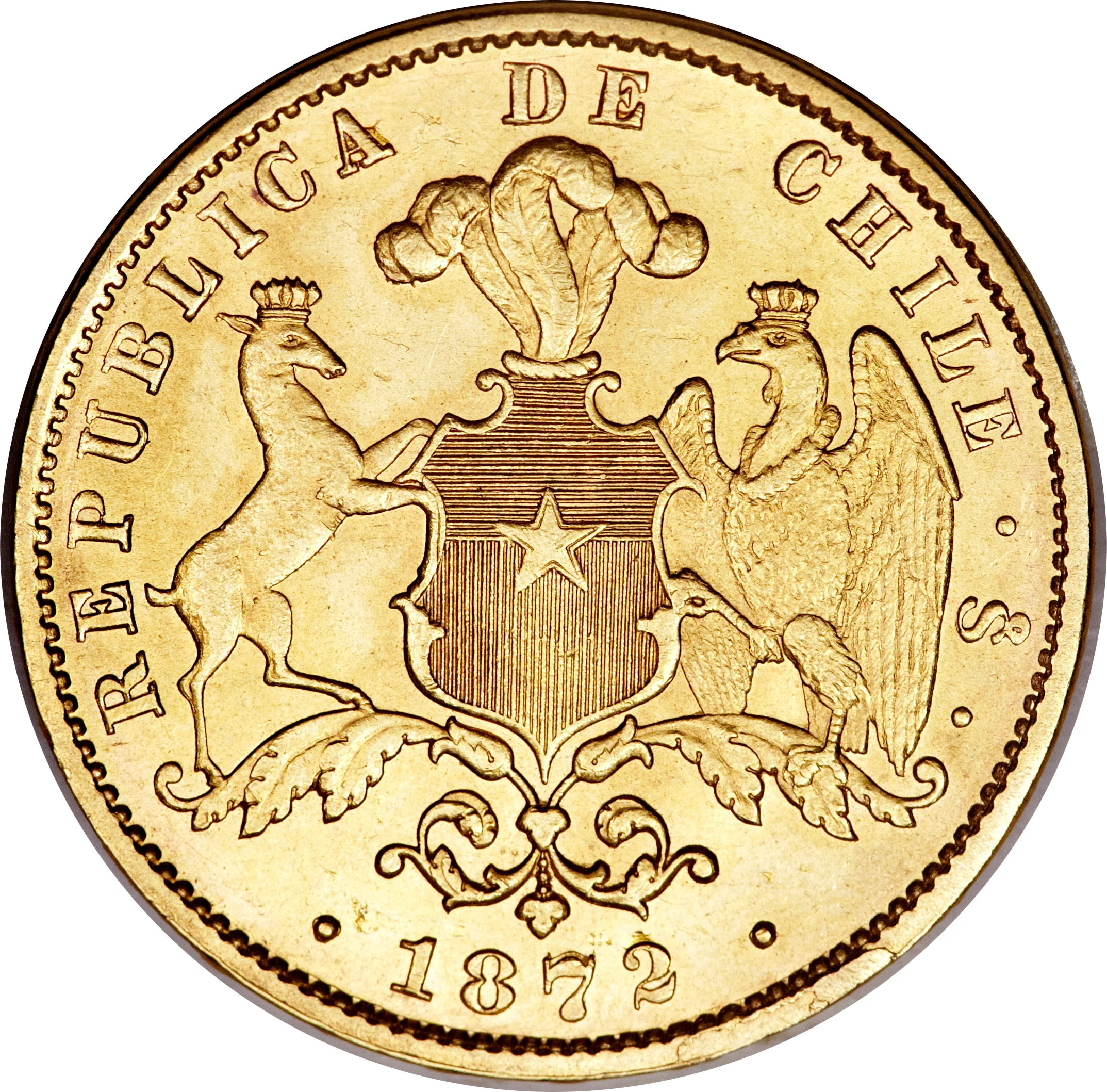
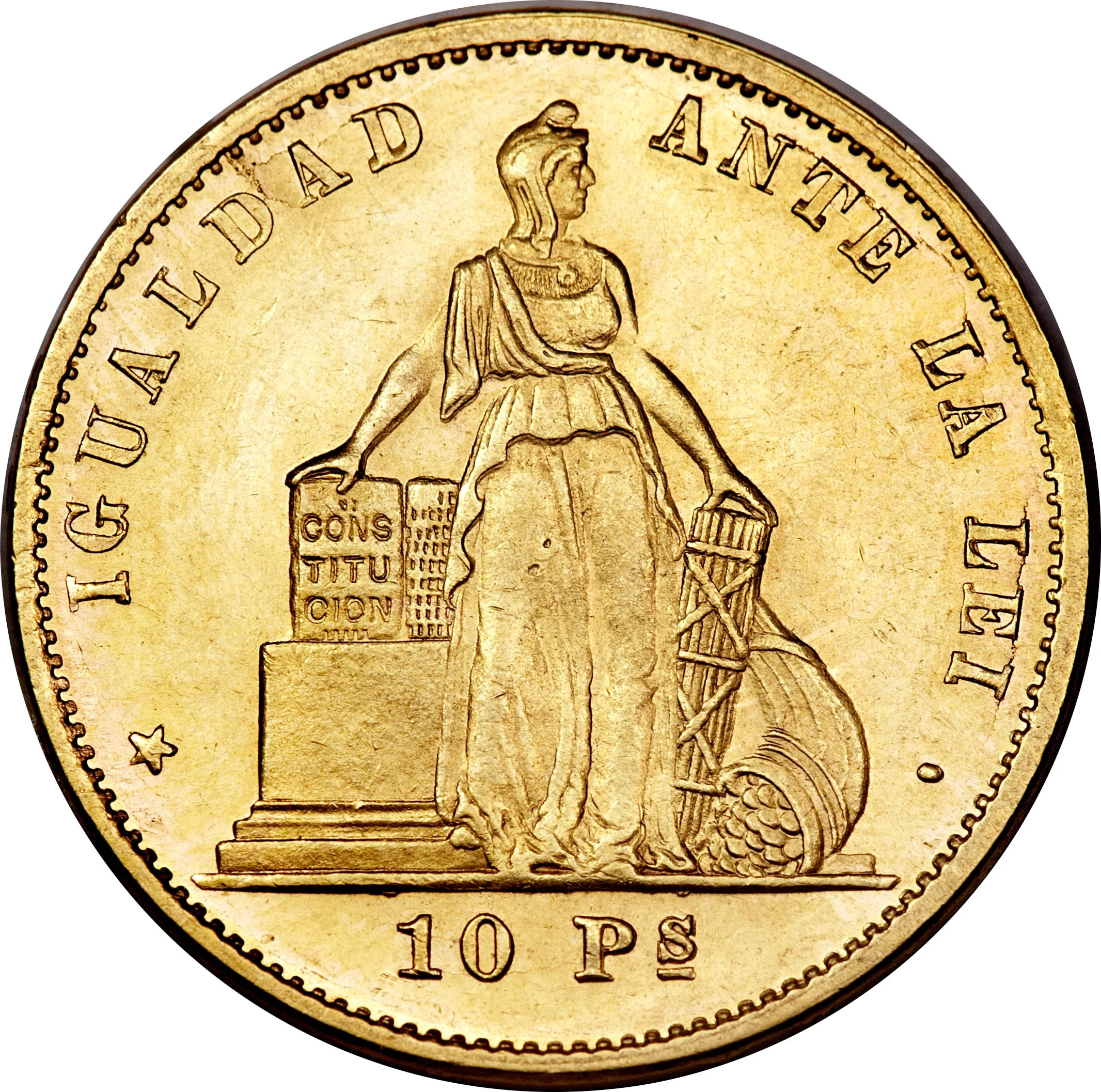

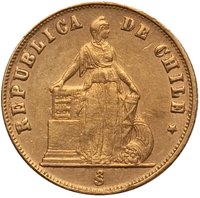
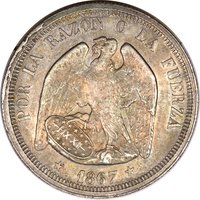
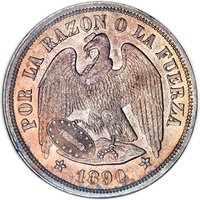
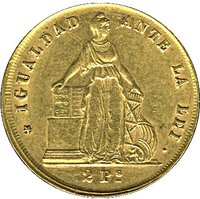
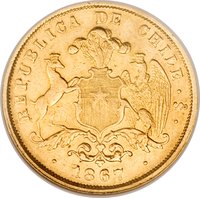
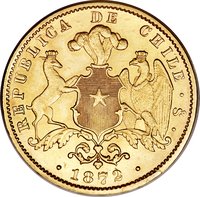
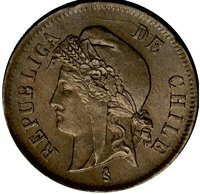
Obverse
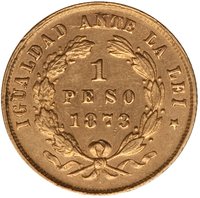
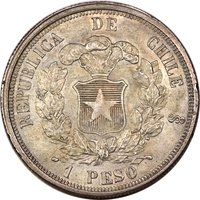
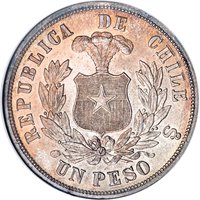
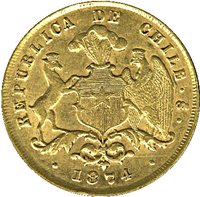
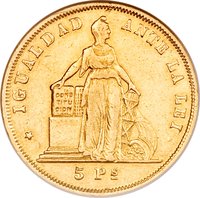
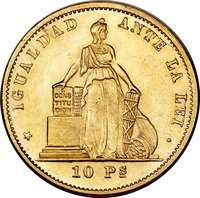
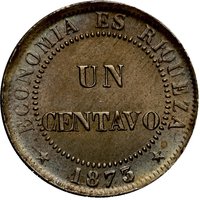
Reverse
Edge
Categories
| Symbol> Phrygian cap |
| Symbol> Allegory |
| Symbol> Cornucopia |
Mints
| Name | Mark |
|---|---|
| Casa de Moneda de Chile | (So) |
Mintings
| Year | Mint Mark | Mintage | Quality | Collection |
|---|---|---|---|---|
| 1867 | So | — | ||
| 1868 | So | 54,000 | ||
| 1869 | So | 36,000 | ||
| 1870 | So | 76,000 | ||
| 1871 | So | 41,000 | ||
| 1872 | So | 235,000 | ||
| 1873 | So | 112,000 | ||
| 1874 | So | 1,277 | ||
| 1876 | So | 2,106 | ||
| 1877 | So | 8,208 | ||
| 1877 | So | — | Proof | |
| 1878 | So | 7,983 | ||
| 1879 | So | 9,805 | ||
| 1880 | So | 11,000 | ||
| 1881 | So | 13,000 | ||
| 1882 | So | 14,000 | ||
| 1883 | So | 8,381 | ||
| 1884 | So | 9,888 | ||
| 1885 | So | 7,758 | ||
| 1886 | So | 3,721 | ||
| 1887 | So | 5,236 | ||
| 1888 | So | 4,217 | ||
| 1889 | So | 4,650 | ||
| 1890 | So | 2,344 | ||
| 1892 | So | 1,192 |
Historical background
In 1867, Chile's currency system was in a state of transition and complexity, caught between its colonial past and its modernizing republican ambitions. The official monetary system was bimetallic, based on the peso (also called the peso fuerte), which was legally defined as containing a specific weight of either gold or silver. However, the reality was far messier. A multitude of coins circulated simultaneously: Spanish colonial reales, Peruvian and Bolivian silver coins from the recently concluded War of the Pacific's precursor tensions, French francs, and even privately issued tokens from mining companies and merchants. This proliferation created chronic confusion in commerce, as the intrinsic metal value of each coin often differed from its nominal face value.
The government of President José Joaquín Pérez sought to impose order through the Law of Monetary Conversion of 1867. This pivotal legislation aimed to decimalize and standardize the currency, formally establishing the centavo as one-hundredth of a peso and mandating the minting of new national coins in copper and silver. Crucially, it sought to demonetize the vast array of foreign and irregular coins in circulation, directing them to be withdrawn and recoined. The law represented a significant assertion of state sovereignty over the monetary supply, a key step in nation-building and economic integration.
Despite this legislative effort, the situation on the ground in 1867 remained challenging. The process of withdrawing old currency and minting sufficient new coinage was slow, meaning the chaotic mix of old and new money persisted. Furthermore, the bimetallic standard itself was under international strain due to fluctuating gold-silver ratios, a problem that would later push Chile toward a gold standard. Thus, 1867 stands as a year of deliberate reform aimed at stability, yet one where the practical goal of a unified, trustworthy national currency was still a work in progress, hindered by logistical hurdles and the entrenched habits of a diverse economy.
The government of President José Joaquín Pérez sought to impose order through the Law of Monetary Conversion of 1867. This pivotal legislation aimed to decimalize and standardize the currency, formally establishing the centavo as one-hundredth of a peso and mandating the minting of new national coins in copper and silver. Crucially, it sought to demonetize the vast array of foreign and irregular coins in circulation, directing them to be withdrawn and recoined. The law represented a significant assertion of state sovereignty over the monetary supply, a key step in nation-building and economic integration.
Despite this legislative effort, the situation on the ground in 1867 remained challenging. The process of withdrawing old currency and minting sufficient new coinage was slow, meaning the chaotic mix of old and new money persisted. Furthermore, the bimetallic standard itself was under international strain due to fluctuating gold-silver ratios, a problem that would later push Chile toward a gold standard. Thus, 1867 stands as a year of deliberate reform aimed at stability, yet one where the practical goal of a unified, trustworthy national currency was still a work in progress, hindered by logistical hurdles and the entrenched habits of a diverse economy.
Series: 1867 Chile circulation coins
💎 Extremely Rare