

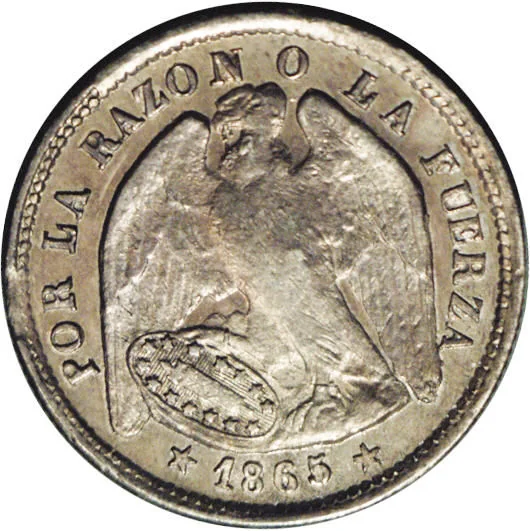
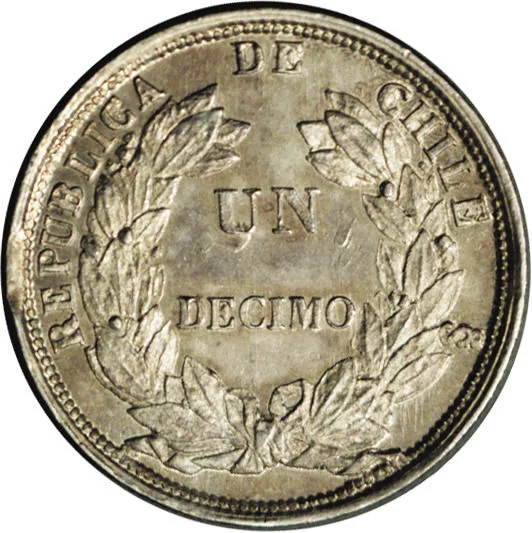

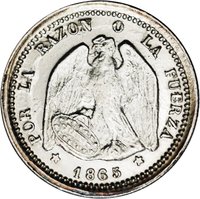
Obverse
Description:
Condor wings spread, claw on shield.
Inscription:
POR LA RAZON O LA FUERZA
• 1865 •
• 1865 •
Script: Latin
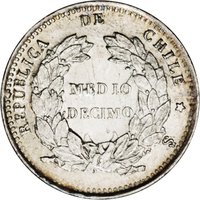
Reverse
Edge
Reeded
Mintings
| Year | Mint Mark | Mintage | Quality | Collection |
|---|---|---|---|---|
| 1864 | So | 96,000 | ||
| 1865 | So | — | ||
| 1866 | So | 96,000 |
Historical background
In 1864, Chile's currency system was in a transitional and somewhat chaotic state, caught between the old colonial system and a modern, unified national currency. The country operated on a bimetallic standard in law, valuing both gold and silver, but in practice, the system was fragmented. A variety of coins circulated simultaneously, including old Spanish colonial reales, Peruvian and Bolivian silver pesos, French francs, and even privately issued tokens from mining companies and merchants. This proliferation of coinage of varying weights and origins created significant confusion in commerce and hindered economic efficiency.
The government had taken a major step toward reform with the Law of June 26, 1851, which aimed to decimalize the currency and introduce the peso as the national unit, subdivided into 100 centavos. However, the transition was slow. While new decimal coins (featuring the national condor) were minted from 1851 onwards, they had to compete with the older, non-decimal foreign and colonial coins that remained legal tender. The state's limited minting capacity meant the new national coinage was insufficient to fully displace the older mixed circulation, leading to a persistent dual system.
This monetary inconsistency posed practical challenges for trade, banking, and government accounting. The situation underscored the need for a stronger, centralized monetary authority, a need that would be decisively addressed just a decade later. In 1874, the government would establish the Banco Nacional de Chile and finally begin the systematic withdrawal of all foreign coinage, completing the monetary unification that was still an ongoing struggle in 1864.
The government had taken a major step toward reform with the Law of June 26, 1851, which aimed to decimalize the currency and introduce the peso as the national unit, subdivided into 100 centavos. However, the transition was slow. While new decimal coins (featuring the national condor) were minted from 1851 onwards, they had to compete with the older, non-decimal foreign and colonial coins that remained legal tender. The state's limited minting capacity meant the new national coinage was insufficient to fully displace the older mixed circulation, leading to a persistent dual system.
This monetary inconsistency posed practical challenges for trade, banking, and government accounting. The situation underscored the need for a stronger, centralized monetary authority, a need that would be decisively addressed just a decade later. In 1874, the government would establish the Banco Nacional de Chile and finally begin the systematic withdrawal of all foreign coinage, completing the monetary unification that was still an ongoing struggle in 1864.
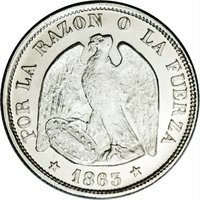
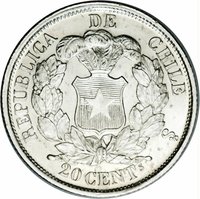
💎 Very Rare