


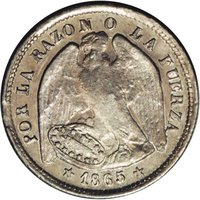
Obverse
Description:
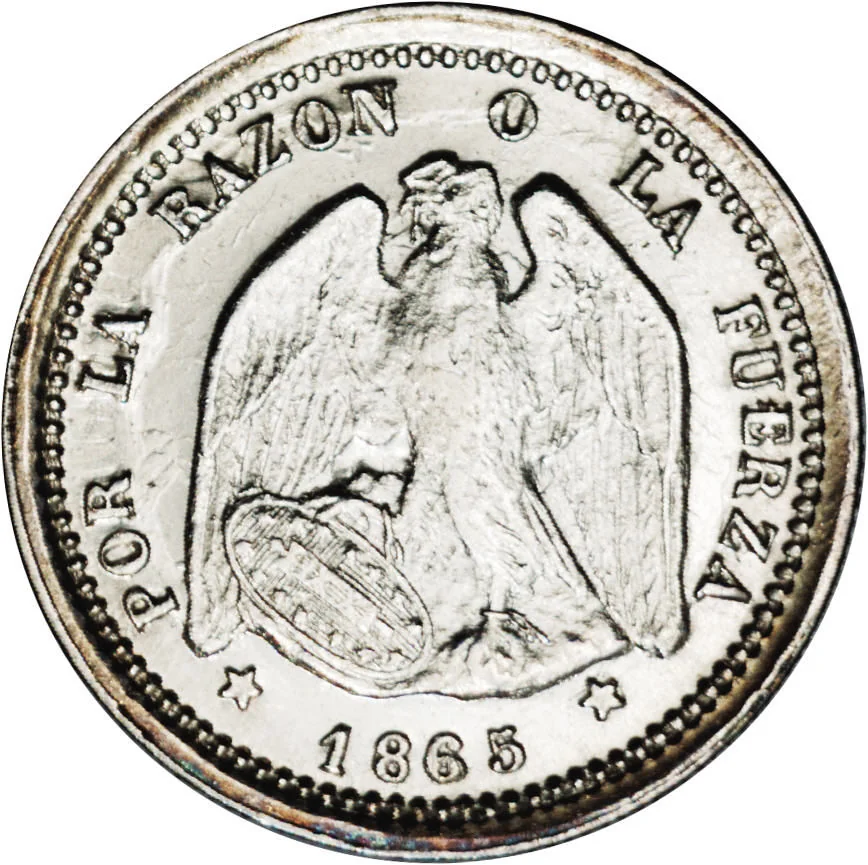
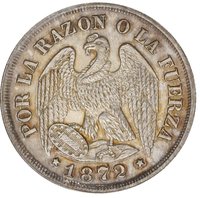
Condor wings spread, claw on shield.
Inscription:
POR LA RAZON O LA FUERZA
* 1865 *
* 1865 *
Script: Latin
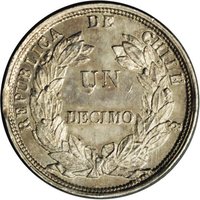
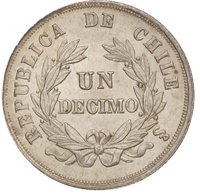
Reverse
Edge
Mintings
| Year | Mint Mark | Mintage | Quality | Collection |
|---|---|---|---|---|
| 1865 | So | — | ||
| 1866 | So | 82,000 |
Historical background
In 1865, Chile's currency system was in a state of transition and complexity, reflecting its growing integration into the global economy. The official monetary standard was the silver peso, valued at eight reales and tied to the French franc under a bimetallic system. However, the discovery of rich silver deposits in the mid-19th century, particularly in Chañarcillo, led to a significant increase in silver coinage, which began to drive gold coins out of circulation due to the global fluctuation in metal values. This created practical difficulties for international trade, as Chile's primary trading partners, like Britain, operated on a gold standard.
Alongside official coinage, a proliferation of private and foreign currency circulated widely. Commercial banks, empowered by an 1860 law, issued their own banknotes, convertible into metal, but these notes often traded at a discount depending on public confidence in the issuing institution. Furthermore, coins from Peru, Bolivia, and even older Spanish colonial reales were commonly used in everyday transactions, leading to a heterogeneous and sometimes confusing monetary environment. The government struggled to enforce its legal tender laws, and the public had to constantly assess the value and authenticity of multiple forms of money.
This unstable situation was a point of concern for policymakers and merchants, highlighting the tension between a traditional, commodity-based system and the demands of a modernizing economy. The inherent weaknesses of bimetallism, combined with unregulated banknote issuance, set the stage for future monetary reforms. Indeed, the pressures felt in 1865 would culminate just a decade later with Chile's decisive shift to the gold standard in 1875, aiming to stabilize the currency and simplify both domestic and international commerce.
Alongside official coinage, a proliferation of private and foreign currency circulated widely. Commercial banks, empowered by an 1860 law, issued their own banknotes, convertible into metal, but these notes often traded at a discount depending on public confidence in the issuing institution. Furthermore, coins from Peru, Bolivia, and even older Spanish colonial reales were commonly used in everyday transactions, leading to a heterogeneous and sometimes confusing monetary environment. The government struggled to enforce its legal tender laws, and the public had to constantly assess the value and authenticity of multiple forms of money.
This unstable situation was a point of concern for policymakers and merchants, highlighting the tension between a traditional, commodity-based system and the demands of a modernizing economy. The inherent weaknesses of bimetallism, combined with unregulated banknote issuance, set the stage for future monetary reforms. Indeed, the pressures felt in 1865 would culminate just a decade later with Chile's decisive shift to the gold standard in 1875, aiming to stabilize the currency and simplify both domestic and international commerce.
💎 Extremely Rare