

Chile
Context

Material
References
KM: #Click to copy to clipboard135
Numista: #26203
Value
Bullion value: $13.03
Obverse
Description:
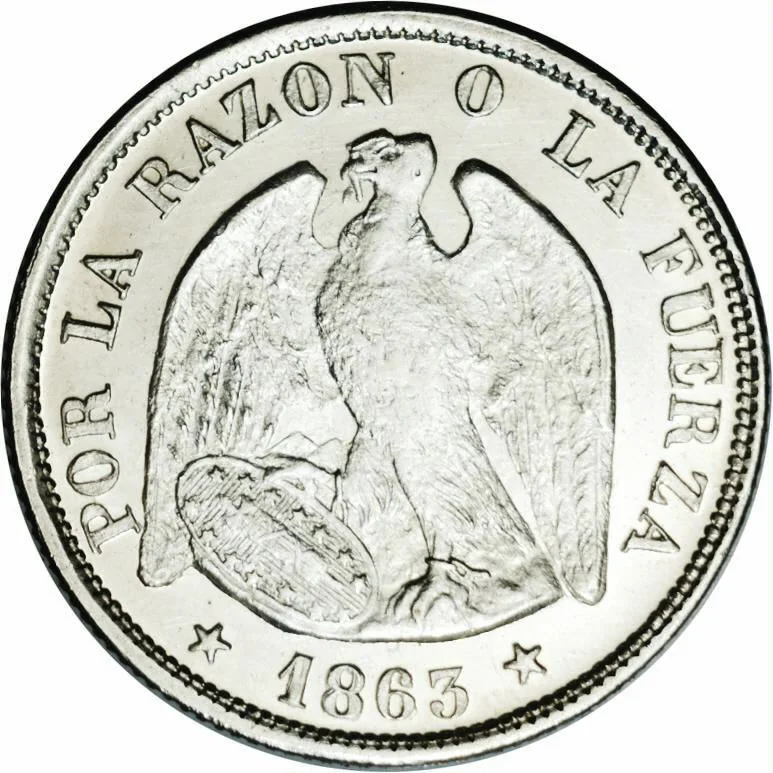
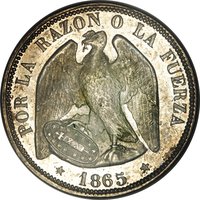
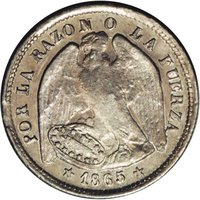
Condor wings spread, claw on shield.
Inscription:
POR LA RAZON O LA FUERZA
* 1863 *
* 1863 *
Script: Latin
Reverse
Edge
Milled
Mints
| Name | Mark |
|---|---|
| Casa de Moneda de Chile | So |
Mintings
Historical background
In 1863, Chile’s currency system was in a state of transition and complexity, rooted in the colonial legacy of the Spanish real but increasingly influenced by the demands of a modernizing export economy. The official monetary system was bimetallic, based on the peso (also called the peso fuerte), which was legally defined in terms of both gold and silver. However, the fixed legal ratio between the two metals did not match their fluctuating market values, leading to the recurring problem of one metal being undervalued and consequently being exported or hoarded, a classic consequence of Gresham’s Law. This instability was compounded by the widespread circulation of a variety of foreign coins, particularly from Peru, Bolivia, and Europe, which circulated alongside domestic issues, creating a chaotic and unreliable medium for everyday commerce.
This monetary confusion presented a significant obstacle to Chile's economic ambitions, as the nation was experiencing a mining-led export boom, notably in silver and copper. The government recognized that a stable and uniform currency was essential for facilitating trade, attracting foreign investment, and simplifying fiscal administration. Consequently, the period leading up to 1863 was marked by legislative efforts to reform and standardize the system. The most significant step came just a few years later, with the Law of Monetary Conversion of 1865, which was already in preparation during this time. This law would ultimately demonetize foreign coinage and establish a new, decimal-based gold standard centered on the condor (10 pesos) and the peso.
Therefore, the currency situation in 1863 can be characterized as the final chapter of an outdated and unwieldy system. It was a period of mounting pressure for reform, sitting on the cusp of a decisive transformation. The existing bimetallic chaos, while still operative, was widely seen as an unsustainable relic, and the financial and political groundwork was being laid for the creation of a modern, national, and gold-backed currency that would support Chile’s integration into the global economy.
This monetary confusion presented a significant obstacle to Chile's economic ambitions, as the nation was experiencing a mining-led export boom, notably in silver and copper. The government recognized that a stable and uniform currency was essential for facilitating trade, attracting foreign investment, and simplifying fiscal administration. Consequently, the period leading up to 1863 was marked by legislative efforts to reform and standardize the system. The most significant step came just a few years later, with the Law of Monetary Conversion of 1865, which was already in preparation during this time. This law would ultimately demonetize foreign coinage and establish a new, decimal-based gold standard centered on the condor (10 pesos) and the peso.
Therefore, the currency situation in 1863 can be characterized as the final chapter of an outdated and unwieldy system. It was a period of mounting pressure for reform, sitting on the cusp of a decisive transformation. The existing bimetallic chaos, while still operative, was widely seen as an unsustainable relic, and the financial and political groundwork was being laid for the creation of a modern, national, and gold-backed currency that would support Chile’s integration into the global economy.
🌟 Uncommon