

2 centavos – Honduras
Add to wishlist
Honduras
Obverse
Description:
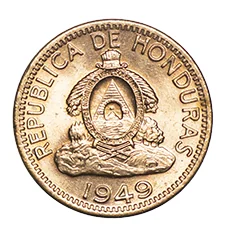
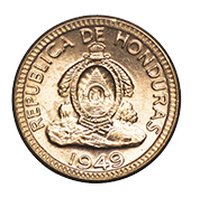
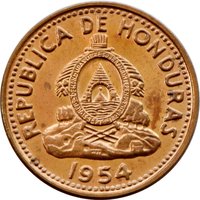
Coat of arms (pyramid, no clouds) with legend: "República de Honduras Libre Soberana E Independiente" and date below.
Inscription:
REPUBLICA DE HONDURAS
REP CA DE · HONDURAS · LIBRE · SOBERANA · INDEPENDIENTE
· 15 SEPT BRE 1821 ·
1956
REP CA DE · HONDURAS · LIBRE · SOBERANA · INDEPENDIENTE
· 15 SEPT BRE 1821 ·
1956
Translation:
REPUBLIC OF HONDURAS
REPUBLIC OF HONDURAS FREE SOVEREIGN INDEPENDENT
15 SEPTEMBER 1821
1956
REPUBLIC OF HONDURAS FREE SOVEREIGN INDEPENDENT
15 SEPTEMBER 1821
1956
Script: Latin
Language: Spanish
Reverse
Edge
Plain
Categories
| Symbols> Coat of Arms |
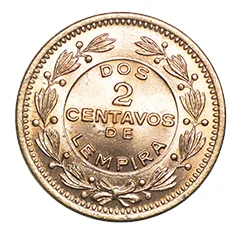
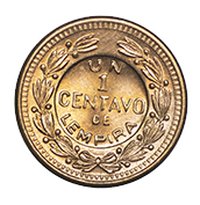
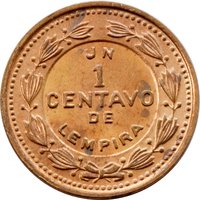
| Symbol> Wreath |
Mintings
| Year | Mint Mark | Mintage | Quality | Collection |
|---|---|---|---|---|
| 1939 | — | 2,000,000 | ||
| 1949 | — | 3,000,000 | ||
| 1954 | — | 2,000,000 | ||
| 1956 | — | 20,000,000 |
Historical background
In 1939, Honduras operated under a currency system anchored to the silver standard, with the Lempira as its national unit. Established in 1931 and named after a 16th-century indigenous leader, the Lempira replaced the Honduran Peso at par. Its value was legally defined by a fixed quantity of silver (0.5 grams of fine silver per Lempira), which provided a degree of stability but tied the currency's fate to international silver prices. This system was managed by the country's major commercial banks, as Honduras lacked a central bank until 1950, leaving monetary policy fragmented and reactive.
The Honduran economy was overwhelmingly agrarian, dependent on exports of bananas, coffee, and silver. This made it highly vulnerable to global commodity price swings and trade disruptions, a significant concern as war clouds gathered in Europe in 1939. While the fixed silver link provided a nominal anchor, the economy was deeply integrated with the United States dollar due to the dominant presence of American fruit companies, like the United Fruit Company. In practice, major transactions and foreign trade were often conducted in U.S. dollars, creating a de facto dual-currency environment, especially within the export enclaves along the northern coast.
Consequently, the currency situation in 1939 was one of fragile and dependent stability. The silver-backed Lempira functioned for domestic use, but Honduras's monetary reality was heavily influenced by external forces: the value of silver on world markets, the flow of U.S. dollar investment and trade, and the looming threat of global conflict. The outbreak of World War II later in the year would soon test this system, leading to inflationary pressures, trade dislocation, and ultimately, a formal shift to a U.S. dollar peg in 1947 to achieve greater stability.
The Honduran economy was overwhelmingly agrarian, dependent on exports of bananas, coffee, and silver. This made it highly vulnerable to global commodity price swings and trade disruptions, a significant concern as war clouds gathered in Europe in 1939. While the fixed silver link provided a nominal anchor, the economy was deeply integrated with the United States dollar due to the dominant presence of American fruit companies, like the United Fruit Company. In practice, major transactions and foreign trade were often conducted in U.S. dollars, creating a de facto dual-currency environment, especially within the export enclaves along the northern coast.
Consequently, the currency situation in 1939 was one of fragile and dependent stability. The silver-backed Lempira functioned for domestic use, but Honduras's monetary reality was heavily influenced by external forces: the value of silver on world markets, the flow of U.S. dollar investment and trade, and the looming threat of global conflict. The outbreak of World War II later in the year would soon test this system, leading to inflationary pressures, trade dislocation, and ultimately, a formal shift to a U.S. dollar peg in 1947 to achieve greater stability.
🌱 Very Common