

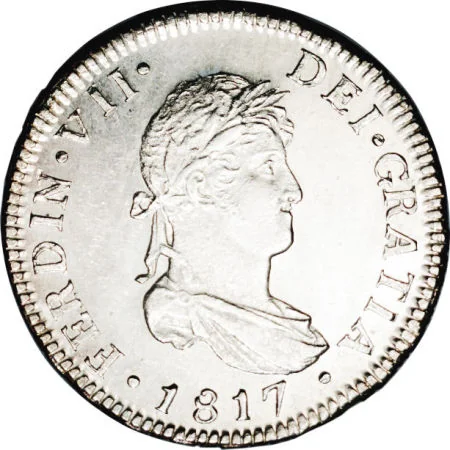
2 reales – Chile
Add to wishlist
Chile
Context
Years: 1812–1817
Issuer: Chile
Ruler: Ferdinand VII
Currency:
(1541—1852)
Demonetized: Yes
Total mintage: 164,000
Material
References
KM: #
Numista: #35217
Value
Bullion value: $15.44
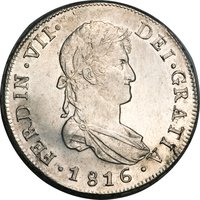
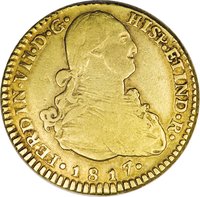
Obverse
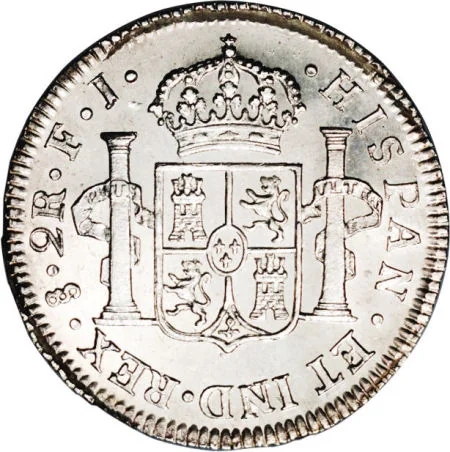
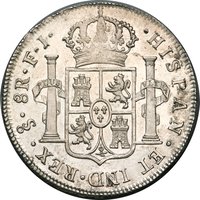
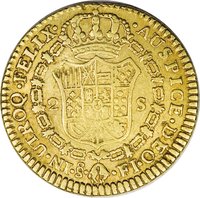
Reverse
Description:
Crested arms and columns.
Inscription:
HISPAN ET IND REX
So 2R FJ
PLUS VLTRA
So 2R FJ
PLUS VLTRA
Script: Latin
Edge
Chained
Mints
| Name | Mark |
|---|---|
| Casa de Moneda de Chile | (So) |
Mintings
| Year | Mint Mark | Mintage | Quality | Collection |
|---|---|---|---|---|
| 1812 | So | 69,000 | ||
| 1813 | So | — | ||
| 1814 | So | 4,000 | ||
| 1815 | So | 24,000 | ||
| 1816 | So | 67,000 | ||
| 1817 | So | — |
Historical background
In 1812, Chile's currency situation was a direct reflection of its turbulent political state, caught between colonial tradition and revolutionary aspiration. Officially, the territory remained part of the Spanish Empire, and the legal tender was the Spanish colonial real, minted in silver. However, the first stirrings of self-government were already underway following the establishment of the First National Government Junta in 1810. This nascent autonomy created immediate practical and symbolic challenges, as the new administration sought to assert its authority while navigating a precarious economic landscape strained by the disruption of traditional trade routes and royalist opposition.
The most pressing monetary issue was a severe shortage of circulating coinage. This scarcity was exacerbated by the ongoing Peninsular War in Spain, which disrupted the supply of precious metals and official minting, and by local hoarding of silver due to political uncertainty. To address this crisis, the patriot government, led by José Miguel Carrera, took a bold and symbolic step in 1812 by authorizing the first locally issued coinage. These crude, provisional silver coins, known as "monedas de la Patria Vieja," were minted in Santiago and bore the national seal (a column representing the Tree of Liberty) instead of the portrait of King Ferdinand VII, a powerful visual break from colonial authority.
Thus, the currency of 1812 Chile existed in a dual and transitional state. In practice, a mix of worn Spanish colonial coins, these new provisional patriot issues, and even barter facilitated daily commerce. The creation of a distinct Chilean coinage was less an economic solution to the shortage—as the quantities minted were limited—and more a profound political act. It served as a tangible declaration of growing sovereignty, embedding the ideals of the incipient republic into the very medium of exchange, even as the battle for full independence remained fiercely contested.
The most pressing monetary issue was a severe shortage of circulating coinage. This scarcity was exacerbated by the ongoing Peninsular War in Spain, which disrupted the supply of precious metals and official minting, and by local hoarding of silver due to political uncertainty. To address this crisis, the patriot government, led by José Miguel Carrera, took a bold and symbolic step in 1812 by authorizing the first locally issued coinage. These crude, provisional silver coins, known as "monedas de la Patria Vieja," were minted in Santiago and bore the national seal (a column representing the Tree of Liberty) instead of the portrait of King Ferdinand VII, a powerful visual break from colonial authority.
Thus, the currency of 1812 Chile existed in a dual and transitional state. In practice, a mix of worn Spanish colonial coins, these new provisional patriot issues, and even barter facilitated daily commerce. The creation of a distinct Chilean coinage was less an economic solution to the shortage—as the quantities minted were limited—and more a profound political act. It served as a tangible declaration of growing sovereignty, embedding the ideals of the incipient republic into the very medium of exchange, even as the battle for full independence remained fiercely contested.
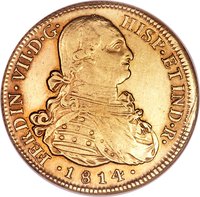
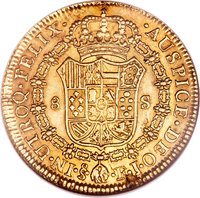
💎 Very Rare