

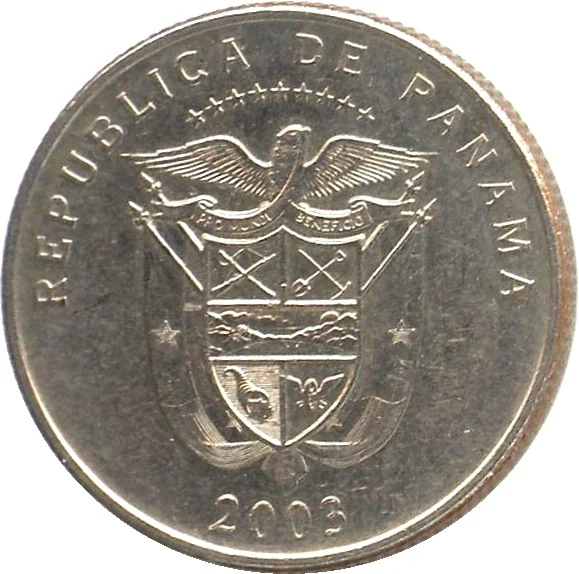
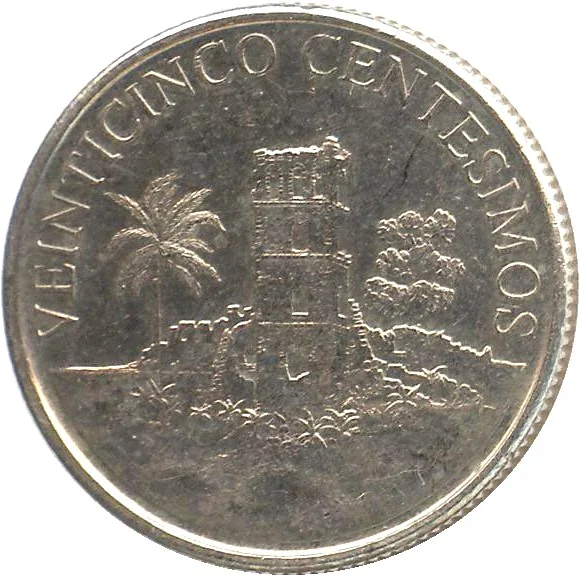
25 centesimos – Panama
Add to wishlist
Circulating commemorative coins
Commemoration: Ruins of Old Panama
Panama
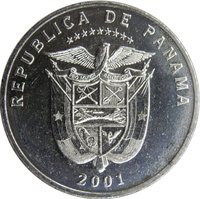
Obverse
Reverse
Edge
Reeded
Categories
| Building> Religious building |
| Symbols> Coat of Arms |
Mints
| Name | Mark |
|---|---|
| Royal Canadian Mint of Winnipeg | — |
Mintings
| Year | Mint Mark | Mintage | Quality | Collection |
|---|---|---|---|---|
| 2003 | — | 6,000,000 | ||
| 2003 | — | 2,000 | Proof |
Historical background
In 2003, Panama's currency situation was defined by its unique and long-standing monetary framework, which remains in place today. The country is officially "dollarized," using the United States dollar as its legal tender since 1904. This system replaced the Colombian peso after Panama's independence and was formalized in the monetary agreement established with the U.S. prior to the construction of the Panama Canal. Consequently, Panama does not have a central bank issuing a local currency and does not conduct an independent monetary policy, relying instead on the monetary decisions of the U.S. Federal Reserve.
Alongside the U.S. dollar, Panama also mints its own fractional currency, the Panamanian balboa, which exists only in coin form and is pegged at a strict 1:1 parity with the dollar. In 2003, these balboa coins circulated interchangeably with U.S. coins for everyday transactions. All paper currency in circulation was, and is, U.S. dollars. This dual-system provided price stability and low inflation, but it also meant Panama had no ability to devalue its currency to boost competitiveness or act as a lender of last resort to its banking system during financial stress.
The year 2003 fell within a period of economic recovery and growth for Panama, following the recession of the late 1990s and the early 2000s. The dollarized regime provided macroeconomic stability, which helped foster confidence in the country's robust international banking center and attracted foreign investment. However, it also imposed fiscal discipline, as the government could not finance deficits by printing money. The primary economic challenges in 2003 were related to structural reforms and managing public debt, rather than currency volatility, as the dollarization shield largely insulated the economy from the currency crises that affected some of its regional neighbors.
Alongside the U.S. dollar, Panama also mints its own fractional currency, the Panamanian balboa, which exists only in coin form and is pegged at a strict 1:1 parity with the dollar. In 2003, these balboa coins circulated interchangeably with U.S. coins for everyday transactions. All paper currency in circulation was, and is, U.S. dollars. This dual-system provided price stability and low inflation, but it also meant Panama had no ability to devalue its currency to boost competitiveness or act as a lender of last resort to its banking system during financial stress.
The year 2003 fell within a period of economic recovery and growth for Panama, following the recession of the late 1990s and the early 2000s. The dollarized regime provided macroeconomic stability, which helped foster confidence in the country's robust international banking center and attracted foreign investment. However, it also imposed fiscal discipline, as the government could not finance deficits by printing money. The primary economic challenges in 2003 were related to structural reforms and managing public debt, rather than currency volatility, as the dollarization shield largely insulated the economy from the currency crises that affected some of its regional neighbors.
🌱 Common