

Spain
Context

Material
References
KM: #Click to copy to clipboard526
Numista: #34492
Value
Bullion value: $6.92
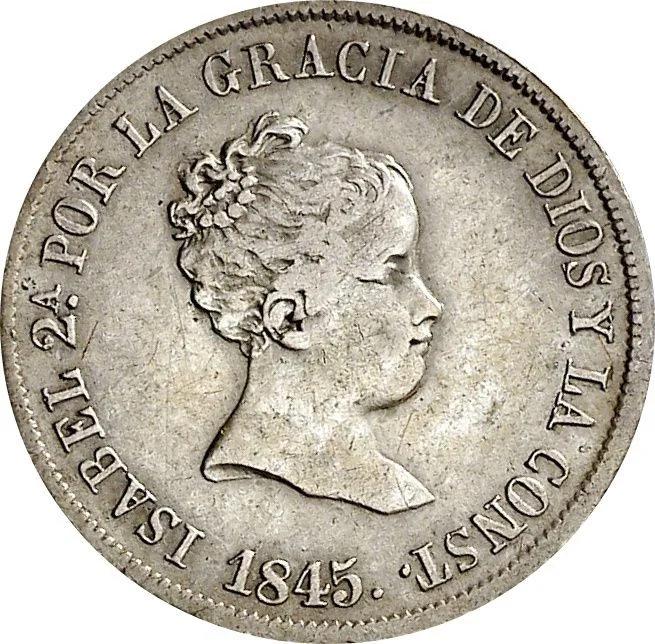
Obverse
Description:
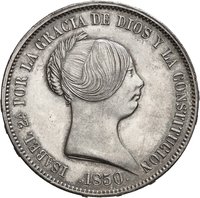
Queen Isabella II facing right.
Inscription:
ISABEL 2A. POR LA GRACIA DE DIOS Y LA CONST ·
1845.
1845.
Translation:
Isabel 2nd, by the grace of God and the Constitution.
1845.
1845.
Script: Latin
Language: Spanish
Engraver: Mariano González de Sepúlveda Salazar
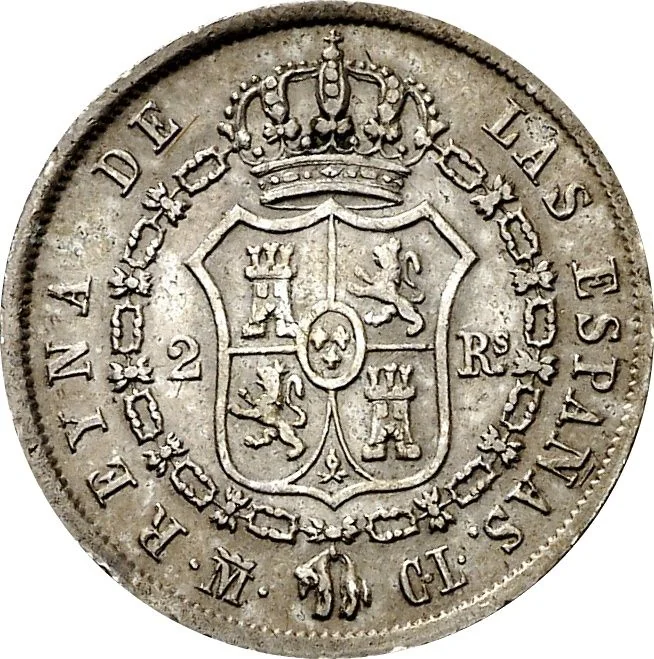
Reverse
Description:
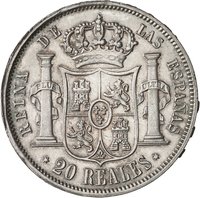
Crowned Spanish coat of arms with the Golden Fleece.
Inscription:
REYNA DE LAS ESPAÑAS.
2. RS.
· M · C · L ·
2. RS.
· M · C · L ·
Translation:
Queen of the Spains.
2. RS.
· M · C · L ·
2. RS.
· M · C · L ·
Script: Latin
Language: Spanish
Engraver: Mariano González de Sepúlveda Salazar
Edge
Categories
| Symbols> Coat of Arms |
Mints
| Name | Mark |
|---|---|
| Royal Mint of Madrid | (M) |
| Royal Mint of Seville | S |
Mintings
| Year | Mint Mark | Mintage | Quality | Collection |
|---|---|---|---|---|
| 1844 | MCL | — | ||
| 1845 | SRD | — | ||
| 1845 | MCL | — | ||
| 1847 | MCL | — | ||
| 1848 | MCL | — | ||
| 1849 | MCL | — | ||
| 1850 | SRD | — | ||
| 1851 | SRD | — |
Historical background
In 1844, Spain's currency situation was characterized by profound instability and complexity, a legacy of the political turmoil and fiscal crises of the early 19th century. The nation operated on a bimetallic standard in theory, but in practice, the system was chaotic. A multitude of coins circulated simultaneously: old pre-Napoleonic Spanish coins, French francs from the recent Carlist War, and even clipped and counterfeit pieces. The most critical issue was the severe shortage of fractional currency (small change), which crippled everyday commerce and led to widespread use of privately issued tokens and foreign coinage.
This monetary disarray directly stemmed from the state's desperate finances. To fund its wars and deficits, the government had repeatedly resorted to debasing the coinage and issuing paper money (vales reales) that had drastically depreciated. Public trust in the monetary system was virtually nonexistent. The political situation, with the Moderate Party consolidating power under Queen Isabella II, created a window for reform. The government recognized that economic modernization and stable state finances were impossible without a uniform and reliable national currency.
Consequently, 1844 was a pivotal year of preparation for major reform. The government began serious work on a comprehensive coinage law that would be enacted just two years later. The intent was to decisively move Spain onto a stable monetary footing by introducing a new decimal-based currency unit, the escudo, and systematically retiring the old heterogeneous mix. Therefore, the currency situation in 1844 is best understood as one of acute disorder, which finally prompted the definitive legislative action that would lead to the creation of a modern, unified monetary system for Spain.
This monetary disarray directly stemmed from the state's desperate finances. To fund its wars and deficits, the government had repeatedly resorted to debasing the coinage and issuing paper money (vales reales) that had drastically depreciated. Public trust in the monetary system was virtually nonexistent. The political situation, with the Moderate Party consolidating power under Queen Isabella II, created a window for reform. The government recognized that economic modernization and stable state finances were impossible without a uniform and reliable national currency.
Consequently, 1844 was a pivotal year of preparation for major reform. The government began serious work on a comprehensive coinage law that would be enacted just two years later. The intent was to decisively move Spain onto a stable monetary footing by introducing a new decimal-based currency unit, the escudo, and systematically retiring the old heterogeneous mix. Therefore, the currency situation in 1844 is best understood as one of acute disorder, which finally prompted the definitive legislative action that would lead to the creation of a modern, unified monetary system for Spain.
🌟 Limited