

20 reales – Spain
Add to wishlist
Spain
Context
Years: 1847–1855
Issuer: Spain
Ruler: Isabella II
Currency:
(1848—1873)
Demonetized: Yes
Total mintage: 4,692,000
Material
References
KM: #
Numista: #7732
Value
Bullion value: $58.74
Obverse
Description:
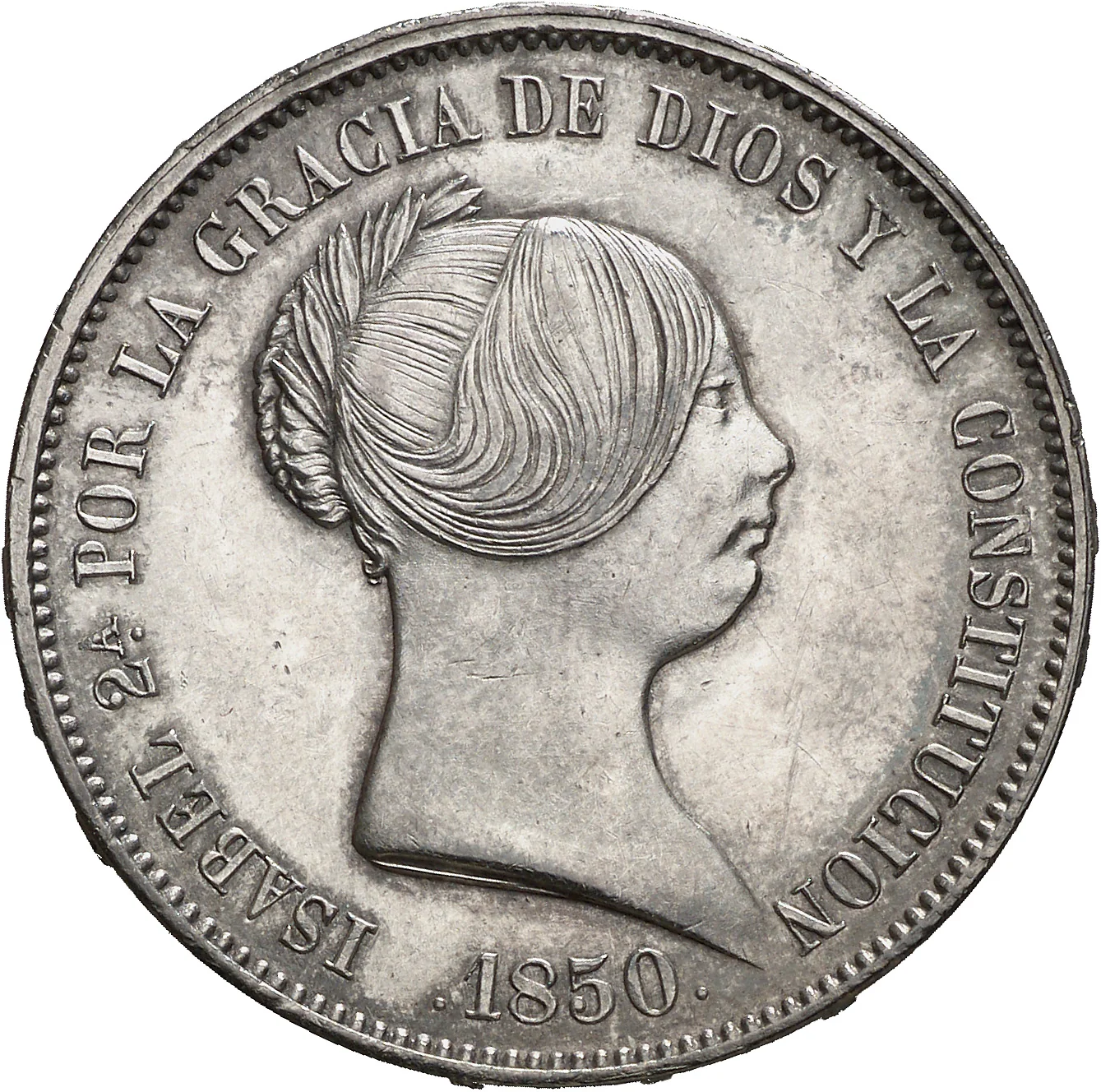
Young Isabella II facing right.
Inscription:
ISABEL 2A. POR LA GRACIA DE DIOS Y LA CONST
.1852.
.1852.
Translation:
Isabel 2nd, by the Grace of God and the Constitution.
1852.
1852.
Script: Latin
Language: Spanish
Engraver: Remigio Vega
Reverse
Description:
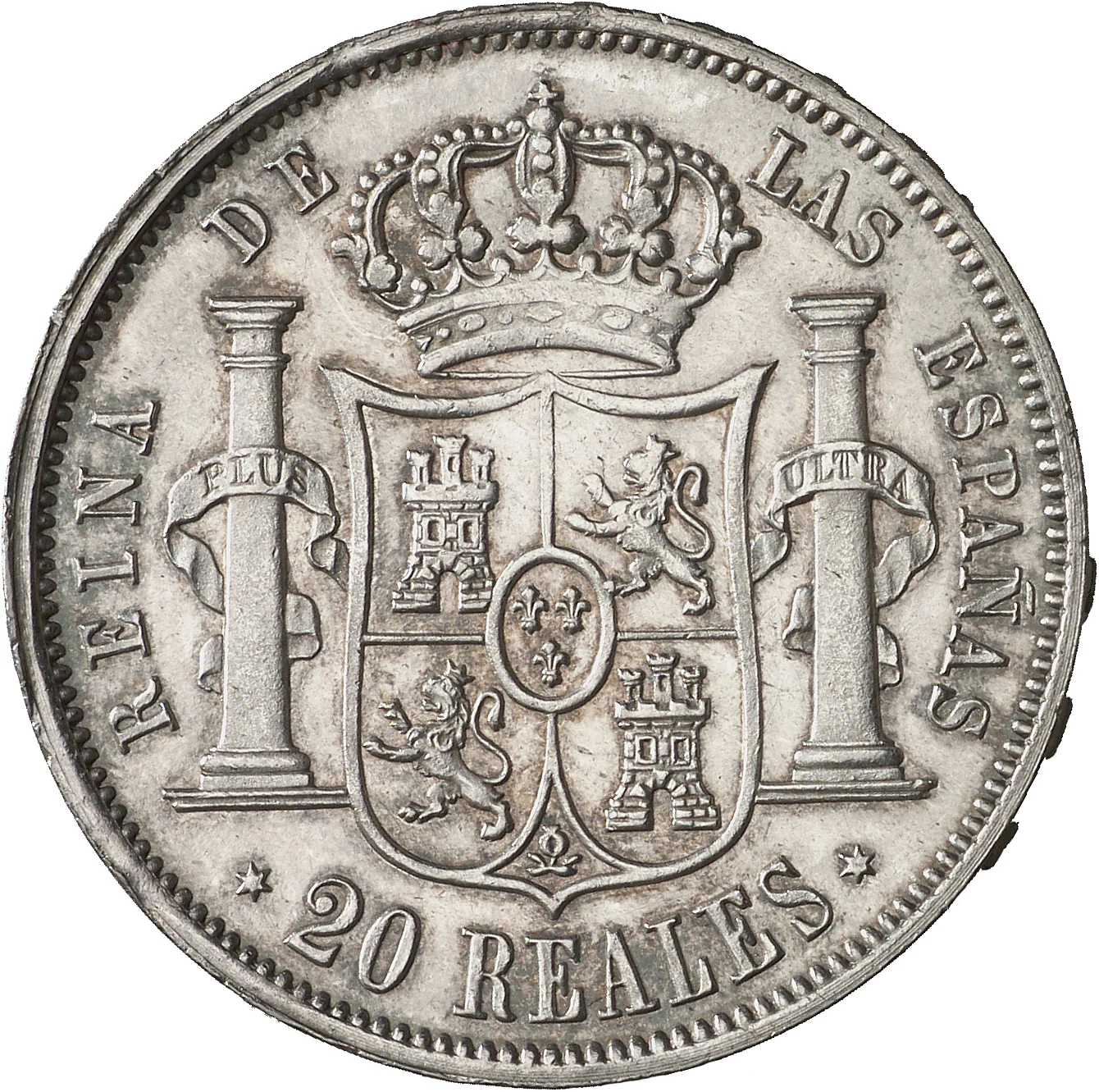
Spanish coat of arms with the Pillars of Hercules.
Inscription:
REINA DE LA ESPAÑAS
PLUS ULTRA
* 20 REALES *
PLUS ULTRA
* 20 REALES *
Translation:
QUEEN OF THE SPANISH LANDS
FURTHER BEYOND
* 20 REALES *
FURTHER BEYOND
* 20 REALES *
Script: Latin
Language: Spanish
Engraver: Remigio Vega
Edge
Categories
| Mythology |
| Symbols> Coat of Arms |
Mints
| Name | Mark |
|---|---|
| Barcelona Mint / La Seca | — |
| Royal Mint of Madrid | — |
| Royal Mint of Seville | — |
Mintings
| Year | Mint Mark | Mintage | Quality | Collection |
|---|---|---|---|---|
| 1847 | MDG | — | ||
| 1850 | — | — | ||
| 1851 | — | 1,055,000 | ||
| 1852 | — | 1,053,000 | ||
| 1854 | — | 1,355,000 | ||
| 1855 | — | 1,229,000 |
Historical background
In 1847, Spain's currency situation was characterized by profound instability and fragmentation, a legacy of the political and economic turmoil of the early 19th century. The national currency, the real, existed alongside a chaotic multitude of locally issued banknotes and coins from various private banks and regional entities, leading to a severe lack of uniform trust in the circulating medium. This period fell within the reign of Isabella II, a time marked by the Carlist Wars and frequent changes in government, which prevented the establishment of a strong, centralized monetary authority. The state treasury was chronically depleted, and the government often resorted to inflationary measures, such as issuing low-quality copper coinage (calderilla), which the public widely distrusted and often refused at face value.
The core of the problem was the absence of a single bank of issue with a nationwide monopoly. While the Bank of San Fernando (precursor to the Bank of Spain) existed, its notes were not universally accepted outside major commercial centers like Madrid. Consequently, transactions across different regions were cumbersome, hampering internal trade and economic development. The proliferation of disparate paper money created constant uncertainty about real value and convertibility, fostering a general preference for scarce silver and gold coinage among those who could obtain it, effectively creating a dual system where metal was hoarded and inferior currency circulated.
This untenable situation set the stage for the critical monetary reforms that would follow in the 1850s and 1860s. The 1847 crisis underscored the urgent need for consolidation and stability. It provided the impetus for the establishment of the Bank of Spain in 1856, which was gradually granted the exclusive right of note issue, and for the eventual adoption of the peseta as the sole national currency in 1868. Thus, the currency chaos of 1847 represents the final, acute phase of an old, fragmented system just before a series of decisive state-led reforms aimed at creating a modern, unified monetary system for Spain.
The core of the problem was the absence of a single bank of issue with a nationwide monopoly. While the Bank of San Fernando (precursor to the Bank of Spain) existed, its notes were not universally accepted outside major commercial centers like Madrid. Consequently, transactions across different regions were cumbersome, hampering internal trade and economic development. The proliferation of disparate paper money created constant uncertainty about real value and convertibility, fostering a general preference for scarce silver and gold coinage among those who could obtain it, effectively creating a dual system where metal was hoarded and inferior currency circulated.
This untenable situation set the stage for the critical monetary reforms that would follow in the 1850s and 1860s. The 1847 crisis underscored the urgent need for consolidation and stability. It provided the impetus for the establishment of the Bank of Spain in 1856, which was gradually granted the exclusive right of note issue, and for the eventual adoption of the peseta as the sole national currency in 1868. Thus, the currency chaos of 1847 represents the final, acute phase of an old, fragmented system just before a series of decisive state-led reforms aimed at creating a modern, unified monetary system for Spain.
🌟 Uncommon