

1 Pfennig – German Democratic Republic
Germany
Context
Years: 1952–1953
Country: Germany 
Issuer: German Democratic Republic 
Period:
(1949—1990)
Currency:
(1948—1990)
Demonetization: 31 December 1970
Total mintage: 511,386,659
Material
References
KM: #Click to copy to clipboard5
Numista: #3418
Value
Exchange value: 0.01 DDM
Obverse
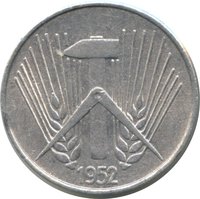
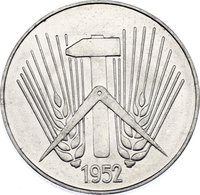
Description:
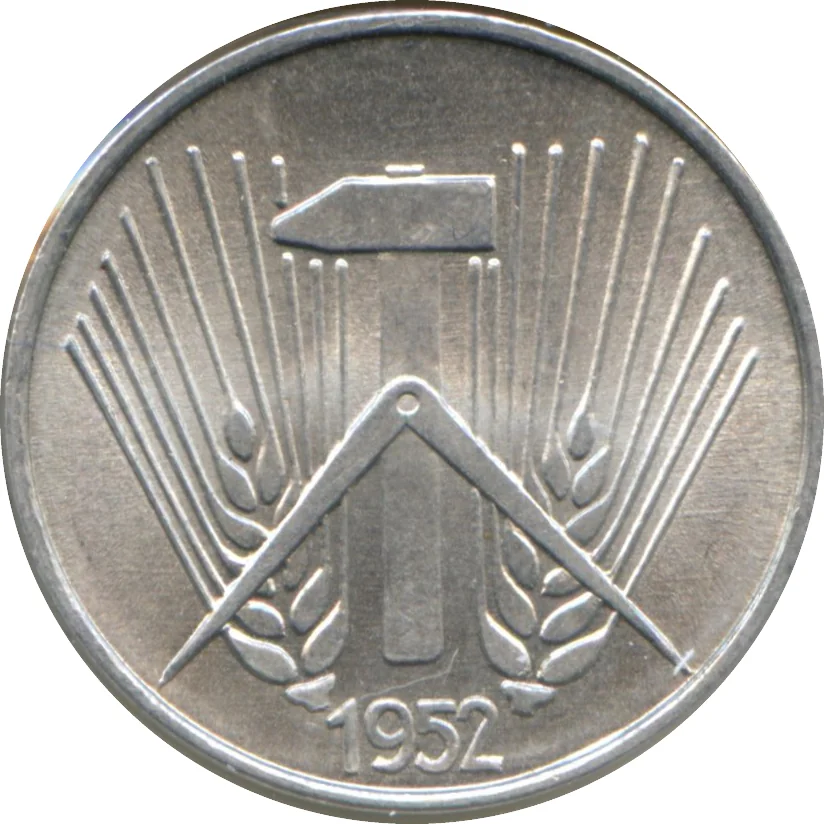
Hammer and compass on wheat, symbolizing the alliance of workers, peasants, and intelligentsia. Date below.
Inscription:
1952
Translation:
ONE PENNY
1952
1952
Script: Latin
Language: English
Engraver: Franz Paul Krischker
Reverse
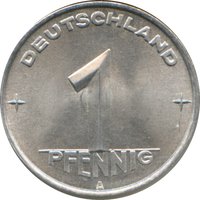
Description:
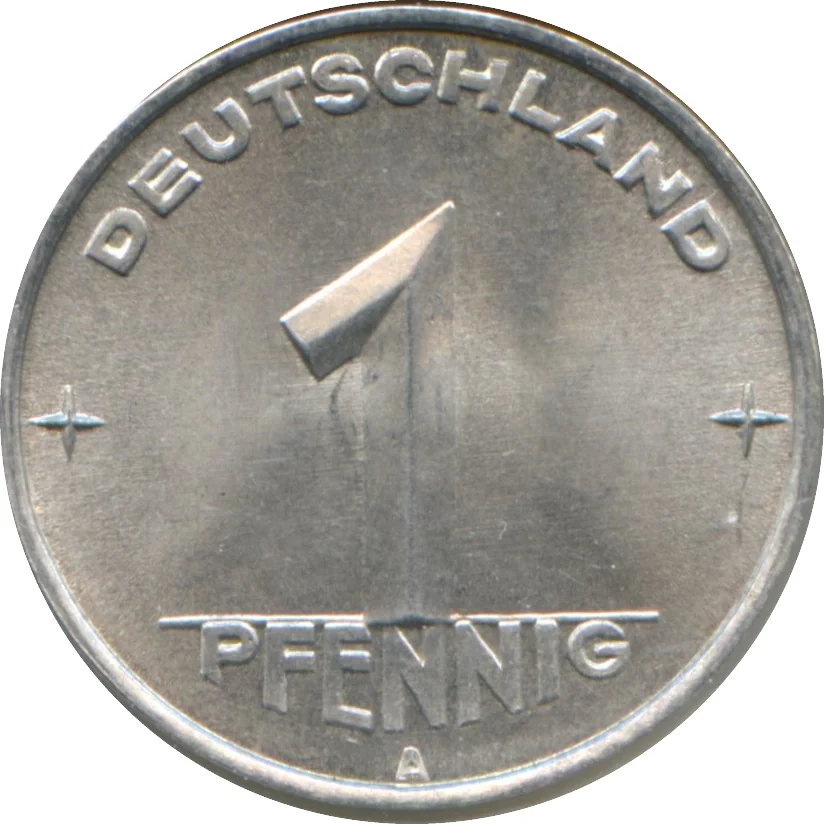
"DEUTSCHLAND" above, mintmark below "PFENNIG".
Inscription:
DEUTSCHLAND
1 PFENNIG
A
1 PFENNIG
A
Translation:
Germany
1 Penny
A
1 Penny
A
Script: Latin
Language: German
Engraver: Franz Paul Krischker
Edge
Plain
Mints
| Name | Mark |
|---|---|
| Berlin | A |
| Muldenhütten | E |
Mintings
Historical background
In 1952, the currency situation in the German Democratic Republic (GDR) was defined by the ongoing division of Germany and the GDR's integration into the Soviet economic sphere. The East German Mark (officially the Mark der Deutschen Notenbank) remained a separate and weaker currency than the West German Deutsche Mark, a division formalized by the 1948 currency reform. This separation created a persistent black market for Western currency, as the Ostmark was not convertible internationally and was viewed with suspicion by the population, undermining state control over the economy.
Economically, the year was marked by the launch of the GDR's first Five-Year Plan, a Stalinist program emphasizing heavy industry and collectivization. This ambitious plan placed immense strain on state finances and consumer goods production, leading to shortages. The government responded with austerity measures, including a wave of price increases in public services and basic goods in the spring of 1952. This effectively devalued the purchasing power of the Ostmark for ordinary citizens, exacerbating public dissatisfaction and contributing to the growing economic disparity with West Germany.
Politically, the currency situation was tightly controlled as part of the broader Abtrennung (separation) policy following Stalin's March Notes, which rejected German reunification. The government intensified efforts to insulate its economy from the West, cracking down on black market currency trading and restricting inter-zonal travel. However, the fundamental weakness of the Ostmark and the contrasting strength of the Deutsche Mark created a powerful pull factor, setting the stage for the catastrophic drain of skilled labor that would culminate in the construction of the Berlin Wall in 1961. Thus, in 1952, the East German currency was not just an economic instrument but a symbol of the GDR's fragile legitimacy and its coercive struggle for economic autonomy.
Economically, the year was marked by the launch of the GDR's first Five-Year Plan, a Stalinist program emphasizing heavy industry and collectivization. This ambitious plan placed immense strain on state finances and consumer goods production, leading to shortages. The government responded with austerity measures, including a wave of price increases in public services and basic goods in the spring of 1952. This effectively devalued the purchasing power of the Ostmark for ordinary citizens, exacerbating public dissatisfaction and contributing to the growing economic disparity with West Germany.
Politically, the currency situation was tightly controlled as part of the broader Abtrennung (separation) policy following Stalin's March Notes, which rejected German reunification. The government intensified efforts to insulate its economy from the West, cracking down on black market currency trading and restricting inter-zonal travel. However, the fundamental weakness of the Ostmark and the contrasting strength of the Deutsche Mark created a powerful pull factor, setting the stage for the catastrophic drain of skilled labor that would culminate in the construction of the Berlin Wall in 1961. Thus, in 1952, the East German currency was not just an economic instrument but a symbol of the GDR's fragile legitimacy and its coercive struggle for economic autonomy.
🌱 Very Common