

50 Cents – East Africa
Context
Years: 1906–1910
Issuer: East Africa
Ruler: Edward VII
Currency:
(1906—1920)
Demonetized: Yes
Total mintage: 400,000
Material
References
KM: #Click to copy to clipboard4
Numista: #34070
Value
Bullion value: $13.31
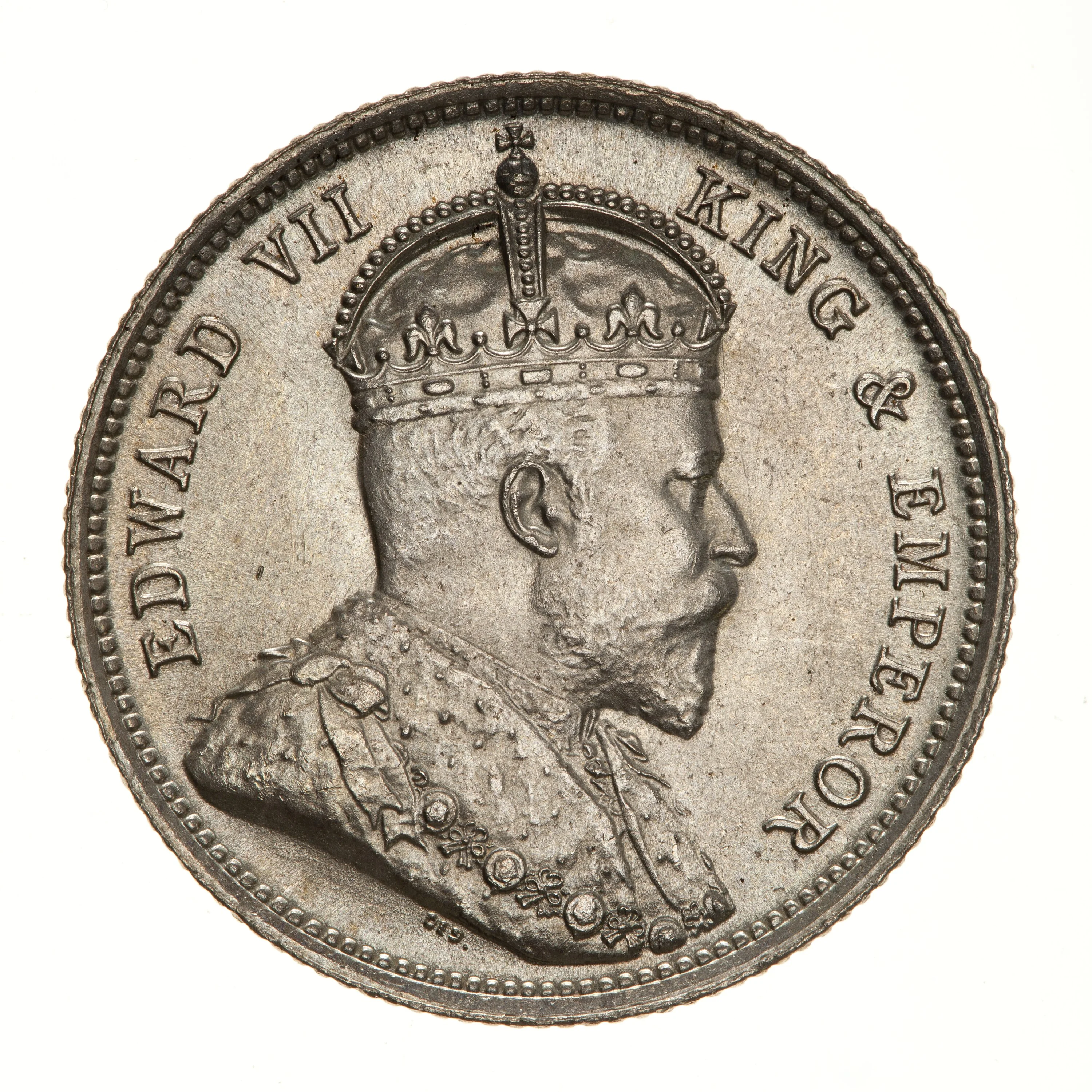
Obverse
Description:
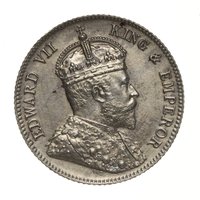
Edward VII bust right, legend surrounding.
Inscription:
EDWARD VII KING & EMPEROR
DES.
DES.
Script: Latin
Engraver: George William de Saulles
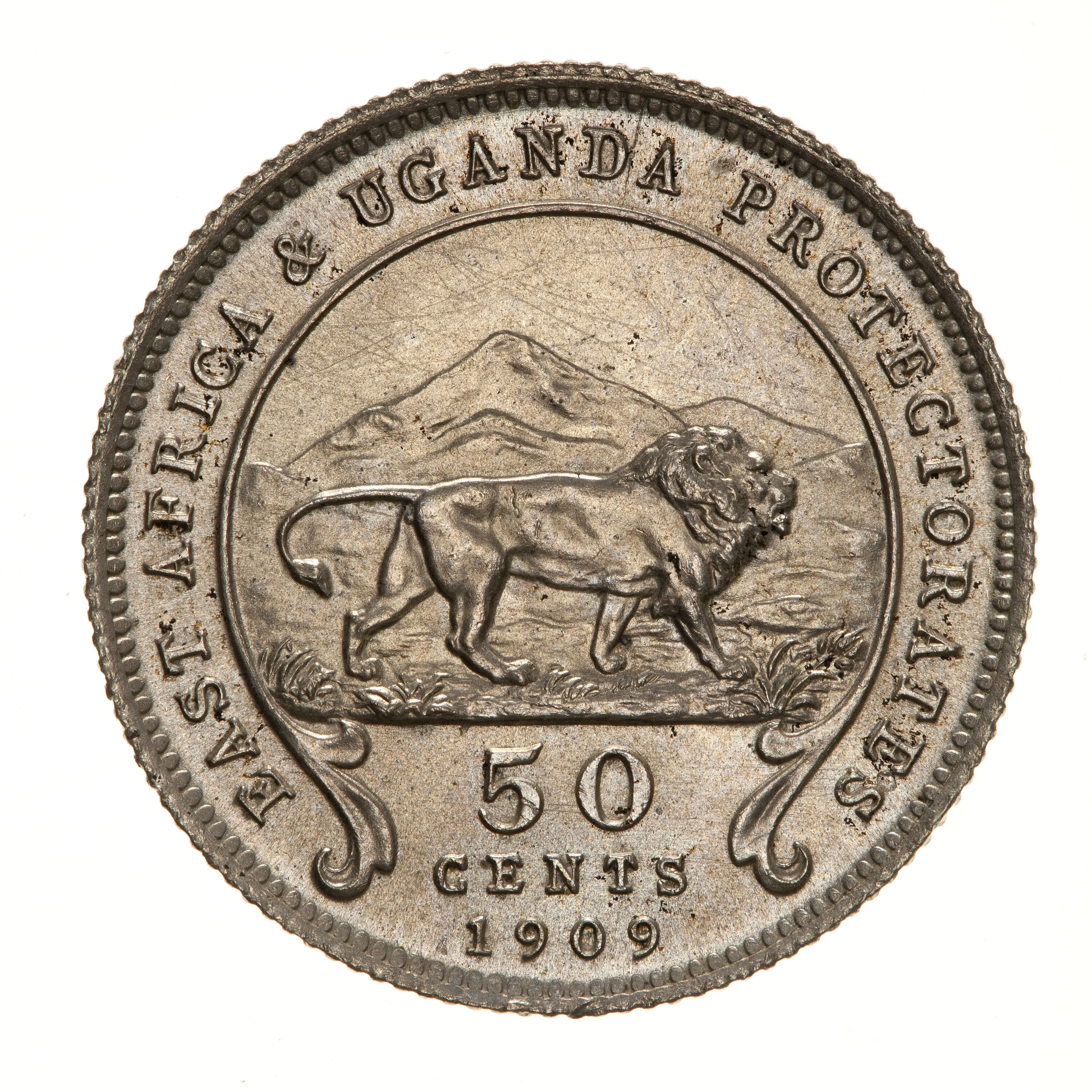
Reverse
Description:
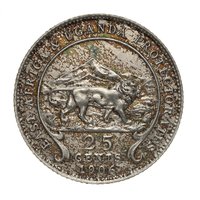
Lion walking right, with name, date, and surrounding caption.
Inscription:
EAST AFRICA & UGANDA PROTECTORATES
50
CENTS
1906
50
CENTS
1906
Script: Latin
Edge
Mints
| Name | Mark |
|---|---|
| Royal Mint (Tower Hill) | — |
Mintings
| Year | Mint Mark | Mintage | Quality | Collection |
|---|---|---|---|---|
| 1906 | — | 200,000 | ||
| 1906 | — | — | Proof | |
| 1909 | — | 100,000 | ||
| 1910 | — | 100,000 |
Historical background
In 1906, the currency landscape of East Africa was a complex patchwork shaped by colonial ambitions and pre-existing trade networks. The region was divided between British and German spheres of influence, each imposing its own monetary system. British East Africa (present-day Kenya and Uganda) used the Indian Rupee as its official currency, a legacy of British imperial administration through India. Meanwhile, German East Africa (present-day Tanzania, Rwanda, Burundi) operated on the German East African Rupie, a distinct silver coinage. Alongside these official currencies, the Maria Theresa Thaler—a large silver coin minted in Austria—remained a trusted and ubiquitous medium for long-distance and high-value trade, particularly in the interior, due to its consistent silver content and wide acceptance.
This multi-currency environment created significant practical challenges for both local populations and colonial economies. Fluctuating exchange rates between the Indian Rupee, the German Rupie, and the Thaler hampered cross-border trade and administration. The British administration faced particular difficulties, as the Indian Rupee was unpopular with European settlers and traders who found it cumbersome and ill-suited to a growing cash economy. This discontent was a key driver behind British plans for monetary reform, which would culminate in 1906 with the establishment of a new currency board.
Consequently, 1906 stands as a pivotal year of transition, especially for the British territories. The East African Protectorate (Kenya) introduced the East African Florin in 1906, valued at two shillings and intended to replace the Indian Rupee. However, this experiment was short-lived; by 1907, the Florin was itself replaced by the East African Shilling, which became the stable and unifying currency for British East Africa, Uganda, and later Tanganyika. Thus, 1906 represents the beginning of the end for the Indian Rupee's dominance and a decisive step toward a sterling-linked monetary system that would define the region for decades.
This multi-currency environment created significant practical challenges for both local populations and colonial economies. Fluctuating exchange rates between the Indian Rupee, the German Rupie, and the Thaler hampered cross-border trade and administration. The British administration faced particular difficulties, as the Indian Rupee was unpopular with European settlers and traders who found it cumbersome and ill-suited to a growing cash economy. This discontent was a key driver behind British plans for monetary reform, which would culminate in 1906 with the establishment of a new currency board.
Consequently, 1906 stands as a pivotal year of transition, especially for the British territories. The East African Protectorate (Kenya) introduced the East African Florin in 1906, valued at two shillings and intended to replace the Indian Rupee. However, this experiment was short-lived; by 1907, the Florin was itself replaced by the East African Shilling, which became the stable and unifying currency for British East Africa, Uganda, and later Tanganyika. Thus, 1906 represents the beginning of the end for the Indian Rupee's dominance and a decisive step toward a sterling-linked monetary system that would define the region for decades.
⭐ Somewhat Rare