

1 Cent – East Africa
Context
Years: 1907–1908
Issuer: East Africa
Ruler: Edward VII
Currency:
(1906—1920)
Demonetized: Yes
Total mintage: 9,819,400
Material
Diameter: 22.9 mm
Weight: 1.94 g
Thickness: 2.9 mm
Shape: Round with a round hole
Composition: Aluminium
Magnetic: No
Technique: Milled
Alignment: Medal alignment
flip
References
KM: #Click to copy to clipboard5
Numista: #33342
Obverse
Description:
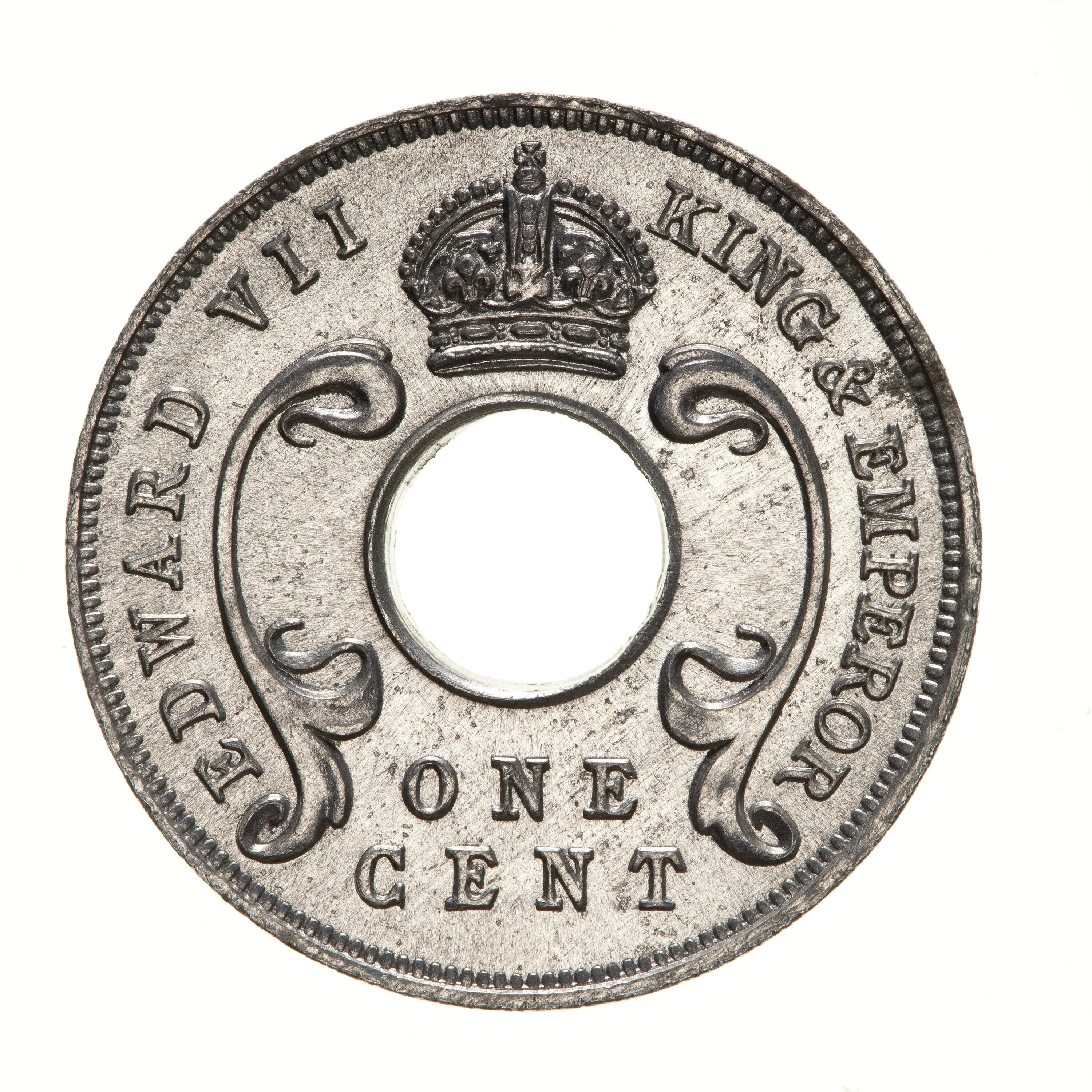
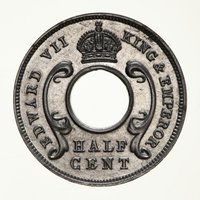
The central hole sits between the crown above and face value below. Stylized lines flank it, rising from the coin's base to the cross's edge. The legend appears between these lines and the scroll on both sides.
Inscription:
EDWARD VII KING & EMPEROR
ONE
CENT
ONE
CENT
Script: Latin
Reverse
Description:
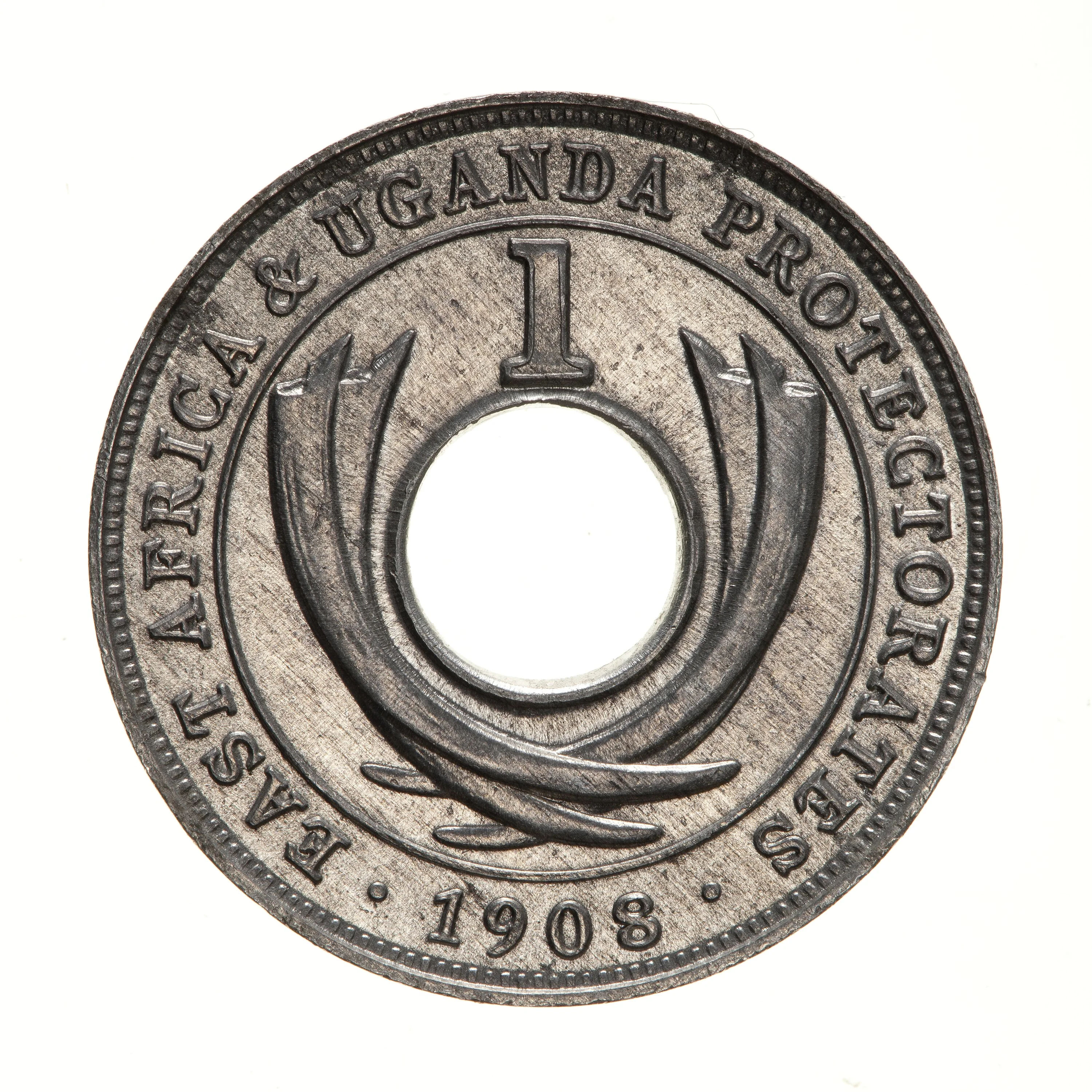
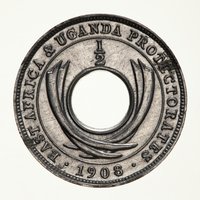
Crossed elephant tusks with top denomination, encircled by legend.
Inscription:
EAST AFRICA & UGANDA PROTECTORATES
1
1907
1
1907
Script: Latin
Edge
Plain
Mints
| Name | Mark |
|---|---|
| Royal Mint (Tower Hill) | — |
Mintings
| Year | Mint Mark | Mintage | Quality | Collection |
|---|---|---|---|---|
| 1907 | — | 6,948,000 | ||
| 1908 | — | 2,871,400 |
Historical background
In 1907, East Africa's currency landscape was a complex mosaic shaped by colonial ambitions, international trade, and local economies. The region was divided between British and German spheres of influence, with the British East Africa Protectorate (present-day Kenya) and the Uganda Protectorate under British control, and German East Africa (present-day Tanzania, Rwanda, Burundi) under German administration. Each colonial power sought to impose its monetary system to facilitate administration, tax collection, and the integration of their territories into the global imperial economy. However, these systems coexisted and competed with a persistent circulation of older, familiar currencies, including the Indian Rupee, Maria Theresa Thalers, and cowrie shells, which remained vital for local and regional trade.
The British administration was actively transitioning from the Indian Rupee, which had been the official currency, to a new decimal system based on the East African Rupee, divided into 100 cents. This change, formalized by the East African Currency Order in 1905, was driven by a desire to break from the Indian monetary sphere and establish a distinct currency union for its East African territories. Simultaneously, in German East Africa, the German East African Rupie (also tied to the Indian Rupee standard) was the official coin, but the currency situation was notoriously chaotic. The government struggled with severe shortages of small change, leading to widespread use of barter and imported coins, undermining economic stability and colonial control.
This period was thus one of monetary flux and imposition. Colonial currencies were not yet fully dominant, creating a hybrid monetary environment. The driving forces were clear: to displace indigenous means of exchange, stabilize colonial economies for the benefit of European settlers and trading companies, and firmly link the region's wealth to the imperial core. The outcomes of these 1907 currency dynamics would lay the groundwork for the future East African shilling systems and create lasting financial borders in the region.
The British administration was actively transitioning from the Indian Rupee, which had been the official currency, to a new decimal system based on the East African Rupee, divided into 100 cents. This change, formalized by the East African Currency Order in 1905, was driven by a desire to break from the Indian monetary sphere and establish a distinct currency union for its East African territories. Simultaneously, in German East Africa, the German East African Rupie (also tied to the Indian Rupee standard) was the official coin, but the currency situation was notoriously chaotic. The government struggled with severe shortages of small change, leading to widespread use of barter and imported coins, undermining economic stability and colonial control.
This period was thus one of monetary flux and imposition. Colonial currencies were not yet fully dominant, creating a hybrid monetary environment. The driving forces were clear: to displace indigenous means of exchange, stabilize colonial economies for the benefit of European settlers and trading companies, and firmly link the region's wealth to the imperial core. The outcomes of these 1907 currency dynamics would lay the groundwork for the future East African shilling systems and create lasting financial borders in the region.
⭐ Somewhat Rare