

100 Réis – Brazil
Brazil
Context
Years: 1938–1942
Issuer: Brazil 
Period:
(1889—1967)
Currency:
(1799—1942)
Demonetized: Yes
Total mintage: 18,188,000
Material
Diameter: 16.87 mm
Weight: 2.53 g
Thickness: 1.4 mm
Shape: Round
Composition: Copper-nickel
Technique: Milled
Alignment: Coin alignment
flip
References
KM: #Click to copy to clipboard544
Numista: #10242
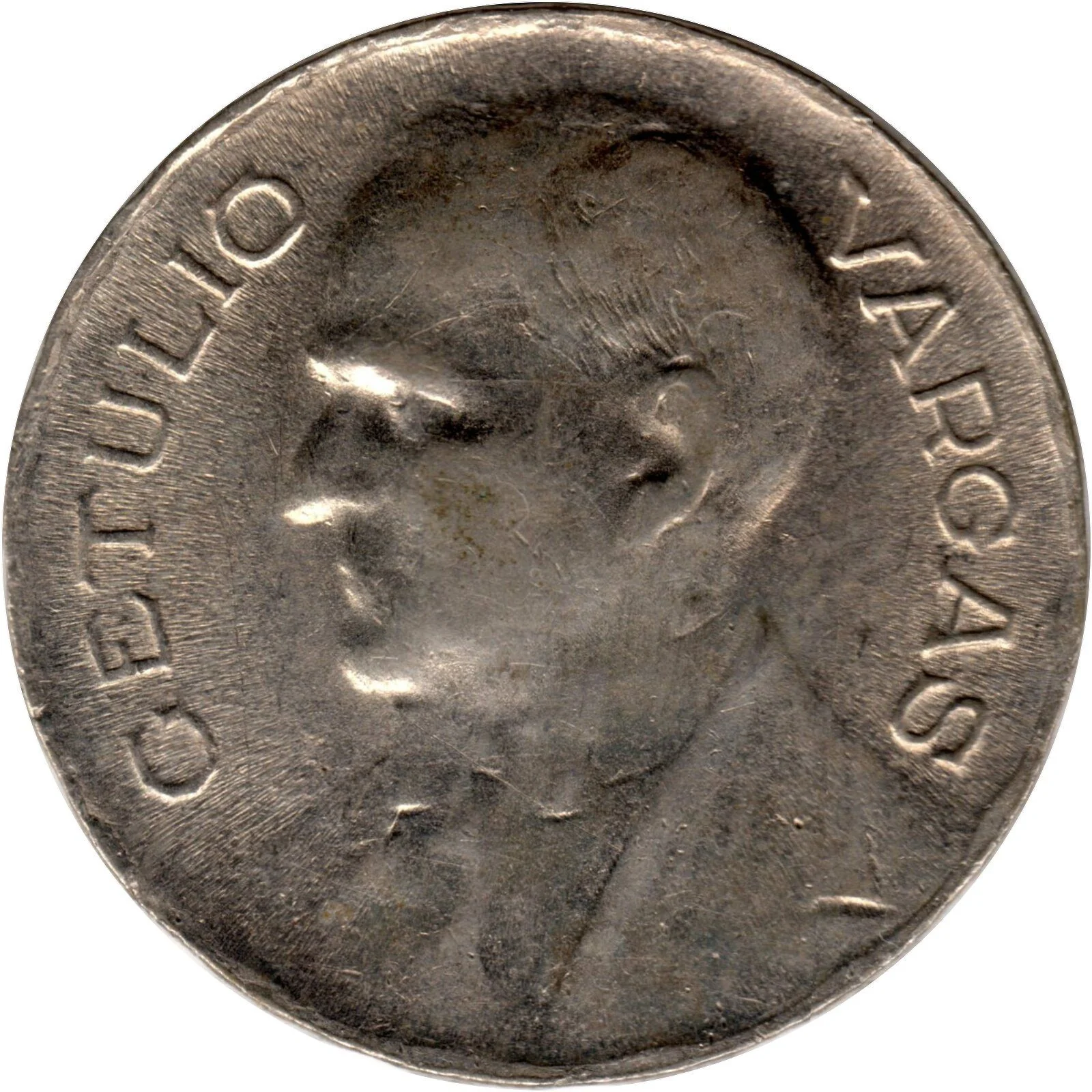
Obverse
Description:
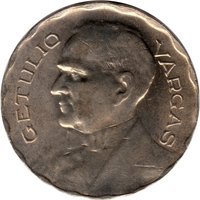
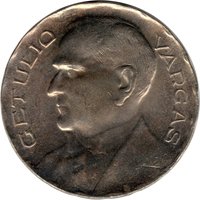
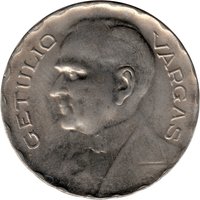
Portrait of Getúlio Vargas (1882–1954), Brazilian president who ruled as dictator from 1930 to 1945 and was democratically elected from 1951 until his 1954 suicide.
Inscription:
GETULIO VARGAS
Script: Latin
Engraver: Leopoldo Alves Campos
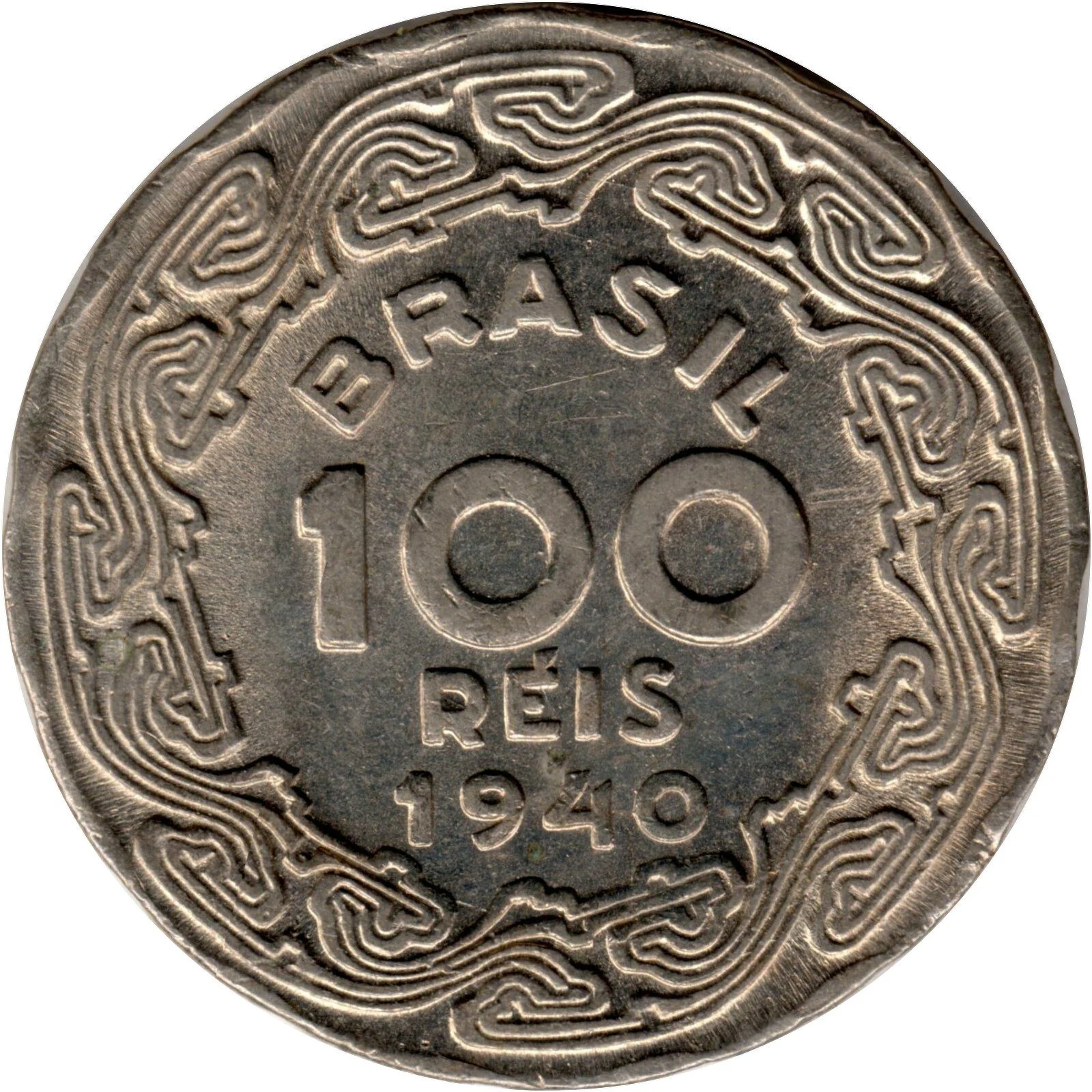
Reverse
Description:
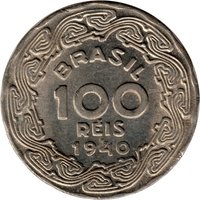
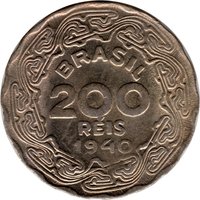
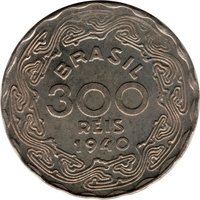
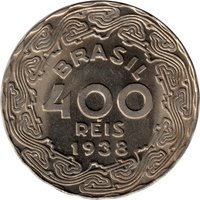
Denomination encircled by Marajoara collar above date.
Inscription:
BRASIL
100
RÉIS
1940
100
RÉIS
1940
Translation:
Brazil
100
Réis
1940
100
Réis
1940
Script: Latin
Language: Portuguese
Engraver: Orlando Moutinho Maia
Edge
Indented
Categories
| Person> Politician |
Mintings
| Year | Mint Mark | Mintage | Quality | Collection |
|---|---|---|---|---|
| 1938 | — | 8,106,000 | ||
| 1940 | — | 8,797,000 | ||
| 1942 | — | 1,285,000 |
Historical background
In 1938, Brazil's currency situation was characterized by the dominance of the mil-réis and the significant influence of the Coffee Valorization Policy on the national economy. The country operated under a gold-exchange standard, but in practice, the currency's value was heavily managed by the government, particularly through the Brazilian Exchange Commission (Caixa de Estabilização). This body intervened to stabilize the mil-réis, but its value remained volatile and susceptible to fluctuations in global coffee prices, which were Brazil's primary export and source of foreign exchange. The Great Depression had severely depleted Brazil's gold reserves, leading to exchange controls and a de facto managed currency system rather than a true free-market peg.
President Getúlio Vargas's Estado Novo regime, established in 1937, centralized economic authority, using monetary policy as a tool for state-led industrialization. The government actively suppressed inflation through price controls and regulated foreign exchange to prioritize essential imports like machinery and fuel for nascent industries. This period saw a deliberate move away from a purely export-dependent model, with policies designed to conserve foreign currency and reduce the economy's vulnerability to the volatile coffee sector. Consequently, the official exchange rate often diverged significantly from black-market rates, reflecting the tight controls and scarcity of hard currency.
Overall, the 1938 currency landscape was one of transition and control. While nominally on a gold standard, the mil-réis was effectively a managed fiat currency, underpinned by exchange controls and state intervention. The primary economic objectives were stabilizing the coffee economy, promoting import-substitution industrialization, and maintaining monetary sovereignty—all hallmarks of Vargas's authoritarian developmentalist state. This controlled system would eventually pave the way for the more sweeping currency reform of 1942, which introduced the cruzeiro to simplify the monetary system and further cement state management of the economy.
President Getúlio Vargas's Estado Novo regime, established in 1937, centralized economic authority, using monetary policy as a tool for state-led industrialization. The government actively suppressed inflation through price controls and regulated foreign exchange to prioritize essential imports like machinery and fuel for nascent industries. This period saw a deliberate move away from a purely export-dependent model, with policies designed to conserve foreign currency and reduce the economy's vulnerability to the volatile coffee sector. Consequently, the official exchange rate often diverged significantly from black-market rates, reflecting the tight controls and scarcity of hard currency.
Overall, the 1938 currency landscape was one of transition and control. While nominally on a gold standard, the mil-réis was effectively a managed fiat currency, underpinned by exchange controls and state intervention. The primary economic objectives were stabilizing the coffee economy, promoting import-substitution industrialization, and maintaining monetary sovereignty—all hallmarks of Vargas's authoritarian developmentalist state. This controlled system would eventually pave the way for the more sweeping currency reform of 1942, which introduced the cruzeiro to simplify the monetary system and further cement state management of the economy.
Series: 1938 Brazil circulation coins
🌱 Very Common