

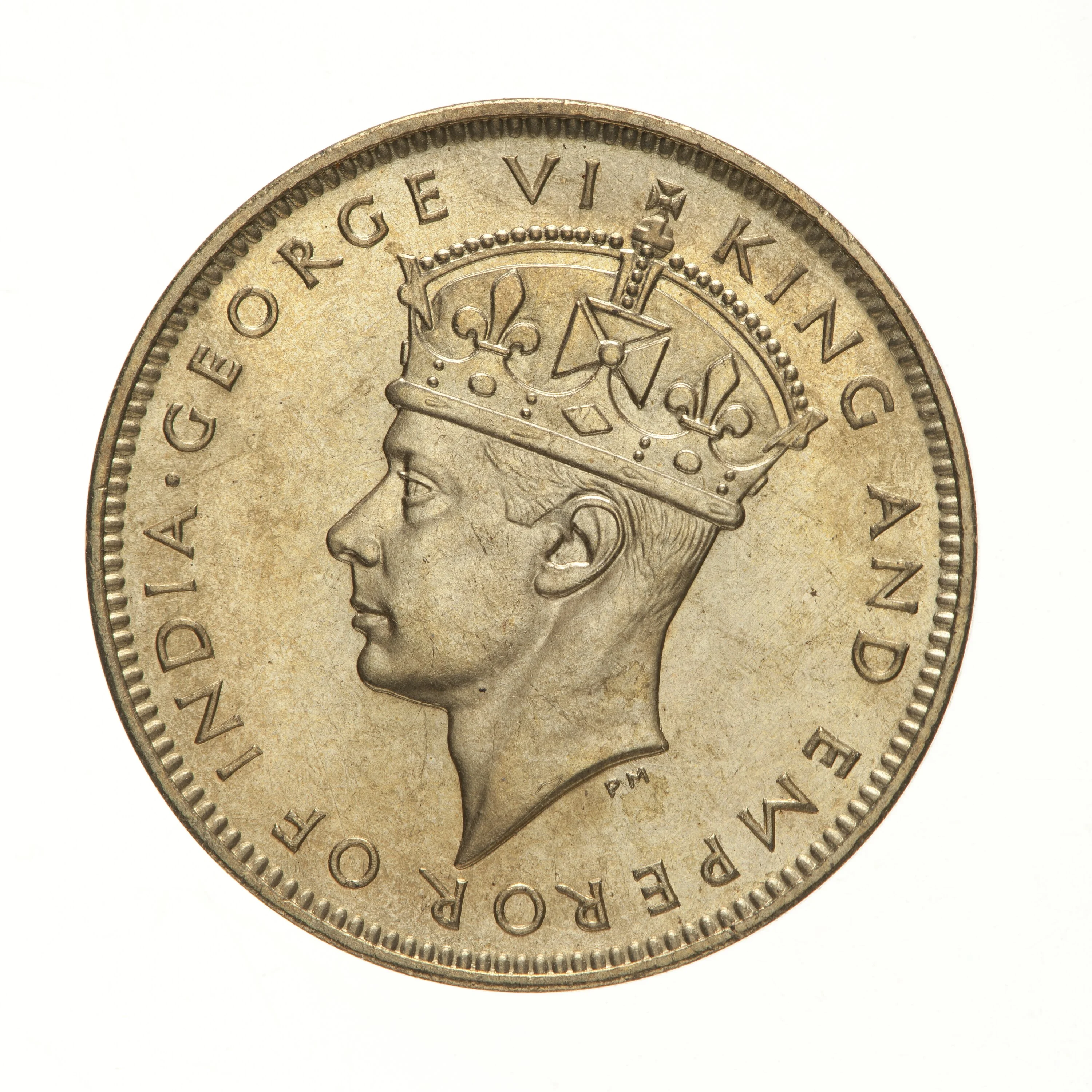
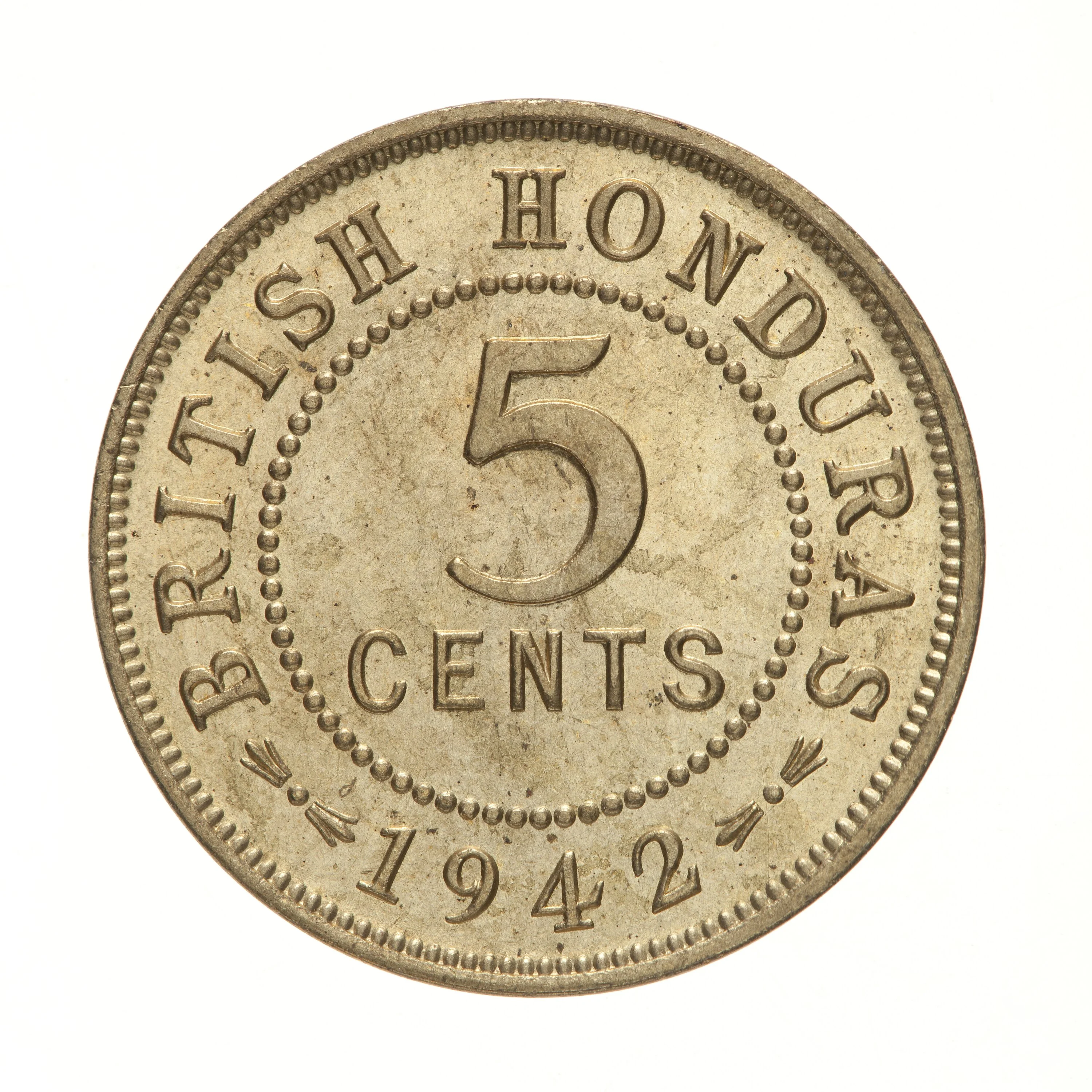
5 Cents – British Honduras
Belize
Context
Years: 1942–1947
Country: Belize 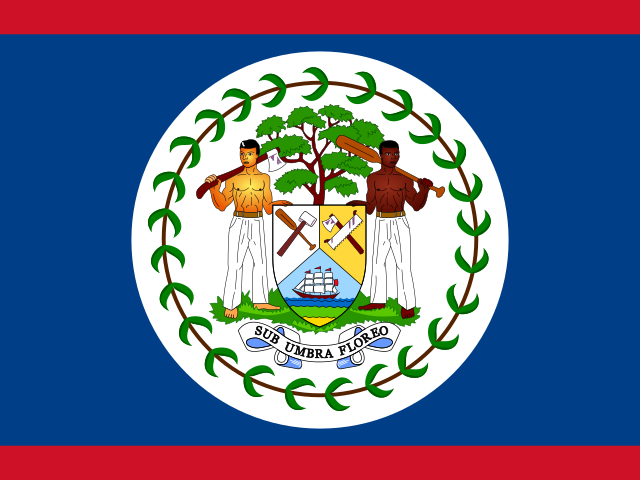
Issuer: British Honduras
Ruler: George VI
Currency:
(1885—1973)
Total mintage: 225,000
Material
Diameter: 20 mm
Weight: 3.63 g
Shape: Round
Composition: Nickel brass
Magnetic: No
Technique: Milled
Alignment: Medal alignment
flip
References
KM: #Click to copy to clipboard22a
Numista: #33981
Obverse
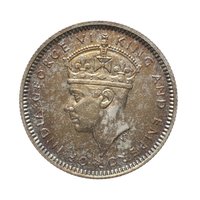
Description:
King George VI facing left.
Inscription:
· GEORGE VI KING AND EMPEROR OF INDIA
PM
PM
Translation:
GEORGE VI KING AND EMPEROR OF INDIA
Script: Latin
Language: English
Engraver: Percy Metcalfe
Reverse
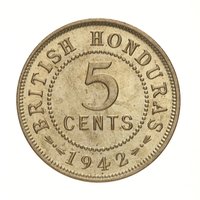
Description:
Denomination in beaded circle, date beneath.
Inscription:
BRITISH HONDURAS
5
CENTS
· 1945 ·
5
CENTS
· 1945 ·
Script: Latin
Edge
Mints
| Name | Mark |
|---|---|
| Royal Mint (Tower Hill) | — |
Mintings
| Year | Mint Mark | Mintage | Quality | Collection |
|---|---|---|---|---|
| 1942 | — | 30,000 | ||
| 1942 | — | — | Proof | |
| 1943 | — | 40,000 | ||
| 1944 | — | 50,000 | ||
| 1944 | — | — | Proof | |
| 1945 | — | 65,000 | ||
| 1945 | — | — | Proof | |
| 1947 | — | 40,000 | ||
| 1947 | — | — | Proof |
Historical background
In 1942, the currency situation in British Honduras (modern-day Belize) was defined by its integration into the broader sterling area and the direct consequences of the Second World War. The official currency was the British Honduras dollar, which had been pegged at a fixed rate of 4 shillings 2 pence sterling (or $4.80 BHD to £1 sterling) since 1894. This peg provided stability but tied the colony's economic fortunes directly to the United Kingdom. In practice, circulation consisted of local government paper notes and UK silver coinage, with the gold standard having been suspended at the outbreak of the war in 1939.
The war profoundly disrupted normal monetary operations. The colony faced severe shortages of hard currency, particularly UK silver coins, as the British government redirected precious metals and minting resources toward the war effort. This scarcity of small change created significant practical difficulties for daily commerce. In response, the British Honduras government issued low-denomination "war emergency" paper notes, including 1-cent and 5-cent denominations, to alleviate the coin shortage and keep the local economy functioning.
Furthermore, the colony's external trade and currency flows were brought under strict imperial control through the operation of the British Exchange Control system. All foreign exchange earnings, particularly from the vital export of mahogany and chicle to the United States, were pooled centrally in London. Access to US dollars or other "hard" currencies for imports was rationed and required official approval, prioritizing essential war supplies. Thus, the 1942 currency situation was one of managed scarcity, characterized by makeshift local solutions and subordination to the wider Sterling Area's wartime financial strategy.
The war profoundly disrupted normal monetary operations. The colony faced severe shortages of hard currency, particularly UK silver coins, as the British government redirected precious metals and minting resources toward the war effort. This scarcity of small change created significant practical difficulties for daily commerce. In response, the British Honduras government issued low-denomination "war emergency" paper notes, including 1-cent and 5-cent denominations, to alleviate the coin shortage and keep the local economy functioning.
Furthermore, the colony's external trade and currency flows were brought under strict imperial control through the operation of the British Exchange Control system. All foreign exchange earnings, particularly from the vital export of mahogany and chicle to the United States, were pooled centrally in London. Access to US dollars or other "hard" currencies for imports was rationed and required official approval, prioritizing essential war supplies. Thus, the 1942 currency situation was one of managed scarcity, characterized by makeshift local solutions and subordination to the wider Sterling Area's wartime financial strategy.
🌟 Limited