

20 francs – Hungary
Add to wishlist
Hungary
Context
Years: 1890–1892
Issuer: Hungary
Ruler: Francis Joseph I
Currency:
(1857—1892)
Subdivision: 20 francs = 8 Florins
Demonetized: Yes
Total mintage: 610,395
Material
References
KM: #
Numista: #33829
Value
Bullion value: $889.89
Obverse
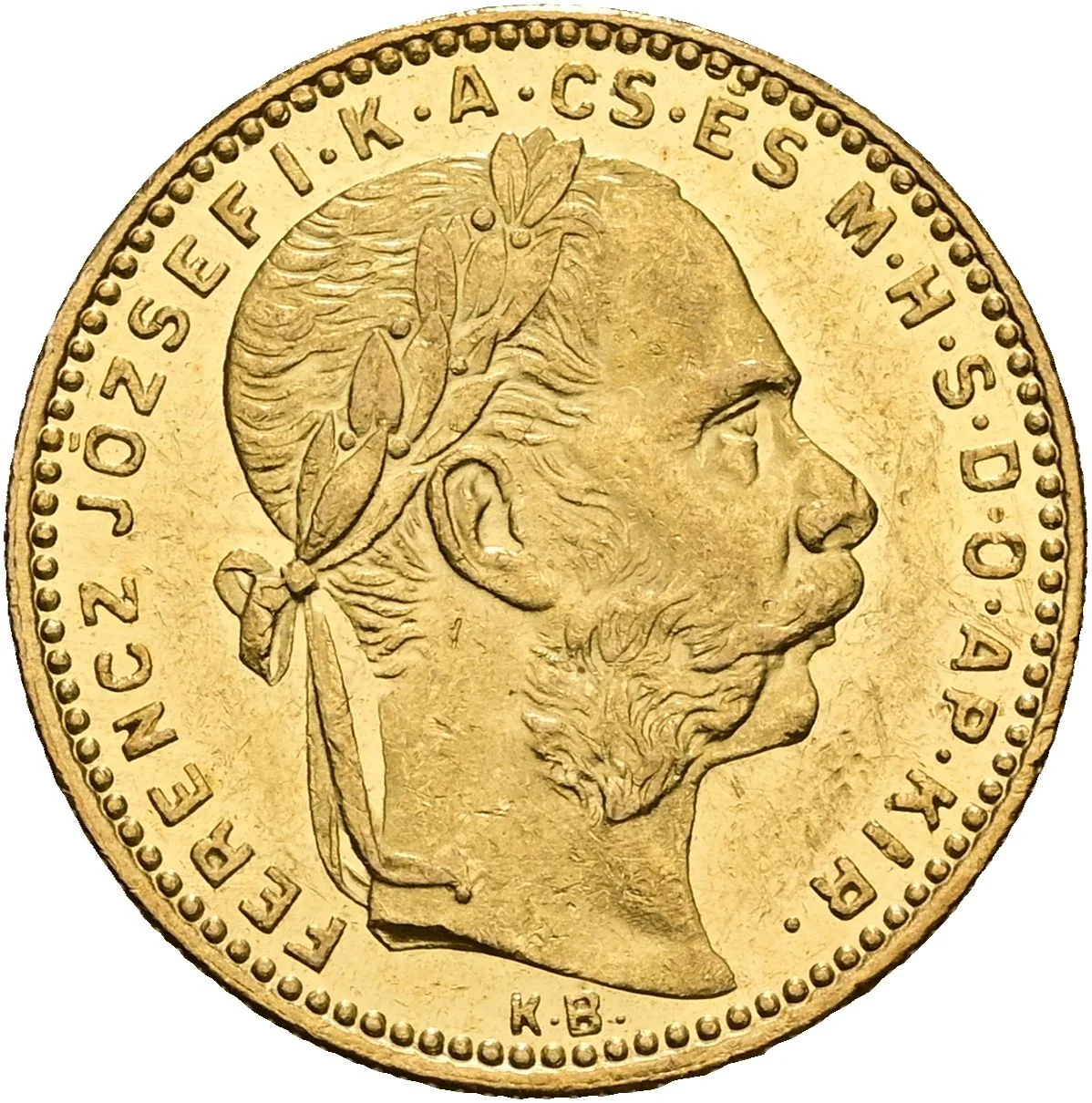
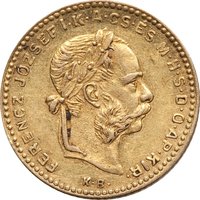
Description:
Right-facing bust
Inscription:
FERENCZ JÓZSEF I ·K · A · CS · ÉS · M · H · S · D · O · AP · KIR ·
K B
K B
Translation:
Francis Joseph I, by the Grace of God, Emperor of Austria, Apostolic King of Hungary, Croatia, Bohemia, and Dalmatia, etc. King.
Script: Latin
Engraver: Josef Tautenhayn
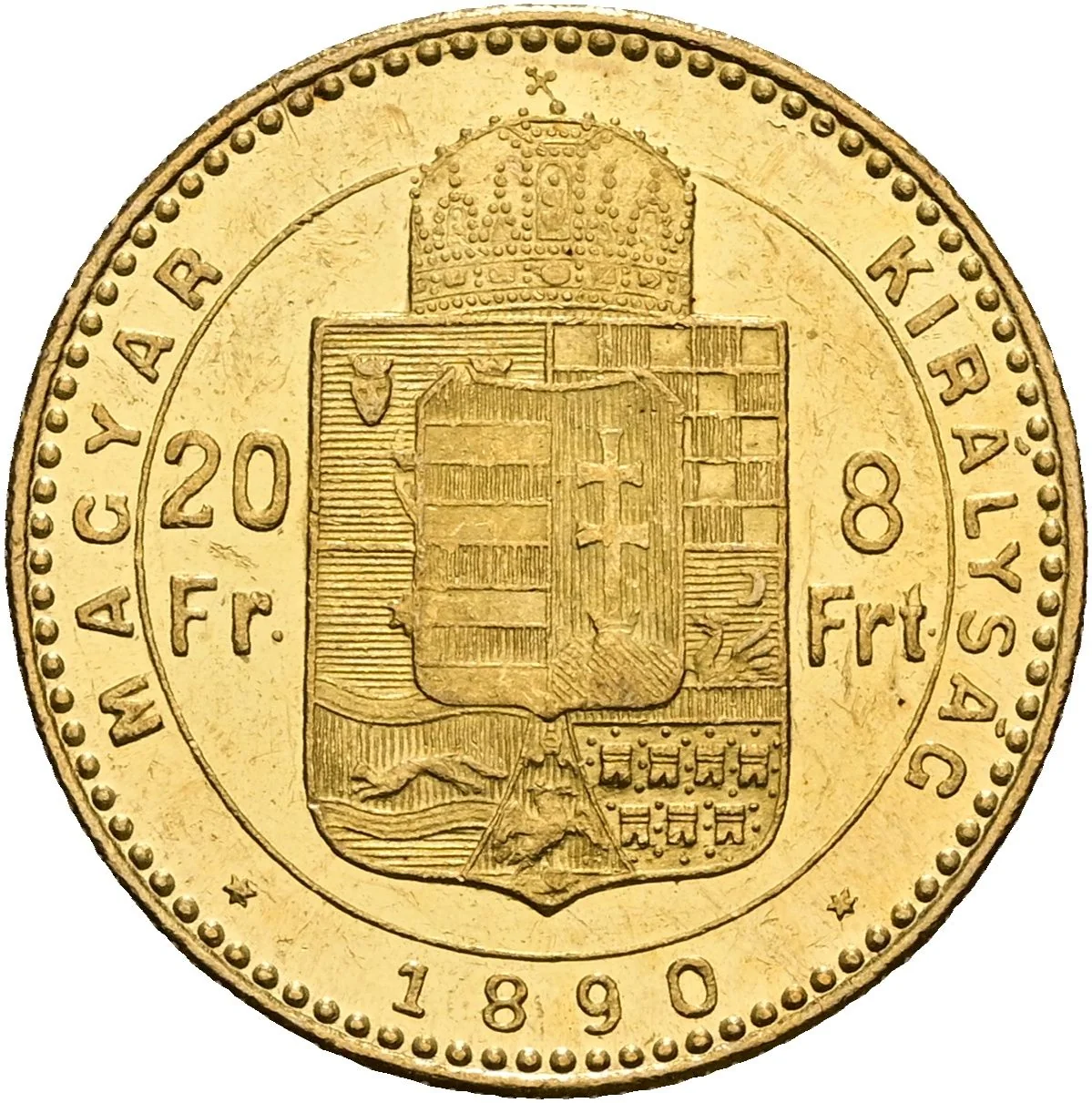
Reverse
Edge
Reeded
Mints
| Name | Mark |
|---|---|
| Kremnica | K B |
Mintings
| Year | Mint Mark | Mintage | Quality | Collection |
|---|---|---|---|---|
| 1890 | K | — | ||
| 1891 | K | 378,201 | ||
| 1892 | K | 232,194 |
Historical background
In 1890, the currency situation in Hungary, as part of the Austro-Hungarian Empire, was defined by the Austro-Hungarian gulden (or forint in Hungarian), which was on a silver standard. This system, established by the Austro-Hungarian Compromise of 1867, was shared with Austria, but the Hungarian government held significant influence over the joint National Bank. While the gulden was legally convertible to silver, the period was marked by fiscal pressures, including state debt and trade deficits, which periodically strained this convertibility and led to occasional circulation of paper notes not fully backed by metal.
The era was one of transition and debate. Influential financial circles and politicians, particularly in the more industrialized Austrian lands, began advocating for a shift to a gold standard, seen as more stable and aligned with major global economies like Britain and Germany. Hungary's powerful agrarian interests, however, were often wary, fearing that a stricter, deflationary gold standard could lower the price of their grain exports. Consequently, while the empire was inching toward monetary modernization, political tensions between the two halves and internal economic factions caused hesitation.
Thus, the currency situation in 1890 was one of institutional stability but underlying strain. The dual monarchy operated with a unified, silver-based currency, yet it stood at a crossroads, grappling with the fiscal demands of a modernizing state and the intense international and domestic pressures to adopt gold. This protracted debate would culminate just two years later, in 1892, with the official decision to transition to the gold-based Austro-Hungarian krone (korona), making 1890 a final chapter of the silver gulden era.
The era was one of transition and debate. Influential financial circles and politicians, particularly in the more industrialized Austrian lands, began advocating for a shift to a gold standard, seen as more stable and aligned with major global economies like Britain and Germany. Hungary's powerful agrarian interests, however, were often wary, fearing that a stricter, deflationary gold standard could lower the price of their grain exports. Consequently, while the empire was inching toward monetary modernization, political tensions between the two halves and internal economic factions caused hesitation.
Thus, the currency situation in 1890 was one of institutional stability but underlying strain. The dual monarchy operated with a unified, silver-based currency, yet it stood at a crossroads, grappling with the fiscal demands of a modernizing state and the intense international and domestic pressures to adopt gold. This protracted debate would culminate just two years later, in 1892, with the official decision to transition to the gold-based Austro-Hungarian krone (korona), making 1890 a final chapter of the silver gulden era.
⭐ Rare