

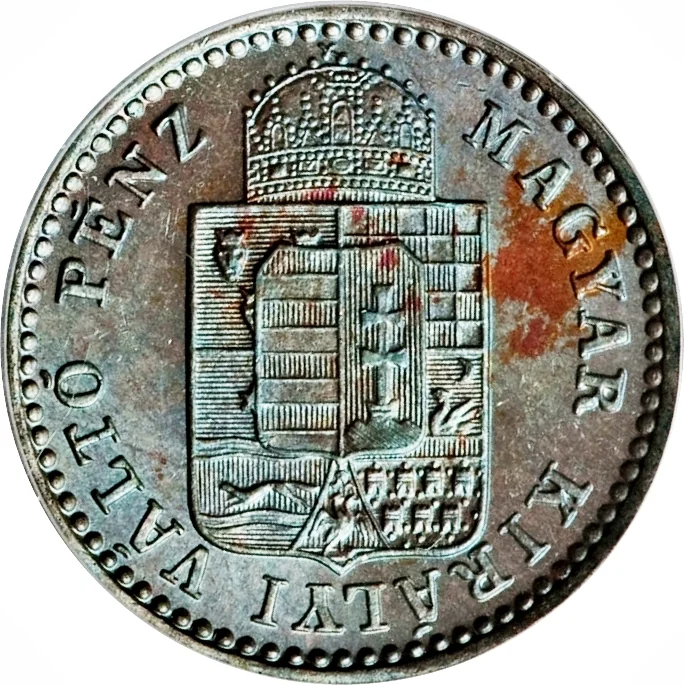
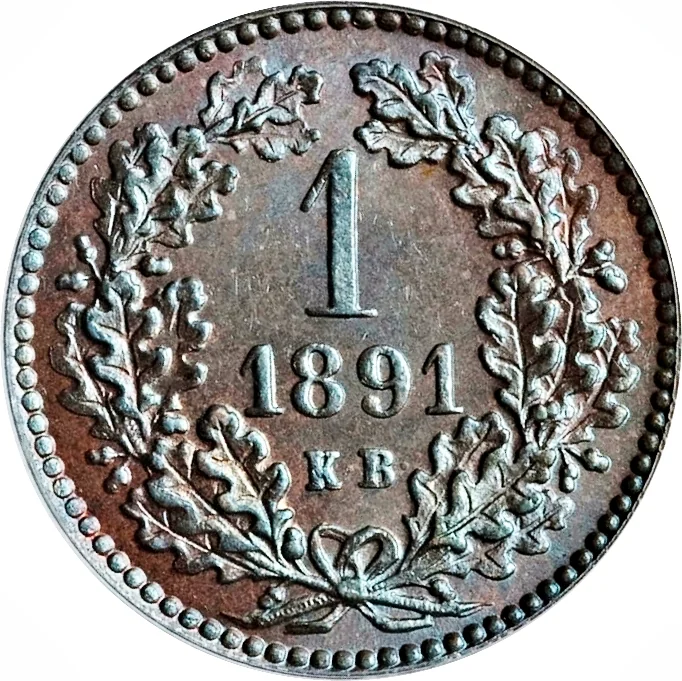
1 kreuzer – Hungary
Add to wishlist
Hungary
Context
Years: 1891–1892
Issuer: Hungary
Ruler: Francis Joseph I
Currency:
(1857—1892)
Demonetization: 30 June 1898
Total mintage: 22,142,183
Material
References
KM: #
Numista: #17298
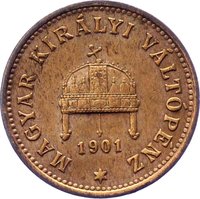
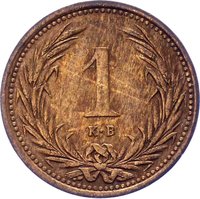
Obverse
Reverse
Edge
Plain
Mints
| Name | Mark |
|---|---|
| Kremnica | KB |
Mintings
| Year | Mint Mark | Mintage | Quality | Collection |
|---|---|---|---|---|
| 1891 | — | 16,271,659 | ||
| 1892 | — | 5,870,524 |
Historical background
In 1891, the Austro-Hungarian Empire, of which Hungary was a constituent kingdom, operated under a complex and strained currency system. The official currency was the Austro-Hungarian gulden (or forint in Hungarian), which was part of a silver standard. However, decades of state deficit financing, particularly following the costly Austro-Prussian War of 1866, had led to the issuance of irredeemable paper banknotes, creating a de facto fiat currency. This resulted in a persistent and troubling disparity: the paper gulden traded at a significant discount compared to silver coinage, causing economic uncertainty and hampering both domestic commerce and international trade.
The situation was a source of major political tension within the Dual Monarchy. Hungarian leaders and economists strongly criticized the common finance ministry in Vienna for its inflationary paper money policy, which they felt disadvantaged the Hungarian economy. There was a growing and forceful Hungarian demand for monetary reform, not just for stability, but also for greater national financial autonomy. The goal was to establish a modern, stable, and gold-convertible currency that would signal economic strength and facilitate integration into the European financial system.
Consequently, 1891 was not a year of stasis but a pivotal moment of legislative action. After intense negotiations, the parliaments in both Vienna and Budapest passed the groundbreaking laws for the introduction of the gold standard. This reform mandated the creation of a new currency unit, the korona (crown), which would replace the gulden at a fixed rate and be fully convertible to gold. Thus, the background of 1891 is defined by the culmination of long-standing monetary instability and political struggle, setting the stage for the transformative introduction of the gold-based korona in 1892.
The situation was a source of major political tension within the Dual Monarchy. Hungarian leaders and economists strongly criticized the common finance ministry in Vienna for its inflationary paper money policy, which they felt disadvantaged the Hungarian economy. There was a growing and forceful Hungarian demand for monetary reform, not just for stability, but also for greater national financial autonomy. The goal was to establish a modern, stable, and gold-convertible currency that would signal economic strength and facilitate integration into the European financial system.
Consequently, 1891 was not a year of stasis but a pivotal moment of legislative action. After intense negotiations, the parliaments in both Vienna and Budapest passed the groundbreaking laws for the introduction of the gold standard. This reform mandated the creation of a new currency unit, the korona (crown), which would replace the gulden at a fixed rate and be fully convertible to gold. Thus, the background of 1891 is defined by the culmination of long-standing monetary instability and political struggle, setting the stage for the transformative introduction of the gold-based korona in 1892.
🌱 Fairly Common