

1 Penny – United Kingdom
United Kingdom
Context
Years: 1860–1874
Issuer: United Kingdom 
Ruler: Victoria
Currency:
(1158—1970)
Demonetization: 31 August 1971
Total mintage: 142,707,001
Material
References
KM: #Click to copy to clipboard749
Numista: #3377
Obverse
Description:
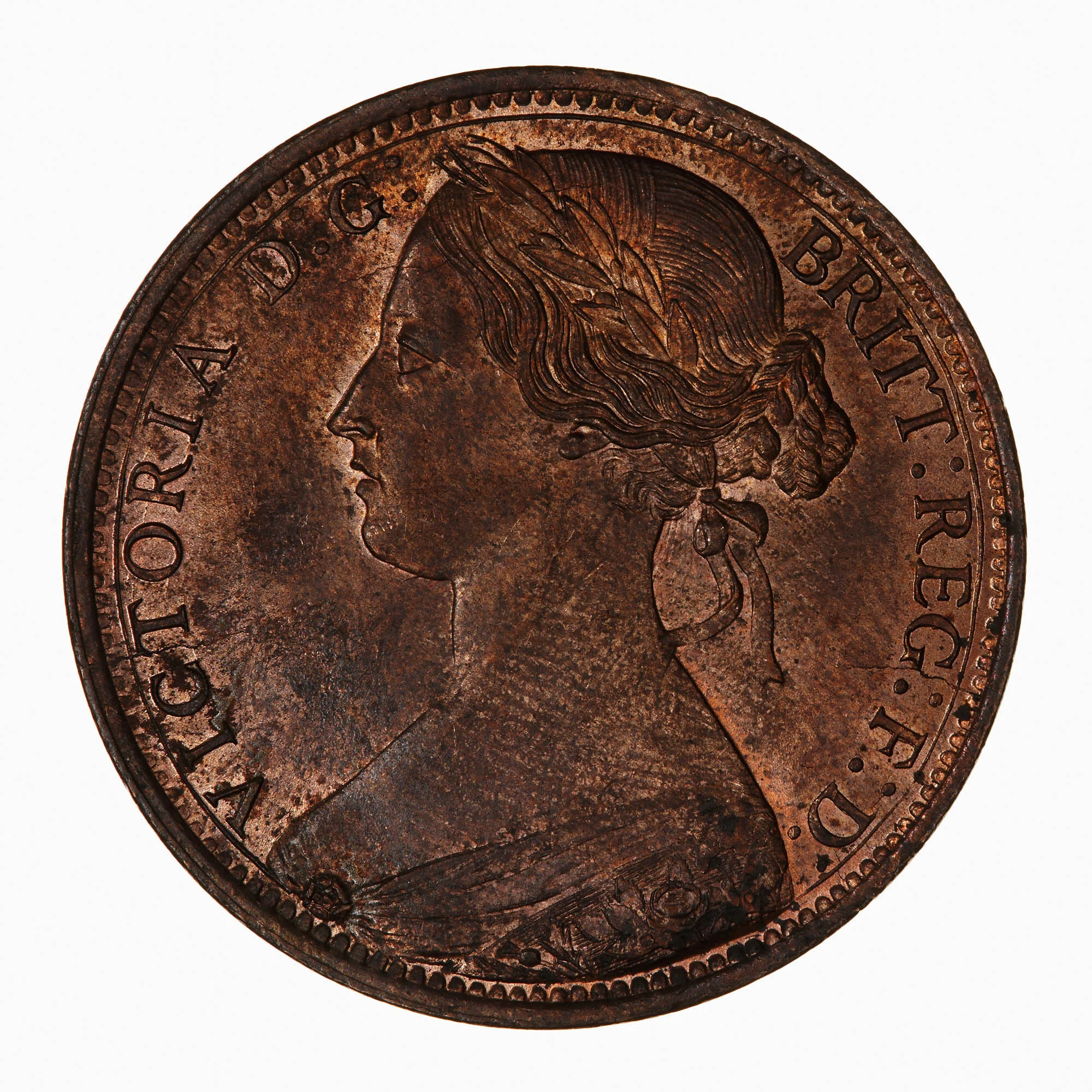
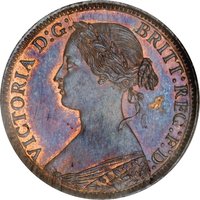
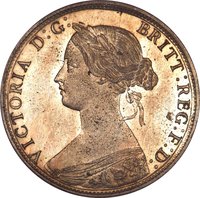
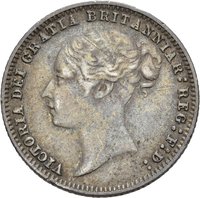
Second laureate and draped bust ('Bun Head') of Queen Victoria left, with legend around. Varieties exist.
Inscription:
VICTORIA D:G: BRITT:REG:F:D:
Translation:
Victoria by the Grace of God, Queen of Britain, Defender of the Faith.
Script: Latin
Language: Latin
Engraver: Leonard Charles Wyon
Reverse
Description:
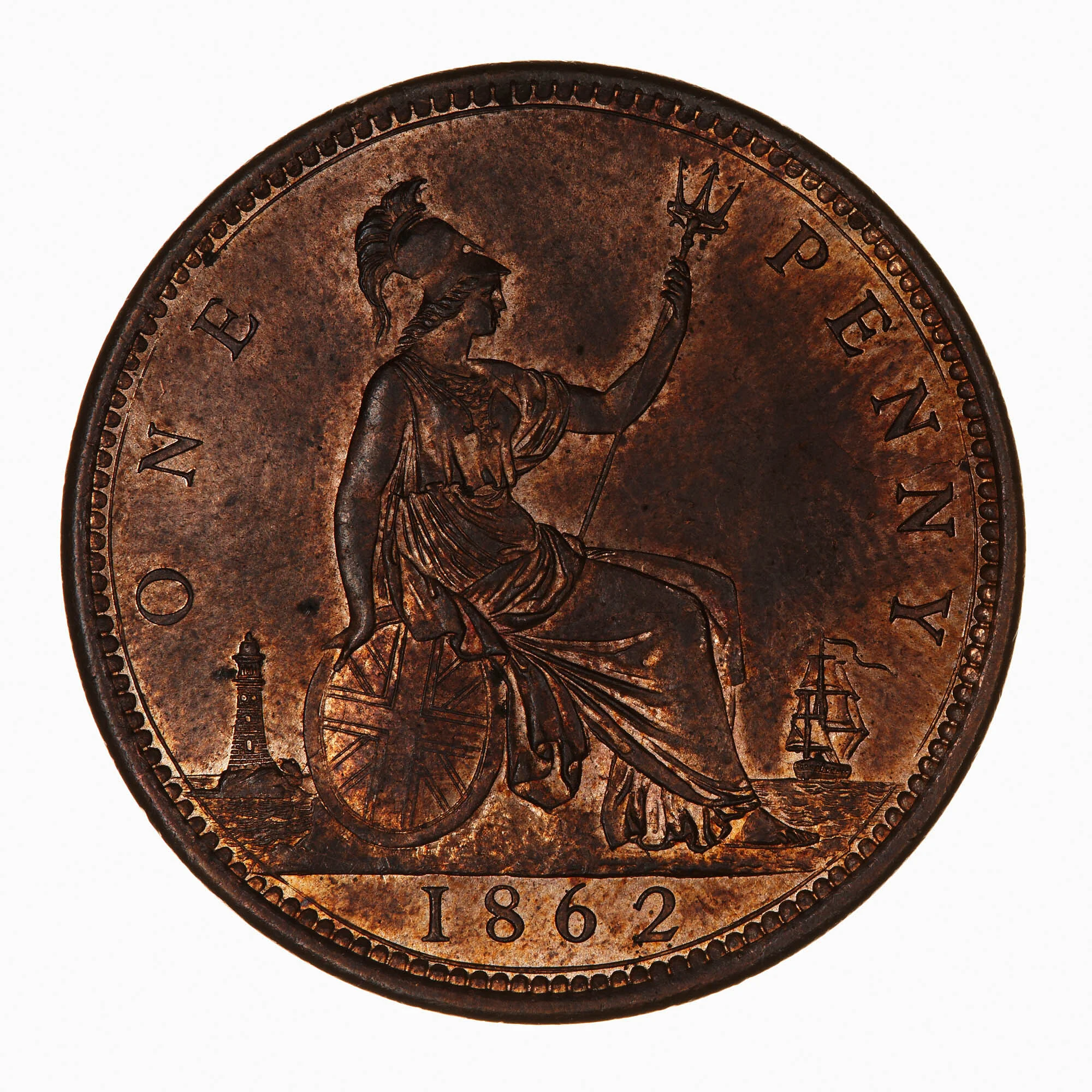
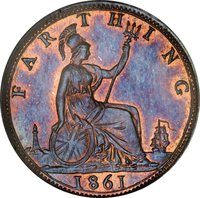
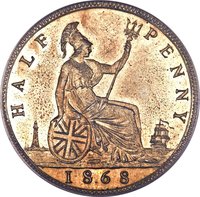
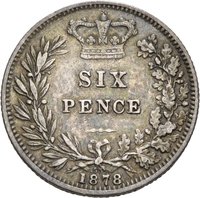
Britannia seated right, holding trident and shield with Union flag. Sea background with lighthouse and ship. Denomination around, date below. Varieties exist.
Inscription:
ONE PENNY
1863
1863
Script: Latin
Engraver: Leonard Charles Wyon
Edge
Plain
Categories
| Object> Armour |
| Building> Lighthouse |
| Person> Monarch |
| Geography> Sea |
| Transportation> Watercraft |
| Symbol> Allegory |
Mints
| Name | Mark |
|---|---|
| Royal Mint (Tower Hill) | — |
Mintings
| Year | Mint Mark | Mintage | Quality | Collection |
|---|---|---|---|---|
| 1860 | — | — | ||
| 1860 | — | — | Proof | |
| 1861 | — | — | ||
| 1861 | — | — | Proof | |
| 1862 | — | 50,534,000 | ||
| 1862 | — | — | Proof | |
| 1863 | — | 28,063,000 | ||
| 1863 | — | — | Proof | |
| 1864 | — | — | ||
| 1865 | — | 8,602,000 | ||
| 1866 | — | 9,999,000 | ||
| 1867 | — | 5,484,000 | ||
| 1867 | — | — | Proof | |
| 1868 | — | 1,183,000 | ||
| 1868 | — | — | Proof | |
| 1869 | — | 2,580,000 | ||
| 1870 | — | 5,695,000 | ||
| 1871 | — | 1,290,000 | ||
| 1872 | — | 1 | Proof | |
| 1872 | — | 8,495,000 | ||
| 1873 | — | 8,494,000 | ||
| 1874 | — | 5,622,000 | ||
| 1874 | H | 6,666,000 |
Historical background
In 1860, the United Kingdom operated under a de facto gold standard, a system that had been formally established by the Coinage Act of 1816. This meant the pound sterling was defined as a specific weight of gold (123.274 grains of standard gold), and Bank of England notes were fully convertible into gold coin upon demand. The currency in circulation was a mixture of gold sovereigns and half-sovereigns, alongside silver and copper token coins for smaller transactions. Banknotes, issued both by the Bank of England and various country banks, represented a promise to pay the bearer in gold, ensuring public confidence in paper money was firmly anchored to the precious metal.
This period was one of financial stability and international commercial dominance for Britain. The gold standard facilitated global trade by providing fixed exchange rates with other major economies that also adhered to gold, reducing transaction risks and fueling London’s rise as the world’s premier financial centre. However, the system was not without its critics and complexities. The Bank Charter Act of 1844 had sought to prevent crises by strictly tying the issuance of Bank of England notes to its gold reserves, but it created a rigid system that sometimes exacerbated credit crunches, as seen in the crises of 1847 and 1857. These events sparked ongoing debate about the need for greater elasticity in the money supply during periods of financial stress.
Furthermore, the role of silver was a secondary but notable issue. While gold was the sole standard for defining the pound’s value, silver coins remained vital for everyday commerce. However, their status was reduced to that of "token" currency; their face value was higher than their intrinsic metal worth, and they were legal tender only for limited amounts. This bimetallic tension was a domestic technicality, but it foreshadowed larger international debates that would emerge later in the century as global silver supplies increased, challenging the gold standard's hegemony. Thus, in 1860, Britain’s currency system was robust and world-leading, yet it contained the institutional rigidities and metallic debates that would shape financial policy for decades to come.
This period was one of financial stability and international commercial dominance for Britain. The gold standard facilitated global trade by providing fixed exchange rates with other major economies that also adhered to gold, reducing transaction risks and fueling London’s rise as the world’s premier financial centre. However, the system was not without its critics and complexities. The Bank Charter Act of 1844 had sought to prevent crises by strictly tying the issuance of Bank of England notes to its gold reserves, but it created a rigid system that sometimes exacerbated credit crunches, as seen in the crises of 1847 and 1857. These events sparked ongoing debate about the need for greater elasticity in the money supply during periods of financial stress.
Furthermore, the role of silver was a secondary but notable issue. While gold was the sole standard for defining the pound’s value, silver coins remained vital for everyday commerce. However, their status was reduced to that of "token" currency; their face value was higher than their intrinsic metal worth, and they were legal tender only for limited amounts. This bimetallic tension was a domestic technicality, but it foreshadowed larger international debates that would emerge later in the century as global silver supplies increased, challenging the gold standard's hegemony. Thus, in 1860, Britain’s currency system was robust and world-leading, yet it contained the institutional rigidities and metallic debates that would shape financial policy for decades to come.
🌱 Very Common