

6 Pence – United Kingdom
United Kingdom
Context
Years: 1867–1880
Issuer: United Kingdom 
Ruler: Victoria
Currency:
(1158—1970)
Demonetized: Yes
Total mintage: 34,546,600
Material
References
KM: #Click to copy to clipboard751
Numista: #13213
Value
Bullion value: $7.61
Obverse
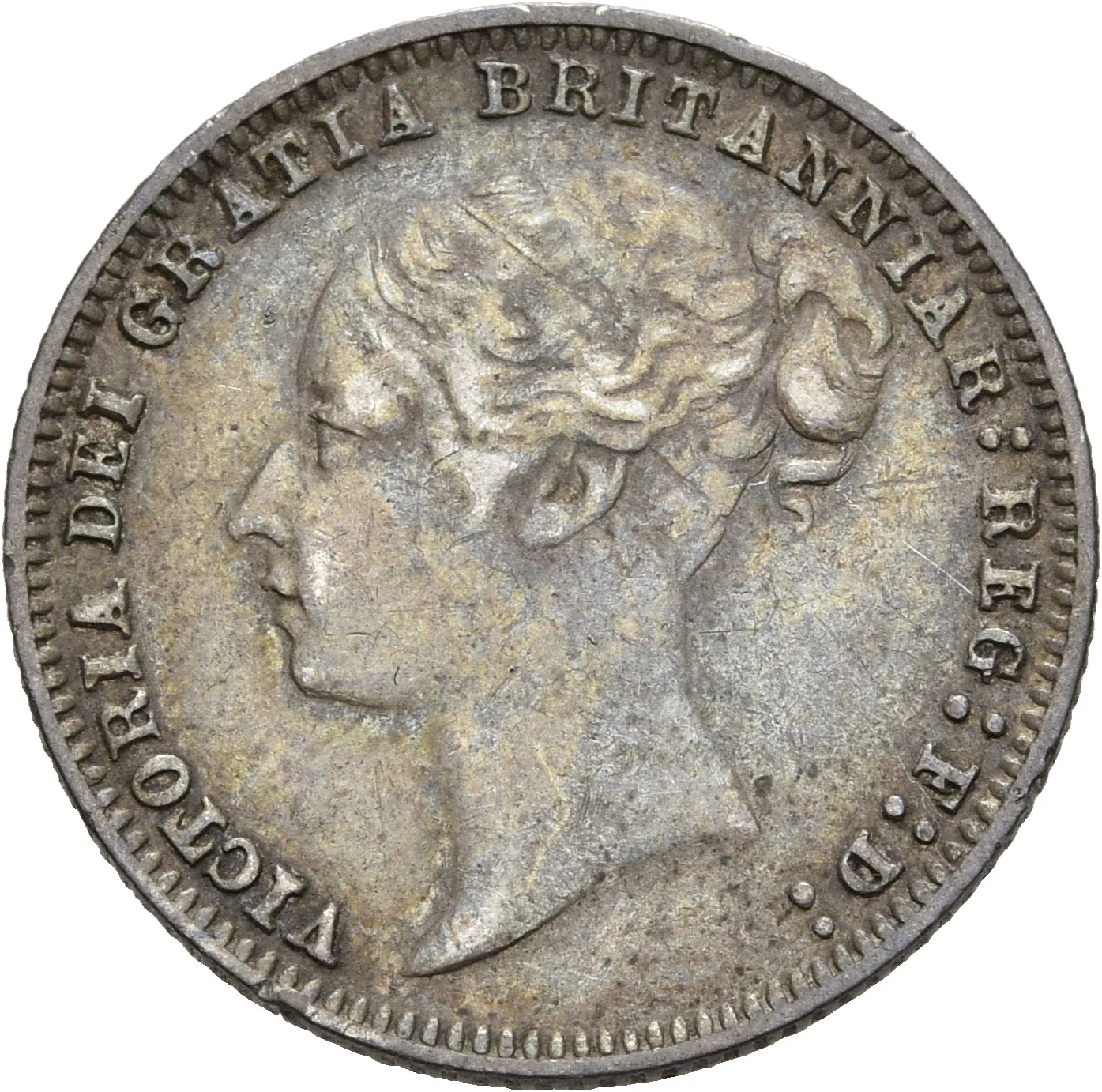
Description:
Young Head Victoria left, legend around.
Inscription:
VICTORIA DEI GRATIA BRITANNIAR: REG: F: D:
Translation:
Victoria by the Grace of God Queen of the Britains Defender of the Faith
Script: Latin
Language: Latin
Engraver: William Wyon
Reverse
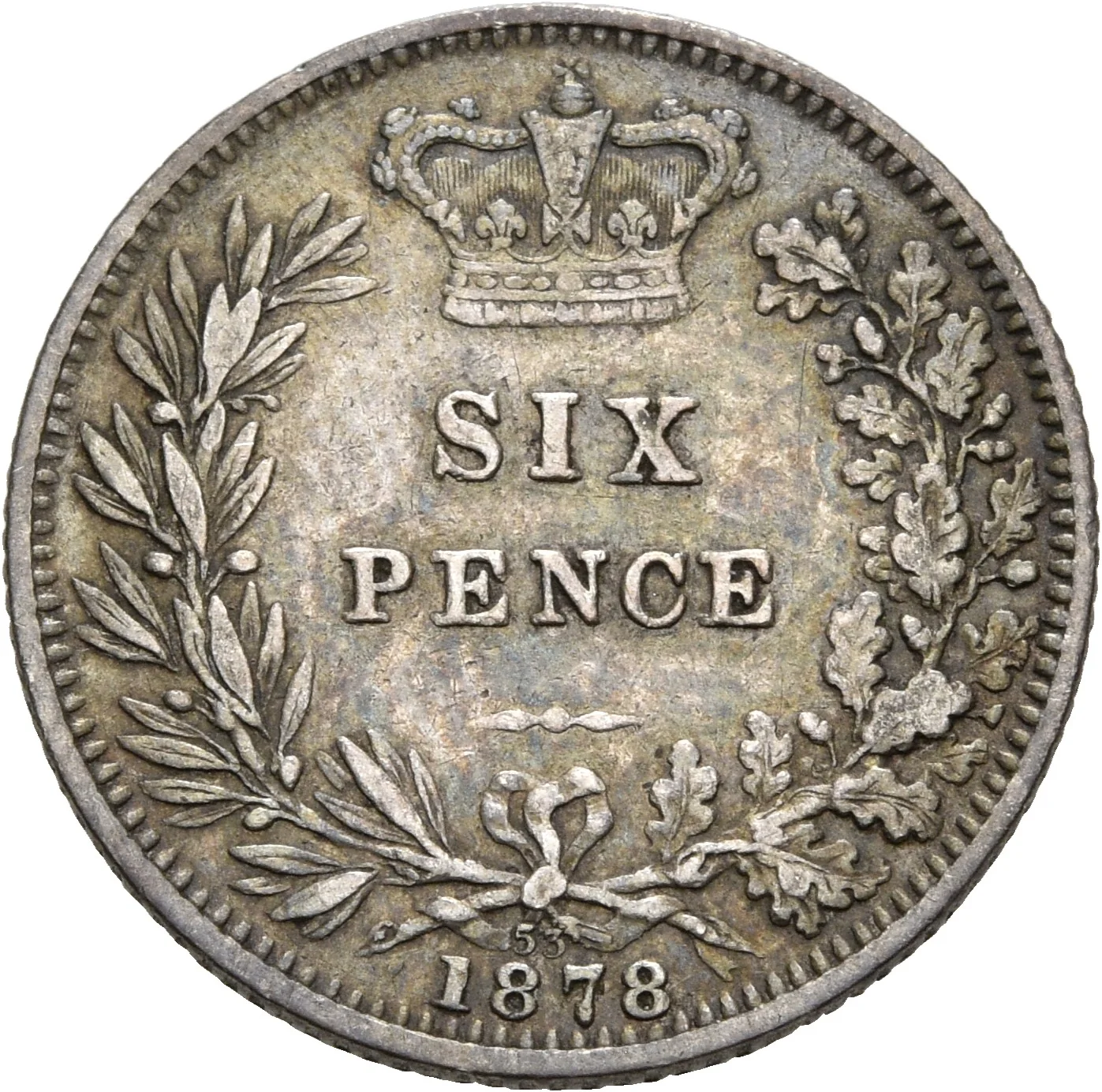
Description:
Denomination crowned in wreath, date beneath.
Inscription:
SIX
PENCE
14
1867
PENCE
14
1867
Script: Latin
Engraver: Jean Baptiste Merlen
Edge
Milled
Mints
| Name | Mark |
|---|---|
| Royal Mint (Tower Hill) | — |
Mintings
| Year | Mint Mark | Mintage | Quality | Collection |
|---|---|---|---|---|
| 1867 | — | 1,362,200 | ||
| 1867 | — | — | Proof | |
| 1868 | — | 1,069,200 | ||
| 1869 | — | 388,000 | ||
| 1869 | — | — | Proof | |
| 1870 | — | 479,600 | ||
| 1870 | — | — | Proof | |
| 1871 | — | 3,662,600 | ||
| 1871 | — | — | Proof | |
| 1872 | — | 3,382,000 | ||
| 1873 | — | 4,594,700 | ||
| 1874 | — | 4,225,700 | ||
| 1875 | — | 3,256,500 | ||
| 1876 | — | 841,400 | ||
| 1877 | — | 4,066,400 | ||
| 1878 | — | — | ||
| 1878 | — | — | Proof | |
| 1879 | — | 3,326,300 | ||
| 1879 | — | — | Proof | |
| 1880 | — | 3,892,000 |
Historical background
In 1867, the United Kingdom operated under a sophisticated and well-established bimetallic system, but one that was effectively on a de facto gold standard. The Coinage Act of 1816 had formally placed the country on the gold standard, defining the pound sterling as a specific weight of gold (123.274 grains of standard gold, 11/12ths fine). Silver coins were legal tender only for payments up to £2, meaning they served as subsidiary, token currency whose face value was higher than their intrinsic metal value. This structure ensured the gold sovereign was the principal measure of value and the foundation of the monetary system.
The period was one of financial confidence and international dominance for sterling. London was the undisputed centre of global finance, and the gold-backed pound was the premier international currency for trade and investment. Bank of England notes were fully convertible into gold on demand, a cornerstone of monetary credibility. However, a contemporary debate was intensifying regarding the international scarcity of silver. Major discoveries of gold in California and Australia in the preceding decades had increased the gold supply, altering the market gold-to-silver ratio and causing many nations to question bimetallism.
Consequently, 1867 fell within a crucial international discourse on currency uniformity. That very year, the UK hosted the International Monetary Conference in Paris, which advocated for the adoption of a single global gold standard to facilitate trade. While Britain was already the model for this system, the conference ultimately failed to achieve widespread European agreement, with countries like France clinging to bimetallism. Thus, the UK's domestic currency situation was stable and gold-based, but it was actively engaged in complex international efforts to shape the global monetary order in its own image, against a backdrop of shifting bullion supplies.
The period was one of financial confidence and international dominance for sterling. London was the undisputed centre of global finance, and the gold-backed pound was the premier international currency for trade and investment. Bank of England notes were fully convertible into gold on demand, a cornerstone of monetary credibility. However, a contemporary debate was intensifying regarding the international scarcity of silver. Major discoveries of gold in California and Australia in the preceding decades had increased the gold supply, altering the market gold-to-silver ratio and causing many nations to question bimetallism.
Consequently, 1867 fell within a crucial international discourse on currency uniformity. That very year, the UK hosted the International Monetary Conference in Paris, which advocated for the adoption of a single global gold standard to facilitate trade. While Britain was already the model for this system, the conference ultimately failed to achieve widespread European agreement, with countries like France clinging to bimetallism. Thus, the UK's domestic currency situation was stable and gold-based, but it was actively engaged in complex international efforts to shape the global monetary order in its own image, against a backdrop of shifting bullion supplies.
🌱 Common