

4 ducats – Austrian Empire
Add to wishlist
Austria
Context
Years: 1860–1865
Country: Austria
Issuer: Austrian Empire
Ruler: Francis Joseph I
Currency:
(1857—1892)
Demonetized: Yes
Total mintage: 117,724
Material
References
KM: #
Numista: #33650
Value
Bullion value: $2113.18
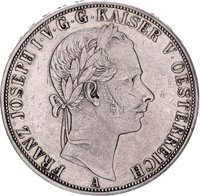
Obverse
Description:
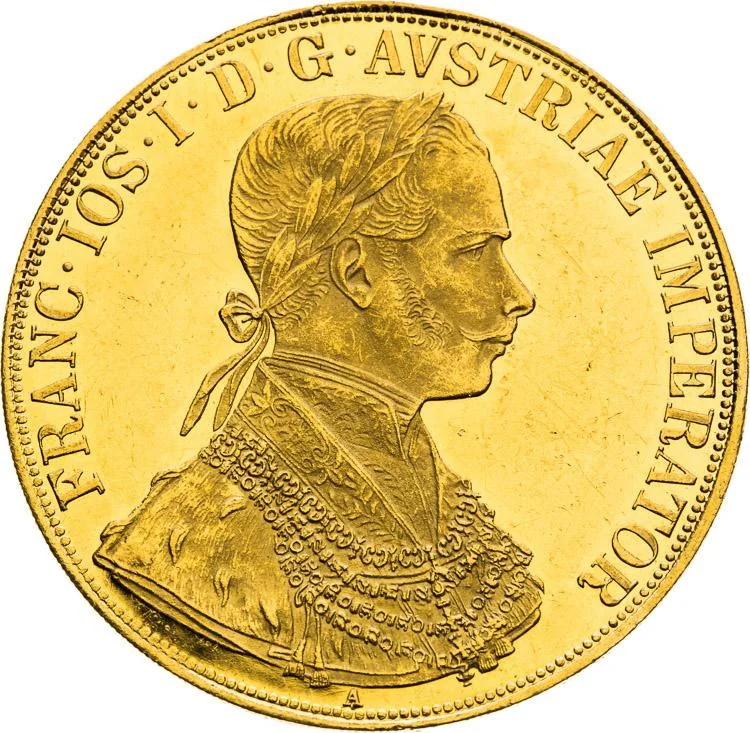
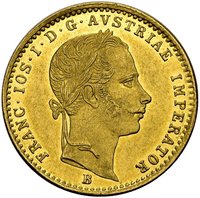
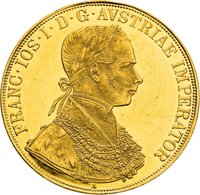
Franz Joseph I, profile right.
Inscription:
FRANC.IOS.I.D.G.AVSTRIAE IMPERATOR
A
A
Translation:
FRANCIS I, BY THE GRACE OF GOD, EMPEROR OF AUSTRIA
Script: Latin
Language: Latin
Engraver: Josef Daniel Böhm
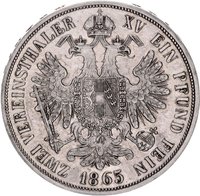
Reverse
Description:
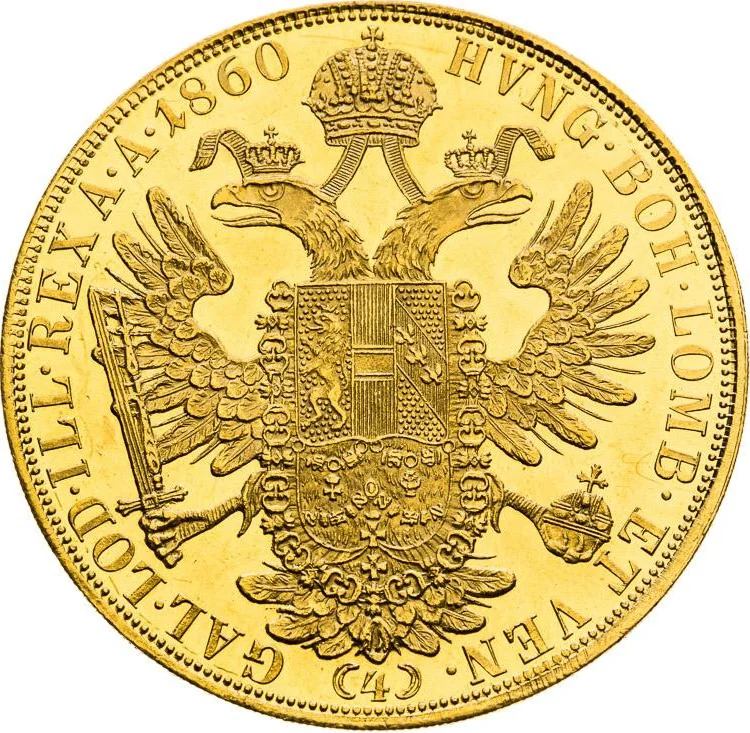
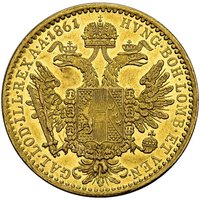
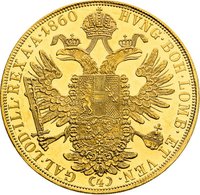
Crowned double-headed Austro-Hungarian eagle holding orb and scepter.
Inscription:
HVNG.BOH.LOMB ET VEN.GAL.LOD.ILL.REX.A.A. date
4
4
Translation:
Hungary, Bohemia, Dalmatia, Croatia, etc., and Galicia, Lodomeria, Illyria, King, Archduke of Austria.
Script: Latin
Language: Latin
Engraver: Josef Daniel Böhm
Edge
Reeded
Mints
| Name | Mark |
|---|---|
| Münze Österreich | A |
| Venice | V |
Mintings
Historical background
By 1860, the currency situation in the Austrian Empire was a complex and unstable system, a direct legacy of the financial strain caused by the Revolutions of 1848 and the subsequent wars. To fund these conflicts, the state had abandoned the silver standard and resorted to printing unbacked paper money, known as Wiener Währung (Vienna Currency). This led to a severe devaluation and the creation of a dual-system where paper gulden circulated at a significant discount to silver gulden, causing confusion, hampering trade, and fueling inflation.
The government recognized the need for reform and, in 1857, attempted a major reset with the Wiener Münzvertrag (Vienna Monetary Treaty) with the German states. This established the Vereinsthaler as a common silver coin and introduced a new unit for Austria, the Vereinswährung (Union Currency), pegged to silver. However, by 1860, this reform was failing. The state's chronic budget deficits, driven by military expenses and centralized administration, prevented a return to full convertibility. Paper banknotes (Banknoten) remained inconvertible and continued to depreciate against the theoretical silver standard, meaning the empire effectively operated on a shaky fiat paper system.
Thus, in 1860, the currency was in a precarious transitional phase. The official policy aimed for a silver-based, stable currency integrated with neighboring economies, but fiscal reality made this impossible. The result was a confusing multiplicity of values—old paper gulden, new union gulden, and actual silver coins—all circulating at different rates. This monetary instability reflected the broader financial weaknesses of the Habsburg state and acted as a significant drag on economic modernization and unity within the multi-ethnic empire, a problem that would only be partially resolved with the creation of the Austro-Hungarian Gulden after the Compromise of 1867.
The government recognized the need for reform and, in 1857, attempted a major reset with the Wiener Münzvertrag (Vienna Monetary Treaty) with the German states. This established the Vereinsthaler as a common silver coin and introduced a new unit for Austria, the Vereinswährung (Union Currency), pegged to silver. However, by 1860, this reform was failing. The state's chronic budget deficits, driven by military expenses and centralized administration, prevented a return to full convertibility. Paper banknotes (Banknoten) remained inconvertible and continued to depreciate against the theoretical silver standard, meaning the empire effectively operated on a shaky fiat paper system.
Thus, in 1860, the currency was in a precarious transitional phase. The official policy aimed for a silver-based, stable currency integrated with neighboring economies, but fiscal reality made this impossible. The result was a confusing multiplicity of values—old paper gulden, new union gulden, and actual silver coins—all circulating at different rates. This monetary instability reflected the broader financial weaknesses of the Habsburg state and acted as a significant drag on economic modernization and unity within the multi-ethnic empire, a problem that would only be partially resolved with the creation of the Austro-Hungarian Gulden after the Compromise of 1867.
✨ Legendary