

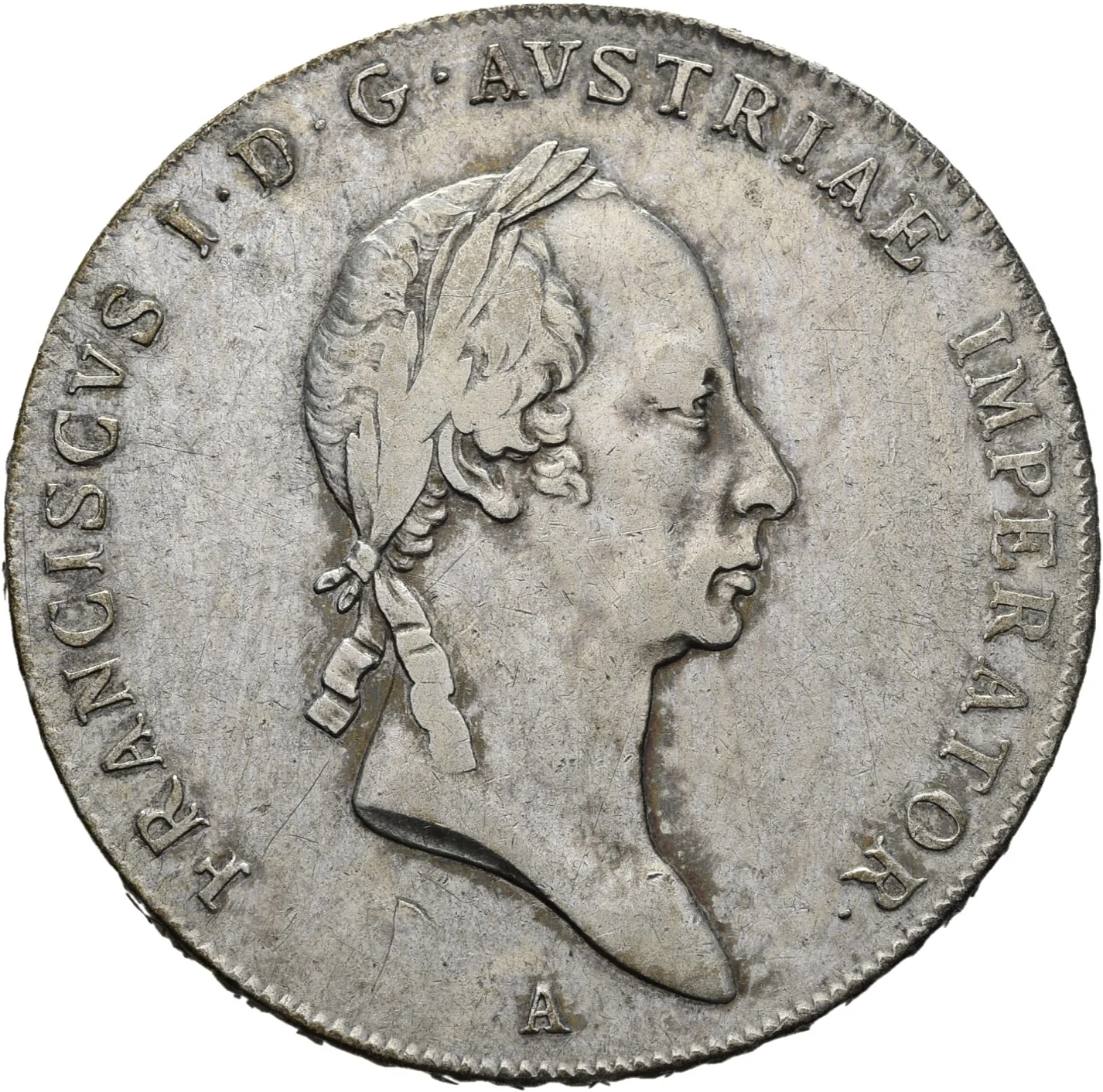
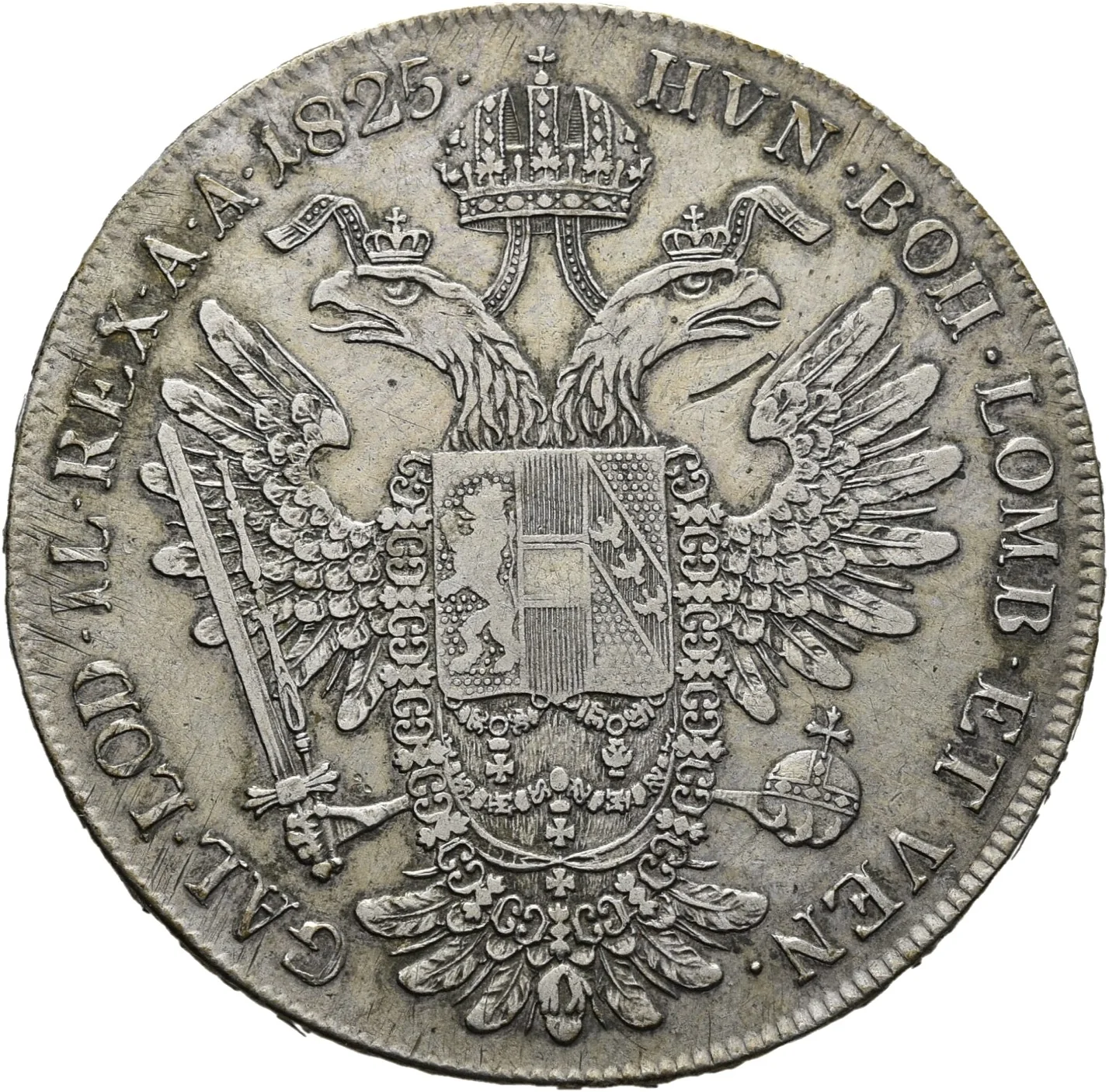
1 Thaler – Austrian Empire
Austria
Context
Years: 1824–1830
Country: Austria 
Issuer: Austrian Empire
Ruler: Francis I of Austria
Currency:
(1754—1857)
Demonetized: Yes
Total mintage: 694,000
Material
References
KM: #Click to copy to clipboard2163
Numista: #33431
Value
Bullion value: $66.86
Obverse
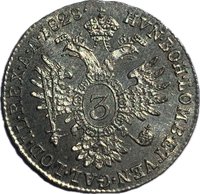
Reverse
Description:
Imperial eagle bearing Habsburg-Lorraine and Austrian arms.
Inscription:
HVN·BOH·LOMB·ET VEN· GAL·LOD·IL·REX·A·A·1829·
Script: Latin
Edge
Inscribed text
Legend:
IUSTITIA REGNORUM FUNDAMENTUM
Mints
| Name | Mark |
|---|---|
| Münze Österreich | A |
| Kremnica | B |
| Prague | C |
| Alba Iulia | E |
| Baia Mare | G |
Mintings
Historical background
In 1824, the Austrian Empire's currency situation was characterized by a fragile and complex system still recovering from the Napoleonic Wars. The state treasury was burdened by substantial debt, and the Empire operated on a de facto silver standard, though paper money remained in circulation. The official unit of account was the Conventionsthaler (or Conventionstaler), a large silver coin, but everyday transactions were more commonly conducted in Gulden (florins), which were subdivided into 60 Kreuzer. This cumbersome 60-based system created practical difficulties for commerce and accounting.
A critical issue was the coexistence of paper banknotes (Bancozettel) issued by the Privileged Austrian National Bank (founded in 1816) with silver coinage. While the bank aimed for stability, these notes were not fully convertible to silver on demand, leading to a persistent gap between their face value and their actual metallic worth. This resulted in a dual pricing system where goods often had one price in silver coin and a higher price in paper notes, causing public distrust and hampering economic efficiency.
The government, under the guidance of ministers like Count Johann Philipp von Stadion, was in a period of cautious stabilization. The National Bank was slowly withdrawing depreciated paper money from the wartime period in an attempt to restore public confidence and move toward a more uniform and reliable currency. However, in 1824, this process was incomplete; the monetary system was in transition, still vulnerable to the Empire's fiscal pressures and the structural challenges of unifying the economies of its diverse lands under a single, sound currency.
A critical issue was the coexistence of paper banknotes (Bancozettel) issued by the Privileged Austrian National Bank (founded in 1816) with silver coinage. While the bank aimed for stability, these notes were not fully convertible to silver on demand, leading to a persistent gap between their face value and their actual metallic worth. This resulted in a dual pricing system where goods often had one price in silver coin and a higher price in paper notes, causing public distrust and hampering economic efficiency.
The government, under the guidance of ministers like Count Johann Philipp von Stadion, was in a period of cautious stabilization. The National Bank was slowly withdrawing depreciated paper money from the wartime period in an attempt to restore public confidence and move toward a more uniform and reliable currency. However, in 1824, this process was incomplete; the monetary system was in transition, still vulnerable to the Empire's fiscal pressures and the structural challenges of unifying the economies of its diverse lands under a single, sound currency.
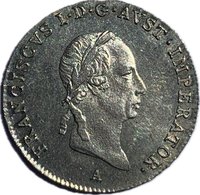
⭐ Somewhat Rare