

Iran
Context
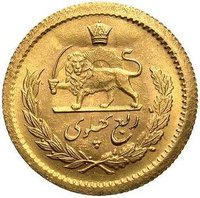
Years: 1957–1973
Issuer: Iran 
Ruler: Mohammad Reza
Currency:
Demonetization: 1971
Total mintage: 988,000
Material
References
KM: #Click to copy to clipboard1160a
Numista: #33381
Value
Bullion value: $304.74
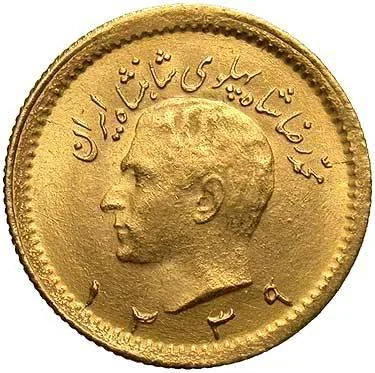
Obverse
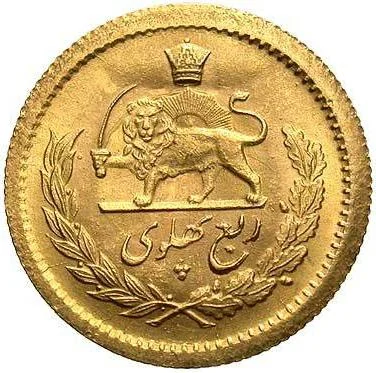
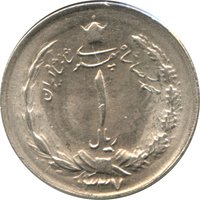
Reverse
Edge
Reeded
Mints
| Name | Mark |
|---|---|
| Tehran | — |
Mintings
| Year | Mint Mark | Mintage | Quality | Collection |
|---|---|---|---|---|
| 1957 | — | — | ||
| 1958 | — | 33,000 | ||
| 1959 | — | 136,000 | ||
| 1960 | — | 156,000 | ||
| 1961 | — | 60,000 | ||
| 1963 | — | 80,000 | ||
| 1964 | — | 40,000 | ||
| 1965 | — | 30,000 | ||
| 1966 | — | 40,000 | ||
| 1967 | — | 30,000 | ||
| 1968 | — | 60,000 | ||
| 1969 | — | 60,000 | ||
| 1970 | — | 80,000 | ||
| 1971 | — | 80,000 | ||
| 1972 | — | 103,000 | ||
| 1973 | — | — |
Historical background
In 1957, Iran's currency situation was characterized by relative stability under the Pahlavi monarchy, a marked contrast to the economic turbulence of earlier decades. The national currency, the rial, was managed by Bank Melli Iran (the National Bank of Iran), which acted as the country's central bank. The monetary system was formally on a silver standard, though its practical link to bullion was limited. This period followed the 1949 monetary reform that had re-established the rial after wartime instability, and the economy was benefiting from increasing oil revenues following the 1953 nationalization crisis and the subsequent international consortium agreement of 1954.
The government of Shah Mohammad Reza Pahlavi, supported by Prime Minister Manouchehr Eghbal, pursued a policy of economic modernization and development, with currency stability being a key pillar. Inflation was controlled, and the rial maintained a fixed exchange rate pegged to the U.S. dollar at approximately 75.75 rials per dollar, a rate established in 1955. This peg provided predictability for foreign trade and investment, which was crucial as Iran embarked on its second Seven-Year Development Plan (1955-1962), heavily financed by oil income and aimed at infrastructure and industrial projects.
However, this apparent stability masked underlying vulnerabilities. The economy remained overwhelmingly dependent on the single commodity of oil, making it susceptible to global price fluctuations. Furthermore, the fixed exchange rate, while beneficial for imports and elite consumption, could overvalue the rial and potentially hinder non-oil exports. The system also required careful management of foreign exchange reserves, which were accumulating from oil but were controlled by a relatively centralized financial structure. Thus, the calm of 1957 represented a managed equilibrium, dependent on continuous oil revenue and conservative fiscal policy to maintain confidence in the national currency.
The government of Shah Mohammad Reza Pahlavi, supported by Prime Minister Manouchehr Eghbal, pursued a policy of economic modernization and development, with currency stability being a key pillar. Inflation was controlled, and the rial maintained a fixed exchange rate pegged to the U.S. dollar at approximately 75.75 rials per dollar, a rate established in 1955. This peg provided predictability for foreign trade and investment, which was crucial as Iran embarked on its second Seven-Year Development Plan (1955-1962), heavily financed by oil income and aimed at infrastructure and industrial projects.
However, this apparent stability masked underlying vulnerabilities. The economy remained overwhelmingly dependent on the single commodity of oil, making it susceptible to global price fluctuations. Furthermore, the fixed exchange rate, while beneficial for imports and elite consumption, could overvalue the rial and potentially hinder non-oil exports. The system also required careful management of foreign exchange reserves, which were accumulating from oil but were controlled by a relatively centralized financial structure. Thus, the calm of 1957 represented a managed equilibrium, dependent on continuous oil revenue and conservative fiscal policy to maintain confidence in the national currency.
⭐ Somewhat Rare