

½ Cent – East Africa
Context
Year: 1908
Issuer: East Africa
Ruler: Edward VII
Currency:
(1906—1920)
Demonetized: Yes
Total mintage: 900,000
Material
Diameter: 20.3 mm
Weight: 0.97 g
Shape: Round with a round hole
Composition: Aluminium
Magnetic: No
Technique: Milled
Alignment: Medal alignment
flip
References
KM: #Click to copy to clipboard6
Numista: #22615
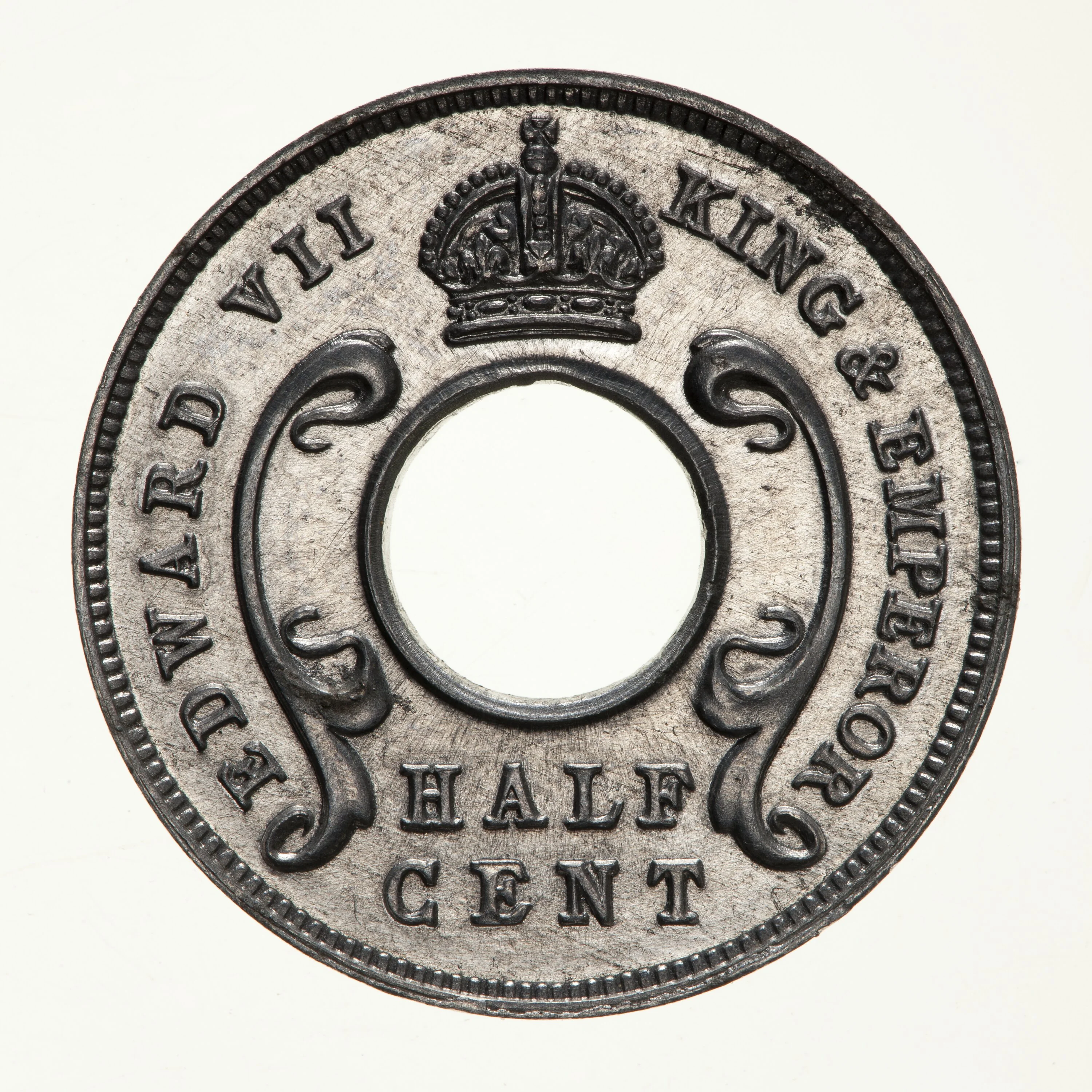
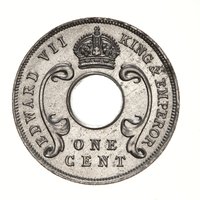
Obverse
Description:
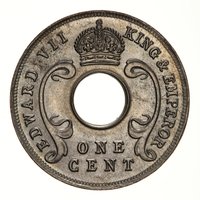
Crown above hole, denomination below, legend around.
Inscription:
EDWARD VII KING & EMPEROR
HALF
CENT
HALF
CENT
Script: Latin
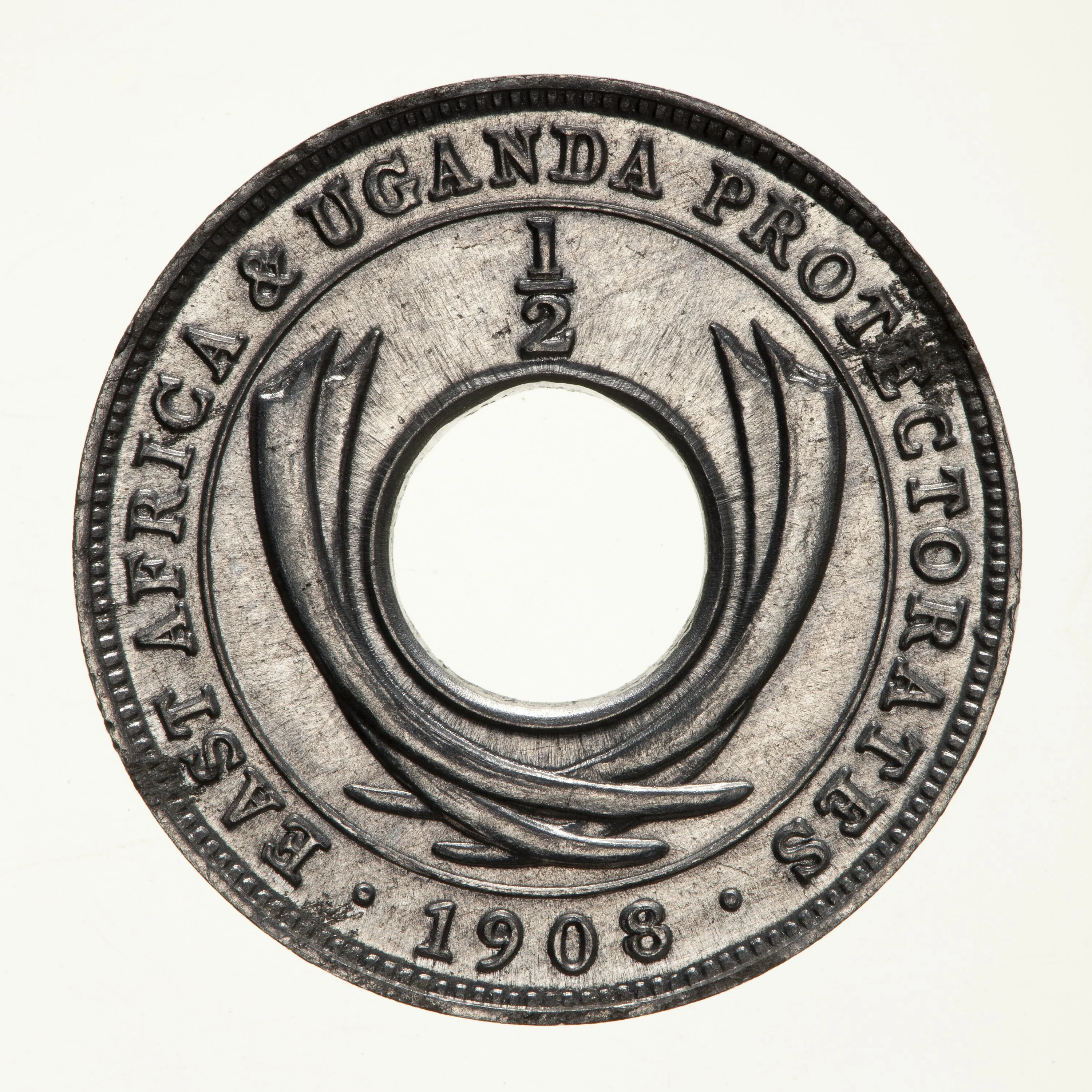
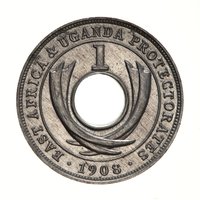
Reverse
Description:
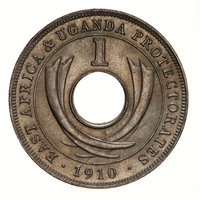
Tusks encircled in legend.
Inscription:
EAST AFRICA & UGANDA PROTECTORATES
½
1908
½
1908
Script: Latin
Edge
Mints
| Name | Mark |
|---|---|
| Royal Mint (Tower Hill) | — |
Mintings
| Year | Mint Mark | Mintage | Quality | Collection |
|---|---|---|---|---|
| 1908 | — | 900,000 |
Historical background
In 1908, the currency situation in East Africa was a complex mosaic shaped by competing colonial powers, long-standing trade networks, and the gradual imposition of European monetary systems. The region was divided between British, German, and Italian spheres of influence, each promoting its own currency: the British East African Protectorate (later Kenya) used the Indian Rupee as its official tender, a legacy of British Indian Ocean administration; German East Africa (Tanganyika) circulated the German East African Rupie; while Italian Somaliland saw the introduction of the Italian Somaliland Rupia. Alongside these, the Maria Theresa Thaler, a silver coin minted in Austria but revered for its consistent silver content, remained a trusted medium for high-value and long-distance trade, especially in the interior and in Ethiopia, which maintained its independence.
This multi-currency environment created significant practical challenges for intra-regional commerce and for colonial administrations. Exchange rates between the different rupees, the thaler, and also the still-circulating cowrie shells and cloth currencies in some areas, were fluid and often disadvantageous to local populations. The British administration, in particular, was growing increasingly dissatisfied with the Indian Rupee, as its value was tied to the volatile price of silver on the world market, causing budgetary instability and complicating trade with Britain and other gold-standard territories.
Consequently, 1908 fell within a period of deliberate monetary transition, especially in British territories. The year was part of the final lead-up to a major reform: the introduction of the East African Protectorate Rupee in 1909, which would be pegged to sterling at a fixed rate (1 rupee = 1 shilling 4 pence). This move was intended to sever the link with India, stabilize the local economy, and firmly integrate the territory into the British imperial financial system. Thus, the currency landscape of 1908 was one of overlapping systems on the cusp of being streamlined and more directly subordinated to colonial economic objectives.
This multi-currency environment created significant practical challenges for intra-regional commerce and for colonial administrations. Exchange rates between the different rupees, the thaler, and also the still-circulating cowrie shells and cloth currencies in some areas, were fluid and often disadvantageous to local populations. The British administration, in particular, was growing increasingly dissatisfied with the Indian Rupee, as its value was tied to the volatile price of silver on the world market, causing budgetary instability and complicating trade with Britain and other gold-standard territories.
Consequently, 1908 fell within a period of deliberate monetary transition, especially in British territories. The year was part of the final lead-up to a major reform: the introduction of the East African Protectorate Rupee in 1909, which would be pegged to sterling at a fixed rate (1 rupee = 1 shilling 4 pence). This move was intended to sever the link with India, stabilize the local economy, and firmly integrate the territory into the British imperial financial system. Thus, the currency landscape of 1908 was one of overlapping systems on the cusp of being streamlined and more directly subordinated to colonial economic objectives.
💎 Very Rare