

5 Crowns – Austrian Empire
Austria
Context
Years: 1900–1907
Country: Austria 
Issuer: Austrian Empire
Ruler: Francis Joseph I
Currency:
(1892—1918)
Demonetized: Yes
Total mintage: 10,500,616
Material
References
KM: #Click to copy to clipboard2807
Numista: #11558
Value
Bullion value: $60.60
Obverse
Description:
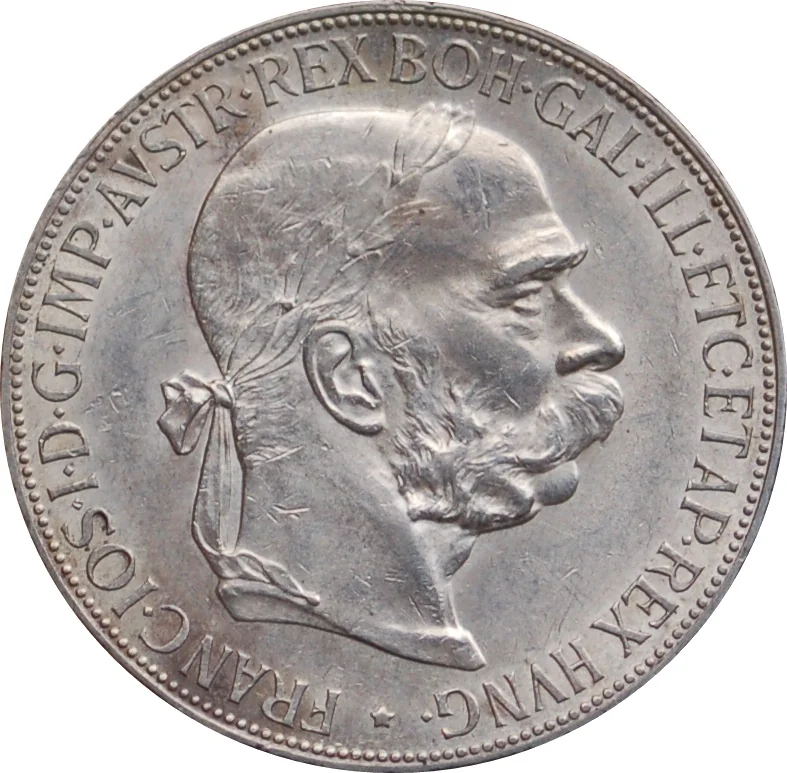
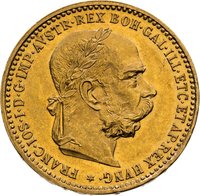
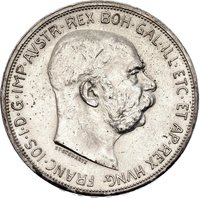
Franz Joseph laureate bust.
Inscription:
FRANC·IOS·I·D·G·IMP·AVSTR·REX BOH·GAL·ILL·ETC·ET AP·REX HVNG·
Translation:
FRANCIS I, BY THE GRACE OF GOD, EMPEROR OF AUSTRIA, KING OF BOHEMIA, GALICIA, LODOMERIA, ETC., AND APOSTOLIC KING OF HUNGARY.
Script: Latin
Language: Latin
Engraver: Stefan Schwartz
Reverse
Description:
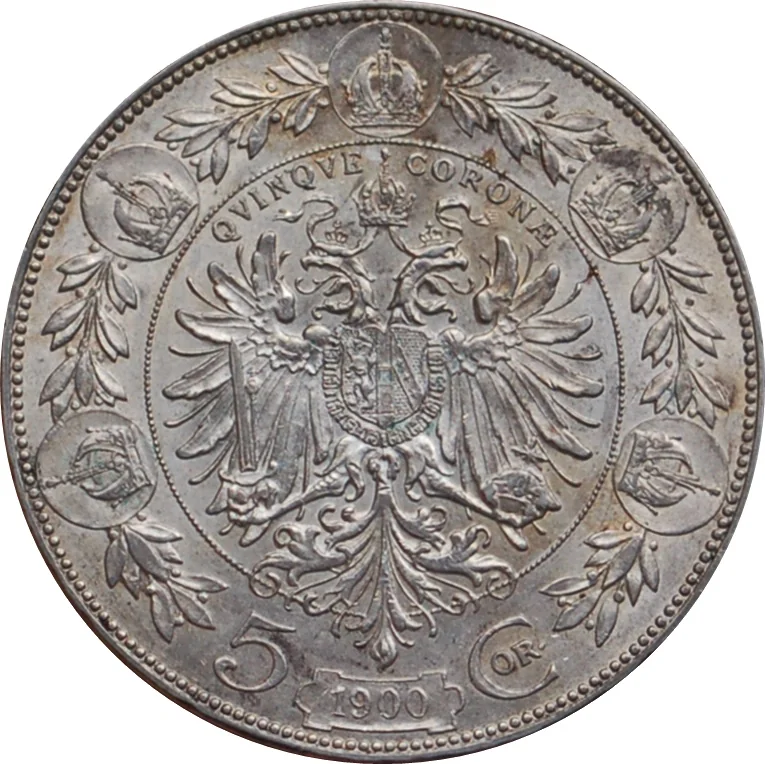
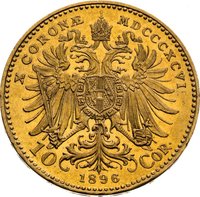
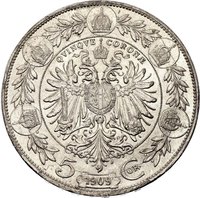
Crowned double eagle encircled by a wreath of leaves and crowned circles.
Inscription:
QUINQUE CORONÆ
5 1900 COR·
5 1900 COR·
Translation:
FIVE CROWNS
5 1900 CROWN
5 1900 CROWN
Script: Latin
Language: Latin
Engravers: Anton Scharff, Andreas Neudeck
Edge
Mints
| Name | Mark |
|---|---|
| Münze Österreich | — |
Mintings
| Year | Mint Mark | Mintage | Quality | Collection |
|---|---|---|---|---|
| 1900 | — | 8,961,416 | ||
| 1900 | — | — | Proof | |
| 1907 | — | 1,539,200 | ||
| 1907 | — | — | Proof |
Historical background
By 1900, the Austro-Hungarian Empire operated under a complex and relatively modern, yet politically symbolic, dual monetary system. The official currency was the Austro-Hungarian gulden (or florin), which was tied to a bimetallic (silver and gold) standard until 1892. However, a major reform in that year introduced the gold standard and a new currency unit, the krone (crown), with 1 gold krone = 0.5 gulden. By the turn of the century, the empire was in a transitional period where both currencies circulated, though the krone was the official unit of account for state finances and increasingly dominant in public use. The central bank, the Austro-Hungarian Bank, issued banknotes for both denominations, striving to maintain stability and public confidence.
This monetary union was a rare and crucial element of cohesion between the two halves of the Dual Monarchy. While Austria and Hungary had separate governments, budgets, and economic policies, they shared the central bank and a unified currency. This required constant negotiation and delicate compromise between Vienna and Budapest, making the krone a tangible symbol of the empire's economic unity. The system was generally successful in providing monetary stability and facilitating trade within the empire's large internal market, which was essential for its industrial growth.
Nevertheless, the currency situation reflected broader imperial tensions. Political debates over banknote design, the language used on notes, and the allocation of the central bank's profits were perennial sources of nationalist friction between Austrian German and Hungarian Magyar elites. Furthermore, while stable, the krone was not a major international currency like the British pound or German mark. The empire's chronic fiscal pressures, driven by military expenditure and political deadlock, often strained the gold cover, revealing how the monetary system was underpinned by fragile political compromise as much as by economic principle.
This monetary union was a rare and crucial element of cohesion between the two halves of the Dual Monarchy. While Austria and Hungary had separate governments, budgets, and economic policies, they shared the central bank and a unified currency. This required constant negotiation and delicate compromise between Vienna and Budapest, making the krone a tangible symbol of the empire's economic unity. The system was generally successful in providing monetary stability and facilitating trade within the empire's large internal market, which was essential for its industrial growth.
Nevertheless, the currency situation reflected broader imperial tensions. Political debates over banknote design, the language used on notes, and the allocation of the central bank's profits were perennial sources of nationalist friction between Austrian German and Hungarian Magyar elites. Furthermore, while stable, the krone was not a major international currency like the British pound or German mark. The empire's chronic fiscal pressures, driven by military expenditure and political deadlock, often strained the gold cover, revealing how the monetary system was underpinned by fragile political compromise as much as by economic principle.
🌱 Common