

1 Sapeque – French Cochinchina
Vietnam
Context
Years: 1879–1898
Country: Vietnam 
Issuer: French Cochinchina
Period:
(1870—1940)
Currency:
(1878—1885)
Demonetized: Yes
Total mintage: 20,000,100
Material
Diameter: 20 mm
Weight: 2 g
Thickness: 0.8 mm
Shape: Round with a square hole
Composition: Bronze
Magnetic: No
Technique: Milled
Alignment: Coin alignment
flip
References
KM: #Click to copy to clipboard2
Numista: #3312
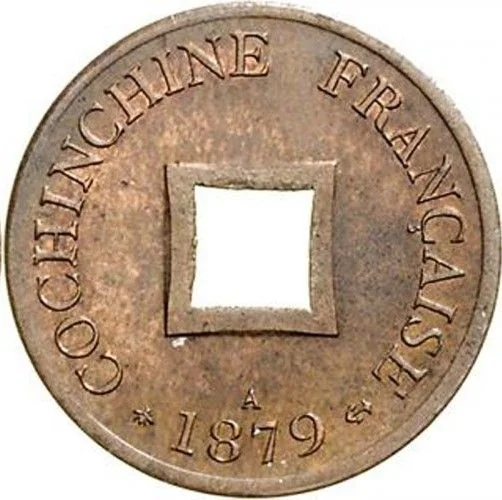
Obverse
Description:
Lettering encircles the square hole, with the date below.
Inscription:
COCHINCHINE FRANÇAISE
A
1879
A
1879
Translation:
FRENCH COCHINCHINA
A
1879
A
1879
Script: Latin
Language: French
Engraver: Jean-Auguste Barre
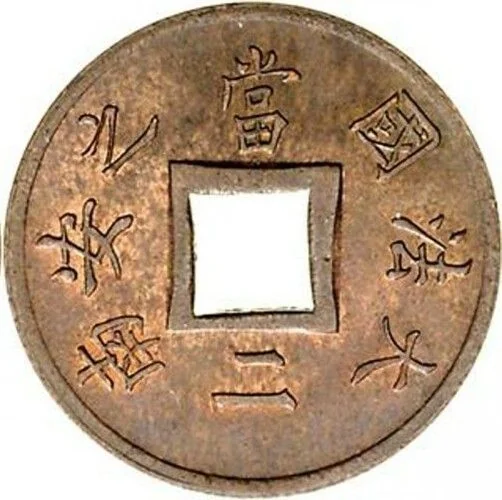
Reverse
Description:
Chinese characters encircling a square opening.
Inscription:
南安之 國法大
當
二
當
二
Translation:
The Great Law of the Country of Nan'an
Equivalent to
Two Dang
Equivalent to
Two Dang
Script: Chinese
Language: Classical Chinese
Engraver: Jean-Auguste Barre
Edge
Plain
Mints
| Name | Mark |
|---|---|
| Monnaie de Paris | A |
Mintings
Historical background
In 1879, the currency situation in French Cochinchina was a complex and transitional one, characterized by the coexistence of multiple monetary systems. As a colony acquired piecemeal between 1858 and 1867, the region operated on a silver standard, with the Mexican piastre (a silver dollar) serving as the dominant trade coin and de facto standard. However, a plethora of other silver and subsidiary coins circulated, including French 5-franc pieces, Spanish and Peruvian pesos, and local Vietnamese currency like the zinc sapèque and silver ligatures. This created a chaotic environment where exchange rates fluctuated and hindered commercial efficiency.
The French colonial administration was actively attempting to impose order and integrate the colony into the Franc Zone. A key step was the establishment of the Banque de l'Indochine in 1875, which received the exclusive right to issue banknotes for the colony. By 1879, these notes, denominated in piastres and convertible into silver, were beginning to circulate alongside the physical silver coins. The French goal was to gradually shift the monetary anchor from pure silver bullion (the Mexican piastre) to a silver-based franc system, though the piastre would remain the official unit of account for decades.
Thus, 1879 represents a point of tension between the old Asian trading economy and the new colonial financial system. Merchants and the population still thought in terms of piastres and sapèques, conducting daily business with a mix of physical silver. Simultaneously, the institutional framework for a modern, bank-dominated currency was being laid, setting the stage for the eventual decree of 1885 that would formally define the Indochinese piastre. The situation was one of monetary duality, with the state promoting banknotes and franc-linked coinage while the market continued to trust in tangible silver.
The French colonial administration was actively attempting to impose order and integrate the colony into the Franc Zone. A key step was the establishment of the Banque de l'Indochine in 1875, which received the exclusive right to issue banknotes for the colony. By 1879, these notes, denominated in piastres and convertible into silver, were beginning to circulate alongside the physical silver coins. The French goal was to gradually shift the monetary anchor from pure silver bullion (the Mexican piastre) to a silver-based franc system, though the piastre would remain the official unit of account for decades.
Thus, 1879 represents a point of tension between the old Asian trading economy and the new colonial financial system. Merchants and the population still thought in terms of piastres and sapèques, conducting daily business with a mix of physical silver. Simultaneously, the institutional framework for a modern, bank-dominated currency was being laid, setting the stage for the eventual decree of 1885 that would formally define the Indochinese piastre. The situation was one of monetary duality, with the state promoting banknotes and franc-linked coinage while the market continued to trust in tangible silver.
🌱 Fairly Common