

1 Sapeque – French Cochinchina
Vietnam
Context
Year: 1875
Country: Vietnam 
Issuer: French Cochinchina
Period:
(1870—1940)
Currency:
(1878—1885)
Demonetized: Yes
Total mintage: 10,000
Material
Diameter: 15 mm
Weight: 1 g
Thickness: 0.5 mm
Shape: Round with a round hole
Composition: Bronze
Magnetic: No
Technique: Milled
Alignment: Coin alignment
flip
References
KM: #Click to copy to clipboard1
Numista: #11299
Obverse
Description:
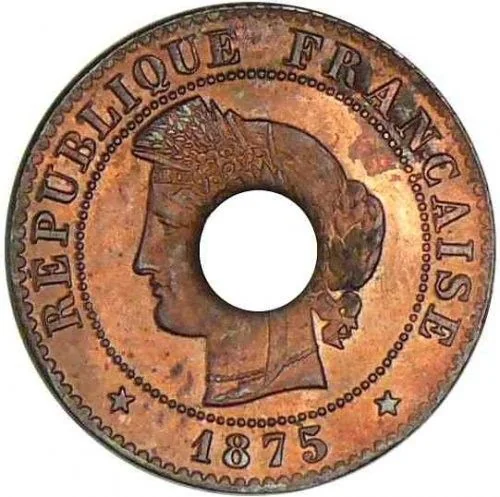
Laureate head left in beaded circle. Date between stars below.
Inscription:
RÉPUBLIQUE FRANÇAISE
* 1875 *
* 1875 *
Translation:
FRENCH REPUBLIC
* 1875 *
* 1875 *
Script: Latin
Language: French
Engraver: Eugène-André Oudiné
Reverse
Description:
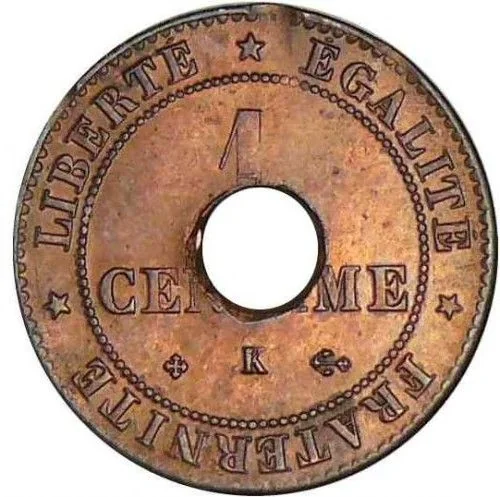
Mint letter below, within beaded circle.
Inscription:
LIBERTÉ * ÉGALITÉ * FRATERNITÉ *
1
CENTIME
K
1
CENTIME
K
Translation:
LIBERTY * EQUALITY * FRATERNITY *
1
CENTIME
1
CENTIME
Script: Latin
Language: French
Engraver: Eugène-André Oudiné
Edge
Plain
Mintings
| Year | Mint Mark | Mintage | Quality | Collection |
|---|---|---|---|---|
| 1875 | K | 10,000 |
Historical background
By 1875, the currency situation in French Cochinchina was a complex and transitional one, characterized by a turbulent coexistence of multiple monetary systems. The colony, under full French control since 1867, had not yet imposed a unified franc-based currency. Instead, the economy operated on a tri-metallic system: the Mexican silver piastre (the dominant trade dollar of East Asia), various silver subsidiary coins (like French 5-franc pieces and Spanish/German talers), and a flood of copper cash coins (sapèques) for everyday local transactions. The official exchange rate was artificially fixed by decree at 1 piastre = 5.37 francs, but this rate often conflicted with the metal's higher intrinsic market value, leading to arbitrage and instability.
This multiplicity created significant practical problems for the colonial administration and merchants. Accounting was cumbersome, requiring constant conversion between francs, piastres, and strings of cash. The fixed rate invited speculation, as piastres were frequently exported to Hong Kong or Shanghai where their silver content was worth more than their nominal French value, causing periodic shortages. Furthermore, the sheer volume and varying quality of copper cash, the lifeblood of the local Vietnamese economy, made small-scale commerce inefficient and prone to counterfeit.
The year 1875 itself was a pivotal moment, as it marked the founding of the Banque de l'Indochine in Paris. Chartered to serve all French territories in Asia, its establishment was a direct response to this monetary chaos, though its full impact would be felt later. The bank was granted the exclusive right to issue currency for the colony, paving the way for the eventual introduction of the Indochinese piastre in 1885. Therefore, the situation in 1875 represents the peak of monetary disorder just before the colonial power initiated a centralized, bank-driven solution to impose financial order and facilitate economic exploitation.
This multiplicity created significant practical problems for the colonial administration and merchants. Accounting was cumbersome, requiring constant conversion between francs, piastres, and strings of cash. The fixed rate invited speculation, as piastres were frequently exported to Hong Kong or Shanghai where their silver content was worth more than their nominal French value, causing periodic shortages. Furthermore, the sheer volume and varying quality of copper cash, the lifeblood of the local Vietnamese economy, made small-scale commerce inefficient and prone to counterfeit.
The year 1875 itself was a pivotal moment, as it marked the founding of the Banque de l'Indochine in Paris. Chartered to serve all French territories in Asia, its establishment was a direct response to this monetary chaos, though its full impact would be felt later. The bank was granted the exclusive right to issue currency for the colony, paving the way for the eventual introduction of the Indochinese piastre in 1885. Therefore, the situation in 1875 represents the peak of monetary disorder just before the colonial power initiated a centralized, bank-driven solution to impose financial order and facilitate economic exploitation.
💎 Very Rare